
The following book review formed part of the discussion at a commission on Marxist philosophy, introduced by TU Senan, at the recent CWI summer school (CWI Summer School 2026 – a vibrant forum for Marxist discussion and debate | Socialist World Media)
[Note: This review touches on a number of points regarding current scientific research related to quantum mechanics. Not all terminology is explained here, but detailed explanations can be found on websites such as:
https://plato.stanford.edu/entries/qm/
https://plato.stanford.edu/entries/qm/
At a higher level – https://stanford.edu/~oas/SI/QM/papers/QMGreensite.pdf
When scientists flirt with philosophy, they can wade into murky waters. When philosophers dabble in science, it plays “Bazinga!” on us (in the words of Sheldon in the Big Bang Theory TV series[1] ): abysmal, chaotic, unintentionally hilarious, and the proud antithesis of both disciplines. Too reductive, maybe, but that’s the summary of Slavoj Žižek’s new book: Quantum History: A New Materialist Philosophy, published by Bloomsbury Academic in 2025 and reprinted this year.
Žižek has written over 50 books and is respected by many as a great thinker of our time, while others regard him as a pop-star philosopher. True to his Hegelian belief, he is an embodiment of the “superposition” of wit and stupidity. He is “witty” in the sense of how he grabs hold of symbols of popular culture and mixes them humorously with his ideas. This can be observed in Variation 8: Sexual Superpositions. The book is divided into three parts, nine variations, and a conclusion (of course, one should also say 44 pages of notes to be “inclusive”). He claims he is reconstructing a “NEW” quantum-inspired ontology—a new dialectical materialism—in the first chapter, applying its vision in the second, and finally drawing from it its political implications. But as a whole, he starts from Lenin and ends with Marx.
Lenin wasn’t a philosopher and never claimed to be a scientist, but as a Marxist, he defended historical dialectical materialism when certain interpretations emerged in his time to use new scientific advancements to justify idealism. Lenin never wrote, “with each big scientific discovery the notion of materialism should be radically rethought,” as Žižek claims. In his book Materialism and Empirio-criticism, he reaffirmed Engels’ stance on how materialist understanding emerged as it went through various stages of development[2], i.e., past development. But in “On the Question of Dialectics,” Lenin spells out clearly, “The correctness of this aspect of the content of dialectics must be tested by the history of science”[3]. For Lenin, human understanding of “concrete truth”—i.e., objective reality—“grows” over time. Neither Engels nor Lenin had an absolute deterministic view or claimed absolute truth is fully “knowable”. They left that to science—to the historical development of knowledge. While ignoring this nuance, Žižek goes along with his usual tirade, denouncing Lenin’s book as “primitive and dogmatic”, “too narrow”, and so on, as Lenin apparently missed the “transcendental aspect”. Zizek set out to explain to us all the “proper”, “new” materialism. But in effect, he attempts to stand materialism and Marx on their heads and take us back to a version of Hegelianism.
His conclusion was not much different from that of many learned professors who somehow denounce Marx’s conclusion of proletarian revolution. He says that he is “ready to renounce the standard leftist idea that, at some point in the future, the majority of the people will be awakened” and “engage in radical emancipatory action”. By excluding what he calls the “progressive-evolutionist aspect” of Marxism, he apparently arrived at an “incomplete reality”—a complex one that goes back and forth in time. An emancipatory act for him is being present in struggle—not class struggle—not as a passive observer but as a non-neutral active participant. “There is no historical necessity.” We are all doomed—going towards annihilation, a “collective suicide”. From this, he draws so-called “practical” political action—i.e., do what is necessary despite no hope of victory existing. In the case of the Middle East Israel-Gaza war, take a non-neutral position and just hope that the future somehow corrects the past (i.e., our present). Despite sounding a bit radical, it’s essentially a metaphysical conclusion. It is one that various religious philosophies have articulated, particularly the Bhagavad Gita: do your duty; don’t expect to enjoy its fruits. Be a cause; you cannot be its effect (in terms of quantum mechanics, non-local). Žižek correctly attacks many who try to link consciousness (and super consciousness—God) as the wave-function-collapsing cause of reality. But he indirectly returns to their realm.
Marx was a much better Hegelian than Žižek. He applies dialectical laws to understand opposing class forces, the development of antagonism, and eventually the Aufhebung (the negation of the negation of property ownership)—a nodal point in Hegelian terms. By abolishing what it is and preserving the essence, a “higher form” emerges. This is not some sort of metaphysical “emancipatory” process as such. The political emancipatory act for Marx was the working class standing for itself—as an agency of Aufhebung, if you like. Marx removed the “final crisis” argument and, in particular, rejected “evolutionary progression” as an act of Aufhebung. Instead, he saw class struggle as an unavoidable aspect of the motion of history—of humans. The final act of the object transforming back into a higher form of the subject—the “absolute spirit” in Hegel—is an attempt at writing a “ghost story” for Marx and Engels. But Žižek writes a full-length zombie novel.
For Marx, participatory action—and conscious action—creates aufhebung, a new, higher form of social relation. There is no passive observer in Marx. Strictly speaking, it is not an emancipatory act as such, but an annihilation of class society—the preservation of a higher form of (labour) common property where alienated labour reappears as commonly owned. A subjective emancipatory feeling comes with it.
Žižek seems to be heartbroken by constant defeat and very rare, temporary “emancipatory” acts. He once said in an interview that he was in tears when he saw what is happening in South Africa, a place that was once a symbol of Black freedom. Žižekian “ontological sadness” is a humanitarian and, at times, “poetical” coining of words. One cannot demystify reality from this. History is not static. In its movement, there were many “victories” (from the point of view of emancipation). In between the nodal points—the ultimate “emancipatory act” of Aufhebung—there were as many victories as there were defeats. Collective consciousness ebbs and flows due to this. What Marx calls “class struggle” is not a single, static act, or rare incidents in history. It continues to flow, feeding on each side’s class actions. A living thing. One that is the locomotive of history. Non-neutrality alone, by default, does not remove the passive observer aspect—but an action to change does, and that too must be a conscious class struggle action.
Hence, the point the philosopher Zizek failed to grasp is the point that is to change.
- Quantum Misinterpretations
The central points that Žižek borrows from quantum mechanics are about wave function collapse, particle entanglement, and nonlocality. It is important to note here that what exists in the popular understanding does not directly correlate to scientific understanding. There are several quantum mechanical findings that have become famous and have penetrated pop culture due to their spooky nature—i.e., they defy regular intuition (see Note 1 for examples). Numerous pop culture languages and symbols now exist that have nothing to do with real science.
The Nobel Prize in Physics in 2022 was given to three experimental scientists who proved local realism is false (proving quantum entanglement and how it violated Bell’s inequality—i.e., that there is no hidden variable responsible for non-local behaviour) and for real-life application development. The majority of physicists think that these experiments have ended the long debate (Einstein–Bohr) and accept the violation of local realism in quantum mechanics. There are, of course, new proposals and theories that continue to emerge, and this understanding will be put to the test.
This has led some scientists to believe that two different realities exist. Žižek wrongly picks on this idea. Roger Penrose—a well-respected scientist—came under fire for pointing out “two kinds of reality”, i.e., there is a possibility that what is real at the quantum level could be something that is not familiar or does not manifest in macro/classical reality. Žižek crudely interprets scientists like Penrose and says the claim is the existence of “two distinctly different realities”. Žižek also attacks Penrose as an “idealist” because he claims consciousness is not computable. What Penrose meant was that the logical algorithm approach to computing consciousness is not possible. For Penrose, there is something about the universe we must understand—he writes, “somehow our consciousness is the reason the universe is here”—meaning that this understanding of consciousness may be connected to understanding the fundamentals of the universe: the quantum world. He wrote a book on it in 1989: The Emperor’s New Mind. He later suggested that “quantum processes inside neuron microtubules” could be connected to understanding consciousness. However, this is disputed by many. But Žižek completely misunderstands and misinterprets Penrose, and later goes on to write a full AI-sceptic chapter. Žižek does not argue that consciousness is not calculable, but that it is impossible. He makes a silly point: “what we experience as reality is always-already augmented even if no digital machinery sustains it”—i.e., when you are already in the augmented reality, how could you produce another one? It is this that is idealism—what he sometimes calls “objective idealism”. This serves his purpose of producing his own “theory of everything”—a Žižekian version of a Hegelian holographic principle theory of sorts. Of course, Žižek did not produce any comprehensive, consistent theory. That is not his style. However, in a random, haphazard, truly Žižekian way, he defends the holographic principle.
There are so many different models that exist that try to explain the strange findings of quantum mechanics (theoretical physics). These models use mathematics and, at times, philosophical reasoning to bring together the best possible understanding of what’s going on—the nature of reality and so on. String theory, the holographic principle, the many-worlds theory, the pilot wave theory, and so on. No model is proved to be fully accurate. Each model has some scientific merits and produces some reliable results in predicting quantum findings.
When a study on black hole entropy revealed that its entropy volume scales with its event horizon—i.e., everything that vanishes inside the black hole can be represented on the two-dimensional surface. This led to the development of the holographic principle—i.e., everything in the three-dimensional universe can be represented at the two-dimensional edge of the universe. Quantum fluctuations in the 2D manifest the 3D universe. The theorists of the holographic principle can explain lots of quantum behaviour mathematically. However, none of their predictions to prove the theory have come to pass. For Žižek, however, it conforms to the metaphysical starting point of Hegel. There was a pure thought, then came the subject—an unreal, temporary, and incomplete material world—before it recoiled back into absolute spirit (or the 2D edge of the universe). After all, Marx was wrong to stand Hegel on his head. So let’s stand Marx on his head and call it “new” materialism.
Žižek also uses the DCQE experiment (Kim et al. 1999—see note 2 for a full explanation of this experiment). This experimental result was once again confirmed last year in 2025, performed with a technical update. An infamous interpretation of the DCQE experiment is the argument that “the future changes the past”. Retroactive correction. This is totally misleading. The experiment does not prove that information is sent to the past to change the state, or that somehow the entangled photon “knows” the past. The experiment simply shows an intrinsic aspect of nature. There will be more experiments and more discoveries. These will help us to understand much more about why particles behave this way. We do not need to “assume” reasons through the power of “thought”. What experiments show, however, is that measurement and what is measured have a certain relationship. It can be interpreted as “an act of measurement can alter reality”. But the act of measurement is not biology-centric; rather, measurement itself is a physical, objective act that is independent of any biological being. Obviously, we have to answer the question of why these two physical events (the act of measurement and what is measured) are related (or not), and this needs to be explained by science. Interpretation should aim to develop that scientific understanding.
Žižek completely misinterprets science. He had numerous discussions and public debates with well-known scientists and theoretical physicists. In the book and in various events and interviews, he has admitted that he does not understand science. And yet, he decided to go with “popular” interpretations of quantum mechanics rather than trying to understand what scientists are really saying. Particularly, the wrong interpretation of the retroactive action of DCQE is taken to the level of a belief system. He claims, “our ordinary reality retroactively posits the wave function”. The collapse comes first—the act of collapse retrospectively brings forth reality among the possibilities that existed before the collapse. There, he solved the “measurement problem” (which he continuously, wrongly referred to as the observer problem). In the real world (holographic), everything is an “observer”! Because they exist in reality and came to be as a result of collapse. So an endless loop of observation, wave function collapse, and manifestation of reality. Having failed to correctly grasp what scientists say about the measurement problem—having failed to grasp the complexity—he arrives at the wrong conclusion and then a simplistic application of it. History via crisis presents us with endless possibilities—and the observer act then collapses to produce a certain reality—then history is rewritten in that new historic light. He quotes Stephen Hawking: “history at the very deepest level emerges backwards in time”.
The entire book was based on this key misunderstanding and misinterpretation.
But this is more Lacan (another favourite of Žižek) than Hegel. But Hegel did beautifully capture (which Marx agreed with and used) that knowledge of a “particular historic period” is limited to that specific period. The full wisdom of this period unfolds only when the new one opens. Marx in Capital Vol. 1, while analysing the relation of equality in commodities, used Aristotle to comment: “The brilliancy of Aristotle’s genius is shown by this alone, that he discovered, in the expression of the value of commodities, a relation of equality. Only the historical limitation inherent in the society in which he lived prevented him from finding out what ‘in reality’ this relation of equality consisted of.” Hegel will note: “Philosophy, as the thought of the world, does not appear until reality has completed its formative process” (this part of Hegel is understood with a different meaning by different Hegelians). This is not retrospective correction, but a historical development. For Marx, this is led by the development of productive forces that change social relations and knowledge. But Žižek claims that Marx’s phrase, “the anatomy of man is a key to the anatomy of the ape,” is also a retrospective correction. He says, “the anatomy of the ape points towards the future, and can only be understood from the future”. You can’t be more subjective. Žižek possibly did not understand how Marx introduced history to dialectical materialism, or he made a pointless misrepresentation “consciously”. Understanding—or improved knowledge—can shape future history, not the past. Whether we understand or not, the ape remains—its anatomy intact. Whatever way Žižek wants to interpret it—it won’t budge. Historical materialism is not time-travel sci-fi.
To give another example of the Žižekian “free will” interpretation at work, we just have to look at how Žižek psychoanalyses Magnus Carlsen, the chess world champion. Carlsen’s “tendency to move to freestyle chess as opposed to classical is so that he can at least win games against a computer! Because no human can win against a computer in classical chess but have a chance in freestyle chess. No one—even the editor of his book—had told him about the reality of freestyle chess. The computer has an Elo of 3600+. Carlsen is 2882. The winning possibility for the computer is 100%—confirming his fear of AI and evoking an ontological sadness which all chess players will share with him.
There is indeed an uncanny similarity between quantum behaviour and Hegelian dialectics. Particle and anti-particle, and their comparison to Hegelian opposites; superposition and the collapse of the wave function, and their comparison to Hegelian measure, and so on and so on! Though they are different, it would have been an interesting study to go into the details of verification of Hegelian ideas. Žižek doesn’t do that. Instead, he uses the vague connection to justify his arguments. As a result, the book tries to modify science to accommodate philosophy.
Incomplete reality develops through observations and wave function collapse—matter is a field of open potential—history exists in superposition, only to be revealed in the action of collapse and then time travel to the past. None of this will constitute sound physics or philosophy.
Žižek’s analysis of current world affairs is not even worth commenting on. A superficial narrative at best. His reality of the “practical” should be characterised in a true Marxian way as “misspelt reality,” where “universal” is spelt as “university”. The radical left for him is always within the campus boundary. Hence, Bernie Sanders becomes the “true world spirit of our time”! Ah, in that there is still hope for “our cause,” he writes.
Academic “pure spirits” reside within the boundaries of the campus. That have no access to the radical actions of the working class—the revolutionary organisations, and the programmes and perspectives they develop. Revolutionary left material exists only to be mined for ideas- for free. When it comes to the revolutionary left, most academics follow a “nick, not quote” policy. No one will notice—like a cat that closes its eyes while drinking milk, convinced that no one is watching. If they cared to engage with—or connect to—the living process of class struggle, their analysis could have benefited from greater depth.
[1] For those who are in the unknown about the “great” jokes of Sheldon, please watch the series The Big Bang Theory.
[2] Frederick Engels, Ludwig Feuerbach and the End of Classical German Philosophy, Part 2: Materialism
“Here, Feuerbach lumps together the materialism that is a general world outlook resting upon a definite conception of the relation between matter and mind, and the special form in which this world outlook was expressed at a definite historical stage — namely, in the 18th century. More than that, he lumps it with the shallow, vulgarized form in which the materialism of the 18th century continues to exist today in the heads of naturalists and physicians, the form which was preached on their tours in the fifties by Buchner, Vogt, and Moleschott. But just as idealism underwent a series of stages of development, so also did materialism. With each epoch-making discovery even in the sphere of natural science, it has to change its form; and after history was also subjected to materialistic treatment, a new avenue of development has opened here, too. ” https://www.marxists.org/archive/marx/works/1886/ludwig-feuerbach/ch02.htm
[3] Vladimir Ilyich Lenin, On the Question of Dialectics https://www.marxists.org/archive/lenin/works/1915/misc/x02.html
Note 1
- Particle duality
Pop-cultural understanding:
The wave-particle duality of nature cannot be predicted with certainty. Only the “observer” decides reality. That is, a particle is detected only when it is observed, a process known as wave function collapse. Until then, the possibilities are said to exist in a state of superposition.
The problem with the pop-culture explanation:
The term “observer” is incorrect, as no human or conscious biological action is necessary to trigger a wave function collapse. Words like “detection” or “measurement”—not to be confused with the Hegelian concept of Measure—can be used instead. However, even these words can be confusing, as the experiment actually involves a highly complex mechanism of mirrors and detectors. Furthermore, the appearance of a particle does not mean that its reality materializes out of nothing. Drawing from this wrong understanding, a flawed conclusion has been reached by some that the entirety of reality appears out of conscious observation. Alternatively, it is sometimes believed by certain interpreters that material reality is somehow connected to the non-material. #
2. Particle entanglement & non-locality
Pop-Cultural Understanding
Two particles are connected somehow from the beginning, as if they were programmed to know each other. They communicate with each other about their state (spin, for example). When one particle changes, the other changes accordingly, regardless of how far apart they are or how much time has passed. In this view, non-local communication takes place. Hence, it violates the physical world of cause and effect.
The Problem with the Pop-Culture Explanation
In reality, entanglement occurs through the physical interaction of particles. Although the exact science to explain/interpret it is still developing, there is general agreement about its physical aspect and that no communication takes place between the entangled particles. The states do not change one after another; rather, the measurement shows instant occurrence.
Entangled particles are born from a single event and share a single quantum state. Because of this, one state cannot produce an additional, independent state—the total sum of their spin, for example, must balance out to zero. This behaviour of maintaining a single, shared state holds over any distance, making the action non-local. However, one particle does not cause the other to change. There is no causality here; it is simply a single quantum occurrence.
Note 2
Delayed Choice Quantum Eraser Experiment (DCQE)
This experiment combines the double-slit experiment and quantum entanglement, allowing which-path information to be either preserved or erased after the entangled photons have been created.
The two-slit experiment reveals that when “which-path” information is unavailable, the detector will have an interference pattern. When “which-path” information is obtained, the interference disappears and two bands corresponding to the slits remain – showing particle features (absence of interference). This detection (often wrongly referred to as observation) is done mechanically. Of course, choosing to detect “which path” is a human choice. But no human is just looking at which path the particle is taking. In fact, the experiment can be automated without any human involvement. Human involvement does not alter the experimental result.
If a pair of particles share an unbreakable connection between their states, they are said to be entangled. Measurements performed on one are correlated with measurements performed on the other, regardless of time and spatial difference. “Instant” action, in the sense that it appears that there is no temporal interval or time-related connection. This shows that entanglement is non-local, i.e., no spatial difference can change this property. Locality is used in Einstein’s terms, i.e., cause and effect are local. Information travelling faster than light is not possible (i.e., instantaneous changes despite spatial differences should not be possible). However, entanglement violates locality, but at the same time does not allow faster-than-light information travel (see below).
(delayed-choice quantum eraser experiment (Kim et al., 2000) )
Here is the short explanation of this experiment.
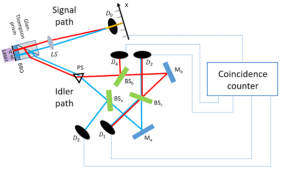
Say-Laser beam fire through two slits
When the photon hits the BBO crystal it is split into two entangled photons (say A and B).
A is sent to detect D0 Directly.
Now let’s work out the path of B.
B passes through beam splitters and mirrors. Electrical click will be emitted in four detectors ( D1, D2, D3.D4) if photons hit.
But B takes complicated/ different paths.
D3 click – Photon went through slit 1 ( in other words preserve “which path” information)
D4 click – Photon went through slit 2
D1 and D2 are called “eraser” detectors. Ie which way ( slit 1 or 2 ) is erased. If D1 or D2 is clicked it could have gone through slit 1 or slit 2.
When photon A lands in detector D0 – We only see blur of dots -random scatter of dots.
Every single dot will have a time stamp (X,Y and time stamp).
All other 4 detectors will record the time stamps. ( which will be compared with the dot time same detected in D0 later by coincidence counter)
Now using the coincidence circuit, we can match the pairs of dots using the time stamp.
Note that the experiment is not done in stages – but live experiment (temporal difference achieved through difference in path length).
4 separate tracker boxes are used to detect (D0 & D1 match, D0 & D1 match etc)
Say for example all connected to 4 monitors sitting side by site for us to monitor.
Expression of particle and wave will take place in all screens – ie blur appears – then pattern emerges after sorting.
As the other four detected points are automatically matched by the coincidence counter, we will see wave patterns forming in D1 & D2 (shifted wave) and particle stripe in D3 and other particle stripe in D4 (no interference).
The measurement outcome of A is intrinsically random. Measuring B later does not determine the earlier result of A; it only reveals the correlation between the two measurements. No signal is transferred from one to other. Its independent of spacial separation. They work as one system – whole.The entanglement correlations are only revealed when measurements of A and B are compared . State can be measured but cannot be manipulated or controlled to extracted its information to be communicated faster than light speed.
Forced change of state is not possible as the particle will lose its isolation – breaks the entanglement (may be entangled with the equipment). Hence its abstract to assume that initial state can be communicated in advance to anyone for communication, as state measurement is random—it can produce any state (i.e., previously not known, not predetermined). If previously not known, the measurement of the entangled other at a distance will also remain random, as the initial state is not known. Without knowing the initial state (or the ability to change it, as it remains random), instantaneous communication is not viable using quantum entanglement. (No-Communication Theorem).
But entanglement measurement can be made of the particle after it travels through the double slit. It will produce the “expected” result, i.e., when one (A) is measured, the other (B) measurement reveals its correlation when measured. But when the measuring possibility is erased, we should expect a similar result. The above experiment asks what if one is measured earlier in time? i.e., assign two different paths for entangled particles, where one takes less time so that it’s measured first. The first measurement (say detecting the result for A) cannot be predetermined. But when the data for its detection is collected, it does not reveal “itself” whether interference (wave) occurred or not. It’s just data and cannot be comprehended without the other (say B). However, data for A is produced already. But only when the other is measured does it produce the correlated pattern (though the event of the first measurement (A) had occurred in the past).
Measuring is not like photographing or filming and recording the state. Not sensing through the naked eye or any other biological “sensuous” way. The measurement occurs through physical interaction with the detector. Data analysis is then used to interpret the results.. The first measurement through data is done earlier to see the random “blur” information.
Measurement of the second entangled particle detection is also random. There is no predetermined position. If its path is observed, it can produce the result for non interference. If not, the interference will be detected.
After the first measurement and the second measurement (time-separated) are done, a process of analysis of the data (coincidence counting) of the first measurement can be done in relation to or based on the data available from the second. Then the coincidence counting will reveal the entangled correlation between A and B.
Note that the data itself does not magically change. But how to read this data only emerges later—we now know the entangled state of the second particle via clicks in the detectors. So that we can arrange the data of the first properly and look at the result.
The spooky aspect is this: The measurement outcome is random, and depending on the measurement arrangement, the correlations reveal either interference or which-path information. By choosing the measurement arrangement, we decide whether which-path information is preserved or erased. This particular decision is taken after the occurrence of the first measurement and collection of data. But regardless of the time interval, they express the correlation.
This experiment demonstrates that entanglement correlations are not limited by spatial separation and remain valid when measurements occur at different times. – but the experiment takes place in space and time. Its not beyond space and time. No subjective (i.e., human consciousness) factor is involved in this process. Rather, the path of the particle is the key aspect, not how or who is observing.