
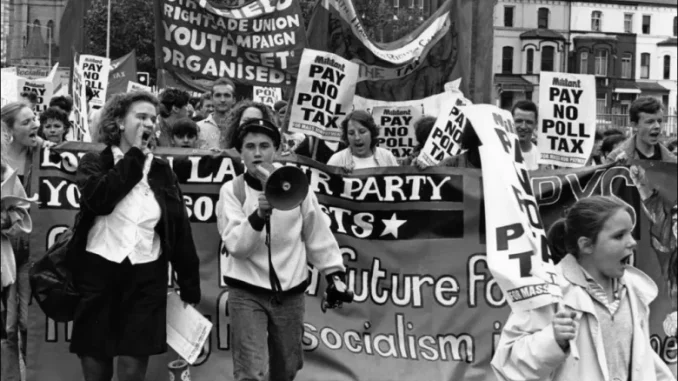
The Economist magazine, 15 August, published an article, ‘What Britain can teach Democrats: How to stop extremists from making a party unelectable’, in which it refers to Militant in Britain – the predecessor of the Socialist Party (CWI England & Wales) – recycling well-worn slurs used by right wing, pro-capitalist opponents. Socialist Party National Committee member Steve Score replied in writing (see below). So far, he has received no response and his letter has not been published.
Despite its assertion that socialist policies are unpopular, actually the column represents a fear of socialism gaining support.
If the idea of socialism is unpopular, why have we seen the rise of the Democratic Socialists of America (DSA)? The argument that they have gained because “not many people vote in primaries” is blown out of the water by DSA member Zohran Mamdani winning the Mayoral election in New York City with more than a million votes, in an election with the highest voter turnout since 1969.
It is above all the collapse in living standards for the majority, while the minority continue to make themselves super-rich that is driving a search for socialist ideas. That’s why, according to a recent Cato poll, 53% of Americans under the age of 30 look favourably on socialism.
The system the Economist defends, of free-market capitalism, is increasingly unpopular, and so it is trying to undermine its most effective opponents.
The article tries to draw parallels between Militant in the Labour Party in the 1980s and the Democratic Socialists of America (DSA) today. It appears to advocate a similar approach by the Democrat establishment today to that of Neil Kinnock, then Labour leader, attacking Militant and beginning a purge of “hard left extremists”.
He did not make Labour more electable as claimed in the article, he lost the subsequent general election, with the Tories winning their fourth in a row, despite huge anger and a mass movement in response to the hated Poll Tax brought in by Margaret Thatcher.
That movement of millions, featuring mass non-payment of the tax, was led by Militant supporters and ultimately led to the downfall of Thatcher.
What Kinnock did achieve was beginning a process, completed by Tony Blair, of transforming the Labour Party into a party that thoroughly represented big business interests rather than those of the working class, as it had been established to do. The Labour Party was created by an alliance of trade unionists and socialists including a recognised input from Marxists. In fact, one of Blair’s aims was to make Labour more like the big business Democrats. I imagine this is seen as a good thing by the Economist’s editors, not so much by many others though.
The article includes the ludicrous claim that Militant had a “secret agenda”. In fact, it always explained that socialism could not be achieved by simply reforming away capitalism. It needed a mass movement behind a programme of complete socialist transformation of society.
Neither did Militant supporters “infiltrate” by hiding our ideas. We were notorious for always selling our paper (Militant) and published material. People always knew when we were there!
The article cannot but repeat a few of the smears used at the time against Militant. The implication that Pat Wall, not just a candidate, but later one of the elected Labour MPs who supported Militant, called for “civil war… and bloodshed” turns reality on its head. He warned that the ruling class would be prepared to use bloodshed and civil war if it felt it necessary to protect its system and profits, such as had happened in Chile in 1973. Rather than advocating violence, he argued for a strategy that could prevent it.
A few other slurs are thrown in for good measure. Unable to find any evidence (because it does not exist) for the accusation that Militant thought “homosexuality was ‘a problem which will disappear under socialism’”, the Economist resorts to quoting an opponent’s slur against Militant. We are proud of our record supporting LGBTQ rights.
It is claimed the result of Militant’s leadership of Liverpool City Council in the 1980s was “lawlessness, fiscal ruin and endless scandal”. In fact, the Militant-led council built 5,000 council homes, seven leisure centres and new parks, creating 2,000 new jobs. The real result was jobs, homes and services.
Liverpool City Council defied the Thatcher government’s cuts in financial support for local councils and mobilised a mass movement to support it. Where else in recent years have we seen mass demonstrations, not against but in support of a council?
Consequently, far from being unelectable, despite the attempts to demonise the heroic 47 Liverpool councillors from all wings of the establishment, backed up by Kinnock, Labour’s vote in Liverpool actually increased when elsewhere it fell.
Since the 1980s, local government has been devastated by cuts, and services pared back to the bone. The idea of building mass support for a no-cuts budget is one that councils such as the Green Party-led ones would do well to look at today. A no-cuts budget, using reserves to balance the books to buy time to build such a campaign, is possible today.
As the article points out, there are differences between the policies and programme of the DSA and Militant. But another is that we believe that in the US, as in Britain today, what is needed is a new mass working-class party. Although only a minority of Militant supporters were expelled during the Labour witch hunts, we took the decision to leave Labour in the early 1990s because Labour’s policies and structures were changed to obstruct the influence of the working class from below. It was no longer a party of the working class, epitomised by Blair’s removal of the socialist clause in Labour’s constitution.
There have been missed opportunities to create a viable party along those lines, such as Bernie Sanders not standing independently for President after being defeated in a rigged 2016 Democratic convention, and more recently the failure of Jeremy Corbyn’s ‘Your Party’ to capitalise on massive initial interest. But other opportunities will arise because millions of people correctly feel the traditional parties do not represent their interests.
Through mass workers’ action in Liverpool, Militant won £60 million from Thatcher (worth £202 million today), and later led over 18 million people in refusing to pay her hated Poll Tax, ultimately leading to her demise.
The Economist is correct to fear increasing support for socialist ideas, and to fear an organisation that can win mass support for those ideas with a fighting strategy and programme.
- A shortened version was sent to the Economist