
MASS DISCONTENT, AN ATTEMPT TO RIG ELECTIONS AND THE POLITICAL TASKS OF THE LEFT
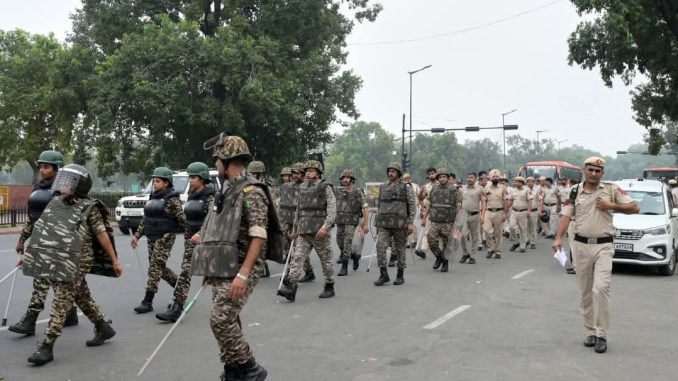
BREAKING: As this article was being posted further arrests, including of leaders of the Cockroach Janta Party (CJP), were taking place in Delhi. Previously the Modi government has restricted the right to protest to the city’s Jantar Mantar area, but now it is striving to prevent protesters from even reaching that district. The arrests show the Modi government’s fear of this mass movement following in the footsteps of the first ‘Cockroach’ movement three months ago and inflicting another defeat on the government.Credit: NewsIndia
On 25 September. 2026, a political storm of an unparalleled scale swept across India. Mass agitations and demonstrations have hit across several parts of India, led by political parties, social organizations, civil society groups, students’ movements, trade unions. Social media, news channels, print media are flooded with the political turmoil.
This trigger is caused on account of an investigative report published by Indian Express, a leading media house of India. The report claimed that the Election Commission of India (ECI) led by is Chief Gyanesh Kumar has indulged in deletion of around 130 million citizens, by systemic deletion of their names from the electoral rolls, during the Special Intensive Revision (SIR). The report claimed that the exercise of SIR has affected 130 million citizens in various states, by disapproving their right to vote.
It was revealed that SIR was undertaken by the ECI despite major objections by two Election Commissioners of the three member ECI. The two members objected to the measures adopted by the ECI 14 times in the past ten months, however, the ECI proceeded with the exercise of SIR at the behest of the Chief Election Commissioner Gyanesh Kumar. The SIR has resulted in the removal of the right to vote from 130,000,000 citizens of India, which is aimed at aiding the ruling Bharatiya Janata Party (BJP).
The conduct of the ECI must be coupled with the recent enactment of the Chief Election Commissioner and other Election Commissioners Act, 2023, by the BJP. The enactment of 2023 permits the Prime Minister and one Cabinet Minister of the Government of India, along with the Leader of Opposition, to appoint the members of the ECI. The constitution of the three-member committee having two government ministers provide no space for opposition. Gyanesh Kumar has been appointed as the Chief in the aftermath of the enactment, which has ultimately benefitted the BJP to gain political control in different states.
Pursuant to the report of Indian Express, political parties, social organizations, civil society groups, have taken over the streets demanding accountability, and resignation of Gyanesh Kumar, over rigging the elections.
The significance of these demonstrations lies in their timing. The country had barely recovered from the political tidal waves experienced in July. The protests of July, led principally by the Cockroach Janata Party (CJP) and Left parties, had developed around the anger over examination irregularities, leakage of national entrance examination papers, and the suicides of students across the country. The movement had acquired a mass-scale, that ultimately compelled the resignation of Dharmendra Pradhan as Union Education Minister.
Even though the two movements, viz. July and September, are caused by distinct reasons, viewing them in isolation shall be detrimental to understanding the political shifts. In both cases, millions of people have flooded streets across India, which is an unprecedented picture, viewed against the twelve-year authoritarian regime of BJP. It is a direct result of the social distress and discontent accumulated for the lengthy twelve years.
This was precisely the argument advanced by New Socialist Alternative (NSA, CWI in India) during the July agitation. NSA had argued that although the protest was led by the infant CJP, the character and scale of the mass agitation could not entirely be attributed to CJP. The movement represented a wider repressed discontent over the divisive and communal politics, the close allegiance of BJP with the bourgeois class, and the neo-liberal transformation of the economy. The July movement, albeit, caused by the immediate crisis in the education system, reflected the broader social crisis underneath. This could be precisely experienced by the scale of opposition that Narendra Modi received by the masses, which was suppressed throughout its twelve-year rule. NSA had argued that the country would witness mass eruptions of higher magnitude in the coming times. The current mobilisations against the ECI contrast with the argument advanced.
The current mass mobilisations have brought back to the centre an important debate within Left and progressive circles as to how should the political regime of Narendra Modi and the BJP be characterised? Prominent sections of the Left have continuously held that the regime under BJP is unmistakably a fascistic regime, evidenced by the majoritarianism, centralization of power, erosion of democratic institutions, etc. NSA, however, has consistently challenged this argument. Though BJP manifests tendencies of fascism, it cannot be categorised as simply having a fascist character. BJP has unquestionably associated with extreme right wing communal politics, majoritarian nationalism, neoliberalism and repression, however a mere direct characterization of it as fascist has affected the political demands and strategy of mobilisation of the masses. Treating the BJP regime as a fascist dictatorship, leads some Left leaders to simply reduce the contemporary political tasks of the Left to restoration of parliamentary democracy and removal of the BJP. Such a framework encourages left forces to subordinate their independent political programme to the pro-capitalist programmes of centrist-liberal sections.
However the ability of large sections of society to organize and mobilize political opposition demonstrates that the form of the Indian State has not transformed into a fascist state. The emergence of protests involving different political parties and social forces, from the CJP and Left organisations to the Congress, and civil society groups reveals that the current regime cannot be painted merely as a fascist state, and the questions before the Left need revisitation. A necessity for a concrete analysis of the state, balance of class forces and tasks of the Left is even more imperative.
The controversy around the ECI, raised by the Indian Express, has raised grave concerns over the hijacking of the ECI. The SIR begun in Bihar State in June 2025, and has resulted in more than 130 million names being struck off the draft electoral rolls across 30 States and Union Territories as it was further implemented.
A second major argument concerns the structure of Electoral Registration Officers (ERO) at the constituency level, and its subordination to the Central IT Division of ECI. The EROs are empowered with preparing electoral rolls, handling claims and objections, deletions, etc. at the constituency level. The ECI recently introduced a new digital infrastructure, ERONet, later ECINet. It is found that the central division of the ECI overseeing the portal, highly intervened in the interface, and controlled and manipulated the entries made by the EROs, and arbitrarily deleted certain entries. One of the two Commissioners, Vivek Joshi, said that was a centralisation of electoral database and proposed an audit. However, these objections were overruled by Chief Election Commissioner Gyanesh Kumar. Tens of millions of citizens were deleted without any authority and power, and mechanism for appeal was explicitly unavailable. Investigation revealed that the Deputy Election Commissioner was authorized the role of overseeing the IT Division over its actions. In a surprising move, he was removed from its position without any consultation. The two Election Commissioners objected to this change, however, their objections were unanswered by the bureaucrats of BJP government. These actions of ECI portray deep BJP penetration into the democratic setup of the nation, having fundamental consequences.
In light of these major exposes, mass movements have begun across India. In Delhi, Communist Parties, the Congress, opposition Alliances have been demonstrating daily since 2 October. The BJP has unleashed the horrors of police brutality against the protests. In Mumbai, the CJP held a one-day agitation, with a call of continuous agitation in Delhi from 10 Oct. The central demand remains the resignation of Gyanesh Kumar. These agitations are gaining momentum and the intensity of these protests shall increase in the coming times. Thousands of the youth, middle-class, working-class organizations are joining hands, shaping the agitations into a consolidated movement against the BJP.
New Socialist Alternative in Pune, an urban area with over 5 million inhabitants, and Shramik Hakka Andolan (SHA, a trade union affiliated to NSA) have been organizing for the last five years an annual march in Pune on the occasion of the anniversary on September 28 of the birth of Marxist, Communist ideologue and martyr of the Indian Independence movement Bhagat Singh. Immediately on the publication of the report by Indian Express on 25 September, the NSA added the call for the resignation and arrest of Gyanesh Kumar to the march’s demands. It was the only left party to have advanced the struggle against the ECI in Pune at the threshold, claiming the march as ‘Rally for Democracy’. The SHA, comprising of primarily construction workers, joined the march and expressed solidarity with the youth movements. NSA has consistently brought the working class to the political space, creating the leadership of the working class alongside the youth.
The NSA issued a call for mass protests in Pune on 2 October. where hundreds of people of sections of society joined and demanded the political overthrow of the BJP. Defying the prominent narrative of the Indian Left, the NSA has invariably and unfailingly brought the class character of politics in praxis, and is reshaping the political agenda of the progressive forces. Demands of scrapping of SIR, the resignation and arrest of Gyanesh Kumar, revocation of the 2023 enactment remain central. The days ahead shall be times of mass turmoil and social and political crisis, as predicted by NSA. Mobilisation of the masses on Left agenda and programme, and strategizing the tasks on the immediate issues, and basing them on narrative of Left shall be crucial for the transition for the Indian democracy.
The protest movement also shows how this Modi regime can be brought down. The alliance of youth, workers, and peasants in opposition is a powerful force that can not only bring down the government but also provide a viable alternative for the future. A new political alternative needs to be built with clarity of perspective and a program that can deliver the needs of workers, peasants, youth, and all the oppressed in India.
While we welcome the CJP’s initiative to mobilise youth, it is important also to point out their programmatic limitations. It is not enough to organise on an issue-by-issue basis. From the crisis in education to electoral manipulation and corruption, all issues are connected. They are part of the systemic problem of the Modi regime and the capitalist system as a whole. Our programme of struggle must include all these issues together and must aim to unite all those in struggle.
The political alternative to Modi is not an alliance with Congress or any other capitalist parties, but rather building a new, clear alternative that can end the rotten rule of capitalist exploiters and bring forth a government of workers and peasants that can deliver the needs of all. We must also appeal to all trade unions to take a central part in organising. Unions should call for at least a day strike to start the escalation.
The New Socialist Alternative calls upon the youth and everyone involved in the struggle to initiate a debate and discussion about what alternative needs to be built—what programme we should adopt, and how such an alternative is organized democratically with accountability.
We demand that: All repressive attacks on protests must be ended immediately. All arrested protesters must be released and all charges dropped immediately. The election department chief must resign and all the deletions from the electrical roll must be reversed. We demand a full transparency of its dealing so far. Build an alternative to Modi regime. Protest must continue till our demands are met.