
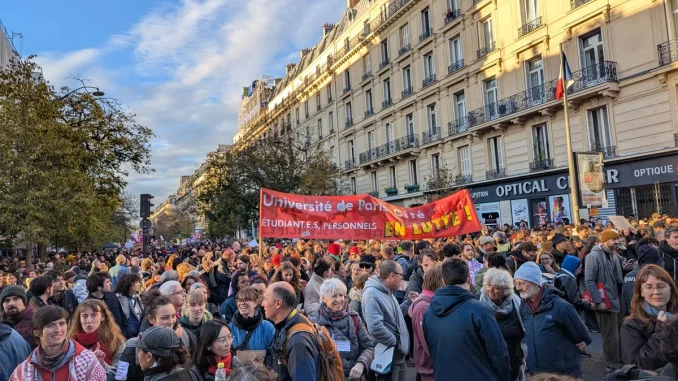
The united cross-sector strike on 5 November marked another step forward for the inspiring mass movement of workers and youth in France. The union federations estimate that 1.6 million people took to the streets in demonstrations right across the country, with 300,000 marching in Paris alongside other huge turnouts in cities like Marseilles, Bordeaux and Lille.
For over a month, a series of mass demonstrations, strikes, and school and university walkouts has gripped French society, putting President Macron, and the French capitalist class that he acts for, under increasing pressure. Just to give one example of its effect, on the evening before the strike, the Government’s budget proposals, proposing another €43 billion of cuts, were unanimously rejected by all sides of the French parliament, leaving the hated Macron needing to force it through using presidential powers alone.
The support for the 5 November strike shows that Macron’s strategy of trying to beat back the movement by throwing riot police at teenagers with truncheons and tear gas grenades, while trying to stigmatise the protests as the work of a violent minority, has failed.
Opinion polls show a majority of the population as a whole are in support of the strike movement, with nine in ten agreeing that its demands for action against the soaring cost of living are a legitimate reason to protest. And that support is strongest amongst the youth, the section of the population that has been driving the protest forward most of all.
Many of the high school students started the day with their usual blockades of school gates. At the Lycée Voltaire in Paris, dustbins were piled up outside the doors of the school and, as there had been all week, police lined up outside the school as well. There was one minor scuffle with the police, but nothing serious and, indeed, the level of police intimidation throughout the day was lower than over recent protest days. This time, the ‘revolutionary orchestra’ was able to play at the start of the march in the Place de la République without being suffocated by clouds of tear gas!
The determination of the youth at the school gates, and on the day’s massive demonstrations, was clear. They are angry at the crumbling state of their schools, class sizes of well over 30, and at a highly selective university entrance system that denies most youth places on their preferred courses, particularly working-class students.
But these specific concerns are just part of a wider anger against a system that denies them a future, as well as racism and police repression. For example, at the Lycée Voltaire, a minute’s silence was held for those killed and injured by the racist drive-by shooting in Trappes, in the suburbs of Paris, a fortnight ago.
Similarly, while many of the trade unionists were taking action to demand higher wages and lower prices, and to protest against job losses and cuts in public services, this is also part of a more generalised opposition to Macron’s government, as well as a wish to show solidarity with the youth, both in their own families and in working-class communities as a whole. This was reflected in a high turnout on the Paris march from the education sector in particular.
The 5 November strike was called, significantly, as a cross-sector strike involving both the public and private sector. Nevertheless, the trade union contingents on the march showed that it was still based mainly on the public sector, with only smaller contingents visible from the private sector. For example, the Paris metro, where the unions have been weakened over recent years, was still running largely unaffected by the action. But the massive Paris demonstration still took four hours before its huge numbers were finally all on the march, most demonstrators just marching with their families, friends and schoolmates, rather than part of any official contingents.
The French section of the CWI, Gauche Révolutionnaire, intervened successfully with a special strike supplement calling for an escalation of the action to a three-day strike and for the need to win a government as determined to fight for the working-class as Macron is for the super-rich.
Talking to demonstrators, the strength of the movement is clearly raising hopes and confidence that Mélenchon and La France Insoumise (LFI) could defeat Le Pen and the other pro-capitalist candidates in next year’s Presidential elections, even though Le Pen is at this stage still ahead in the official opinion polls. If the LFI is prepared to reach out to the best of the workers and youth driving forward the strike movement, and help build combative local committees, to organise and escalate both the industrial and political struggles, then the movement really could go forward to achieve significant victories for the French working-class and youth.