
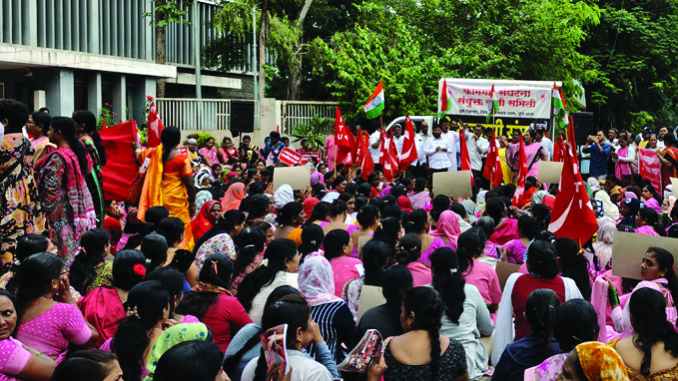
The New Socialist Alternative (NSA) in Pune city, India, took part in the rally organized as part of the one-day general strike held on 9 July 2025. The NSA-linked union, Shramik Hakk Andolan, also mobilized support and actively participated in the general strike.
More than a thousand workers gathered in front of the Collector’s Office (government office responsible for collecting tax and other main governmental tasks) in Pune, shouting slogans and staging a sit-in protest. A similar demonstration was also organized in another part of the Pune district to enable workers from that region to participate in the strike action.
NSA leading member Youvraj addressed the rally, calling for sustained agitation and broader alliances to mobilize unorganized workers into collective action.
The general strike saw an estimated 250 million workers participating across the country. Ten central trade unions issued the call for action, presenting a charter of 17 demands. These demands included the scrapping of the new labour codes, halting privatization of public services, ending contractualization of jobs, as well as political demands such as the repeal of the anti-democratic Public Safety Act in Maharashtra.
Samyukta Kisan Morcha, a united front of various farmers’ organizations, also extended support to the strike. However, Bharatiya Mazdoor Sangh (BMS), the trade union aligned with the ruling BJP, did not participate.
Workers from sectors such as power, banking, mining, postal services, and others joined the strike. Across many cities and towns, workers and farmers rallied to raise their voices. Transport was disrupted in some areas as highways were blocked by striking workers.
Below is the extract from the leaflet produced by NSA for the strike.
Nationwide General Strike 9th July 2025
Revoke anti-worker Labour Codes
Hands-off workers’ right to Unionise
Corporate profits reaching its peak under Modi regime –
In the Modi regime, the most aggressive wing of the capitalist class has found its perfect expression. In the past eleven years it has shunned any pretence of democracy and bent every possible state institution to serve its interest. While Ambani-Adani [two of India’s wealthiest capitalists] represent the face of it, a much wider section, not just of national, but also the regional and global capitalist class that benefitted under the Modi regime. As a consequence, corporate profits have soared to a fifteen year high of 4.8% of GDP as recorded in the government’s own report (Economic survey 2024-25). And all this, at the cost of the working class. Salaries and working conditions have not only stagnated but in fact have been driven negative in a few sectors. Larger working masses in informal sector, farming face the worst conditions. So conspicuous has been the divide that Chief Economic Advisor Mr. Anant Nageshwaran was compelled to remark, “While it is good to improve balance sheets, corporate profitability and workers’ income growth has to be balanced, without this parity, there will not be adequate demand in the economy for corporate products to be purchased”. It is clear that such naked profiteering by capitalist class is weighing down the economy.
Dismantling legal framework for Labour rights –
While labour laws could never guarantee the sanctity of labour rights, they at least provided a bare minimum security to working class. Those laws and regulations were being constantly watered down in the onslaught of neoliberal policies after 1990s. The Modi regime has now ventured to completely dismantle the framework by replacing multiple labour laws with four pro-corporate labour codes viz. Code on Wages (2019), Industrial Relations Code (2020), Code on Social Security (2020), Occupational Safety, Health and Working Conditions Code (2020). These codes drastically impact various aspects of working conditions ranging from working hours to compensation paid paving the way for employers to act with impunity. It would also facilitate employers to terminate employment at will. Standing orders stipulating terms and regulations for employment termination were so far applicable to any enterprises employing more than 100 workers. This initself was never seriously implemented. It was not uncommon for employers to employ more than 100 workers but split them into two different enterprises on paper, thus sabotaging the laws. Now this limit of 100 workers has been revised to 300 thus depriving a larger section of the working class of any job security. Worst of all, it impinges upon the fundamental right of workers to unionise and strike. It’s very clear that going beyond workplace regulations these labour codes seek to undermine the very power of working class organizations and initiative.
Limits and the way forward –
Notwithstanding the big numbers that such strikes represent and the upbeat mood at demonstrations, the action is far from what it would take to lead workers struggle at this historic juncture. Though the Modi regime continues to dominate the political landscape, at ground level there is palpable anguish against its policies. Massive unemployment and inflation has made the mood only more miserable. Though the parliamentary left i.e. the CPI and CPM partially mobilized support for the strike in certain states like Kerala, West Bengal where it had been historically stronger, the actions were far too feeble in other parts. In Bihar, where assembly elections are just round the corner, opposition forces used the opportunity to gain some political momentum. Beyond these regions and certain other pockets, the strike could not have any larger impact on public life. In fact at times, they tend to be ritualistic.
This reflects both prevailing issues within trade union organizations but also a larger political crisis. The trade union movement so far has not been able to organize larger sections of informal workers. Its strength even now comes from certain public sector enterprises. The industrial landscape has changed considerably in the past three decades with more and more fragmentation of production. Conventional methods of organizing workers have hit the floor. On the political front, the erroneous characterization of the current regime as fascist has paralyzed large sections of left. Such a characterization has led the CPI, CPM, CPI (ML) Liberation and others to rally behind Congress, the main opposition party abandoning independent working class politics. Political expediency immanent in such an analysis means their orientation and forces are more aligned to serve narrow political alliances within parliamentary politics rather than building mass struggle at grass root level. In the past eleven years too, despite the authoritarian grip of the Modi regime, there has been no dearth of mass mobilizations against this government. Be it mass agitations of Dalits nationwide following the institutional murder of Rohit Vemula in 2016, the nationwide protest against the citizenship laws in 2019-20 or the heroic struggle of peasants against corporatization of agriculture in 2020-21, masses in the country have put up a strong resistance to the regime. The left, however, has failed to mobilize this discontent with a sharp program against the regime and wider capitalist system.
Building a sustainable resistance would require the left to grasp the potential of the current situation. Economic prospects have more or less stagnated. Though it may keep afloat, that is too feeble to create more jobs or or lead to any increase in workers’ living standards. Agriculture continues to be in crisis with farmers’ suicide continuing in thousands. Thus workers, farmers and equally important, youths continue to bear the brunt of capitalist system. Programs oriented towards such working class sections of society but leading towards a larger struggle for socialism would build the mass alliance of the working class.
Demands –
- Revoke new labour codes and strengthen the existing labour laws
- Put an end to privatization and casualisation of labour
- Strengthen the social security benefit framework for all workers including those in unorganized sector registered on e-shram portal.
- Implement service charter stipulating processing time for various welfare scheme applications for construction workers
- Strengthen Public Health and Education Services
- In addition to allocating higher amount for MGNREGA scheme, launch Urban Employment Guarantee scheme to provide employment to youths.