
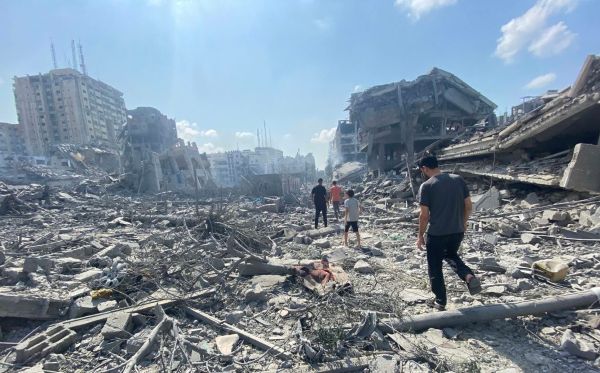
The Italian working class are beginning to take centre stage in the fight for the end to the brutal genocide inflicted on the people of Gaza by the Israeli state. In the middle of August the Global Sumud Flotilla that aims to break the Israeli blockade of Gaza docked in Genoa. Workers from across the city collected tonnes of aid to send to Gaza where the Israeli state is using starvation of Palestinians as a military tactic alongside their scorched earth policy of destroying everything.
On Monday 22 September the radical USB union alongside others called a general strike under the slogan of “Let’s Block Everything” that blocked ports, particularly in USB strongholds of Genoa and Livorno, and in many others as well. Other sectors of workers also went on strike. The strike on the railway network started at 9pm on Sunday evening for 24 hours, with national trains being severely disrupted and in some cities and regions no local or regional trains running, at all.
The USB called on all its members in both the public and private sectors out on strike. Other trade union federation, such as CUB, did the same.
In Roma, over 100,000 marched and many other demonstrations took place in 81 other cities such as 50,000 in Milan, Florence, Bologna, Turin and Venice. The cry came from many to block everything if the Flotilla is not allowed to complete it’s mission. These protests attracted support from school and university students.
The dock workers who were part of the USB trade union federation pledged that if the flotilla was attacked or the aid was not received by Palestinians they would not load or unload any commercial or military cargo to Israel. Genoa is one of the main ports in Italy. That pledge was made in front of a mass demonstration of Genovans.
Two weeks earlier, on 30 August, over 50,000 marched through the streets of Genoa in a mass show of solidarity with the dockers and the people of Gaza.
In a meeting on 11 September of 600 workers and youth met to plan action and to hear from dockers leaders in the city. USB leader Guido Lutrano called on other unions to “focus their strikes for 22 September”.
Pressure
The mass response of workers to the strike is putting pressure on all sectors of society. One of the largest trade union federations, the CGIL, did not support the 22 September call but organised a four hour action amongst its members on Friday 19 September. In Naples, CGIL members attracted over a thousand in a late afternoon rally.
Workers are now putting increasing pressure on the right wing Italian government. They demanded an end to all military ties with Israel and full support for the flotilla to achieve its aims. As a USB teachers leader put it, “let’s stop our government…this day gives us hope”. The strike raised the potential to link all the grievances workers have against the government into one mass struggle.
This general strike raised the opportunity for workers to discuss how can they end the brutal right wing Meloni government; how can the trade unions put together a workers’ list of candidates to replace them and what should the policy and programme be and the centrality of the ideas of socialism.
They have also built links to trade unions in other ports in the Mediterranean, such as Athens, Marseille and Tangiers. An international link, not just with Mediterranean dock workers but also including workers running the Suez Canal, the oil exporting ports in the Gulf, and other ports around the world, with similar solidarity action could end the genocidal war on Gaza.
The 22 September general strike can reawaken the sleeping giant of the organised Italian working class not just on the key question of Palestine but also to end austerity by removing their own government, and fighting for a workers government that will bring in socialist policies to benefit the working class.