
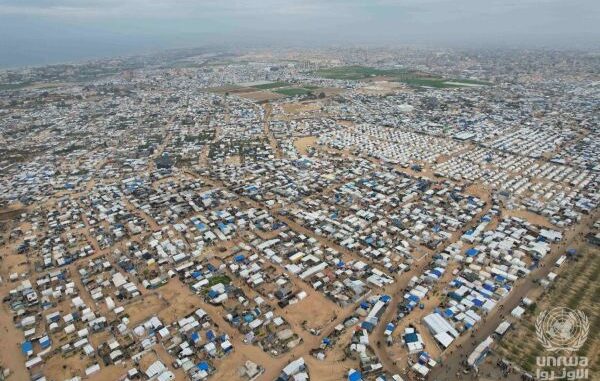
On 27 September, the largest mass demonstration to date in Germany calling for solidarity with the people of Gaza and the West Bank and against occupation, displacement and war by the Israeli government could take place. Sol is calling for nationwide participation in the large demonstration, followed by a rally in Berlin, and is participating in the mobilisation from many cities.
On this day, the ‘Together for Gaza’ demonstration will take place, starting at the Neptune Fountain in Berlin and then leading to the ‘All eyes on Gaza – Stop the genocide!’ rally at the Großer Stern. The demonstration was initiated by a group of Palestinian activists and cultural figures, as well as Özlem Demirel (Member of the European Parliament for the Left Party), Ines Schwerdtner (Co-Chair of Die Linke, the Left Party) and Yusuf As (Chair of the Federal Migration Committee of the ver.di trade union). The subsequent rally was initiated by, among others, the chairwoman of the German-Palestinian Women’s Association, Amal Hamad, and is being organised by the Palestinian Community in Germany, eye4palestine, Amnesty International Germany and medico international. Various musicians will also perform at this closing rally, including the rappers K.I.Z. and PTK. There is also a broad circle of supporters for both events, consisting of individuals and left-wing groups, (Palestinian) diaspora groups, organisations involved in refugee aid, groups with a religious context (such as the Central Council of Muslims, pax christi or the Forum for Peace Ethics of the Protestant Regional Church in Baden) and others. It is worth highlighting the positive development that the GEW Berlin teachers’ trade union and the Berlin Hospital Movement are also calling for participation in the demonstration and rally.
Die Linke is also calling on its members to participate in the demonstration and is planning trips from all over Germany. This is another positive development. Sol, the CWI in Germany, has long called for broad mobilisation by Die Linke and trade unions, and we have submitted motions to this effect and brought this demand to the attention of the party and trade union branches in which we are active.
Unity in struggle instead of division
It is positive that the rally on 27 September was organised with the aim of having a broader impact on society and not just mobilising the existing Palestine solidarity movement. Unfortunately, a (albeit rather small) section of the Palestine solidarity movement is now calling for a boycott of the protests in Berlin and for an alternative nationwide demonstration in Düsseldorf on the same day – to which people are also to travel by bus from across the country, including from Berlin.
This approach divides the movement. Some of the criticism is legitimate – for example, that some of the organising organisations, for example, Die Linke (The Left Party), should have called for such protests much earlier – something we have also been advocating for a long time and which has certainly frustrated many activists. However, it does not help the movement to divide itself over this issue. It is understandable that some activists find it wrong that Amnesty International Germany is collecting donations for the stage technology and organisation of the rally instead of directly for the people in Gaza. However, it is difficult for outsiders to assess whether alternative financing would be possible, and in any case, this should not be a reason not to participate in the protest. It may be perceived as ‘depoliticising’ by some that there will be a concert, but first and foremost, the positioning of the performing artists and, on the other hand, the potentially broader mobilisation this may bring about are positive. This may also lead to people who have not previously attended a protest in solidarity with Palestine taking part, becoming more politicised as a result, learning more, attending demonstrations more often afterwards and contributing to the growth of the movement.
There is also further criticism of the texts of the appeal: among other things, that they do not go far enough and do not shed light on the historical background of today’s genocidal war. In addition, some of the critics say that the demands are insufficient and that, for example, a demand for ‘peace’ falls short. In most cases, however, there is considerable room for interpretation as to what the critics are demanding instead. Sol does not share all aspects of this political criticism, but agrees that there can be no lasting peace and no real solution within this system, and that a socialist transformation of societies in the region is therefore necessary. However, it would be wrong on our part to make a socialist orientation of the demands and programme of a protest a precondition for participation. On the contrary, it is precisely then that it is necessary to bring a socialist programme into the movement and the large protests, rather than boycotting them. Ultimately, it is sectarian, in this instance, to make agreement of one’s own position on a call to action a basic condition for participation.
This debate, which is entirely legitimate, highlights the need for a democratically organised solidarity movement in which questions of demands and programme can be discussed collectively (more on this here: https://solidaritaet.info/2025/06/nein-zu-besatzung-ermordung-und-vertreibung-der-palaestinenserinnen-2/). However, this also requires that not every person or group makes their participation in a protest conditional on all of their demands and formulations being accepted, but that people come together on the basis of internationalist principles. We need the greatest possible unity on the basis of a few central demands, and a debate on demands and a programme against mass murder, occupation and expulsion, and for the right of self-determination of the Palestinians.
In our view, the basic positions of such a movement should include:
- An immediate end to the attacks on Gaza and the withdrawal of the Israeli army
- An end to the siege of Gaza and the occupation of the West Bank
- An immediate halt to settlement expansion in the West Bank
- No to terror against civilians
- Release of all civilian hostages and Palestinian political prisoners
- Rejection of all forms of racism and anti-Semitism
- Rejection of the western governments’ support for the Israeli government through arms deliveries and other measures
- Fight against the restriction of democratic rights and tightening of residence rights for migrants in the context of the Gaza war
- Recognition of the democratic and national rights of all population groups in the Middle East and advocacy for a broad and democratic debate on a political solution to the Middle East conflict
On this basis, joint protests could be organised and events held to raise awareness of the causes of the conflict and spread solidarity against war and occupation.
Turning point for the German solidarity movement?
Unfortunately, in the last two years there have been too few large, broad protests that appeal to those sections of the population who are not yet active in the solidarity movement and whose mass character would make police repression and criminalisation more difficult. At the same time, support for Netanyahu’s actions against Gaza continues to decline, and despite massive propaganda, more and more people believe that the Merz government’s support for Israel must end. The large demonstrations in Berlin in June and in Frankfurt in August, attended by tens of thousands, showed that a period of mass mobilisation has begun. These large demonstrations have put so much pressure on Merz that he has had to back down, at least verbally. Even if we have no confidence in Merz and must not be blinded by his critical words, it is clear that mass pressure on the streets can make a difference. Calls for boycotts and parallel events will not get us anywhere, especially now that we may be at a turning point in the solidarity movement.
In this context, the aforementioned support from GEW Berlin and the Berlin hospital movement is also a key step in putting further pressure on the DGB trade unions to mobilise their members against occupation, mass murder and expulsion. The potential power of trade unions and the working class is currently also evident in Italy, where on Monday, 22 September, strikes and protests against the ‘worsening humanitarian situation in the Gaza Strip’ took place in over 80 cities. These strikes are taking place in transport companies and on the railways, but schools and universities are also to remain closed. In addition, we have repeatedly seen strikes internationally that have prevented arms deliveries and the transport of war material to Israel, as is currently the case in Genoa, where dockworkers are blocking delivery routes to the port. We are still a long way from such forms of action in Germany, but that is precisely why we must continue to bring this debate into the trade unions and oppose the pro-Israeli policies of the current trade union leaderships.
We as Sol will continue to participate in this and in building a mass movement against mass murder, occupation, expulsion and war. We also demand:
- For a mass struggle by the Palestinians under their own democratic control to fight for their liberation
- For the building of independent workers’ parties in Palestine and Israel and links between them
- For an independent, socialist Palestinian state alongside a socialist Israel, with two capitals in Jerusalem/Al-Quds and guaranteed democratic rights for all minorities, as part of the struggle for a socialist Middle East
- For a struggle by the masses of the Arab states against the dictatorial capitalist ruling elites and by the Iranian masses against the reactionary theocratic regime. For a voluntary socialist confederation of the Middle East
First trade union call for “Together for Gaza” demonstrations
GEW regional executive committee decision follows pressure from activists at the grassroots level
The GEW (teachers and science workers trade union) regional association is calling for to participate in the demonstration entitled ‘Together for Gaza’ and a rally entitled ‘All eyes on Gaza’, which will take place in Berlin on 27 September. It is perhaps not surprising that GEW Berlin is the first trade union to take this step, given that the regional association tends to be politically left-wing. Various left-wing groups and organisations are also active, particularly in the Young GEW. And there is also a Peace Working Group within the GEW, which has always taken a clear anti-militarist stance.
By Maren Wiese, (GEW representative and staff council member)
At the last state delegates’ meeting at the beginning of July, there were also several motions on the subject of solidarity with Palestine and, more generally, against armament and war. We, Sol members, have also submitted a motion to various structures.
At the end of June, the DGB district executive committee of Marzahn-Hellersdorf-Lichtenberg decided to speak out against the killings in Gaza and, if necessary, to organise events on the topic. In various GEW chat groups, there were lively discussions based on our model motion and, apart from a few rather anti-German comments, a lot of agreement.
Various activists in the GEW Berlin have repeatedly exchanged views on the issue and tried to gain support in their respective districts through committees such as district leaderships for demonstrations against the genocide in Gaza and for an end to the occupation and oppression of the Palestinians.
In the end, due to the pressure exerted by these joint motions, the state executive committee voted by a majority to support the demonstrations on 27 September and 3 October in Berlin. Members are to be mobilised for both demonstrations. A trade union bloc is also planned.
However, this can only be a start. War, armament and militarisation are financed by governments through social cuts and budget cuts at local, state and federal level.
Critical trade unionists must now, as in Berlin, network and jointly exert pressure on trade union leaders to speak out clearly against the war in Gaza and the oppression of the Palestinians by the Israeli government, and to call for participation in further demonstrations locally and nationwide. In this way, the criminalisation of the movement can also be ended.
It is now more important than ever that as many trade unionists as possible take part in the demonstrations against the war in Gaza. Bring your colleagues with you. Show your colours as trade unionists!
Long live international solidarity!
Below is the text of a SoL leaflet that will be circulated at Saturday’s demonstration in Berlin:
No to occupation, murder and expulsion of Palestinians
Peace and self-determination are only possible through socialist change – proposals for the solidarity movement
For Palestinians in Gaza and the West Bank, life is a never-ending horror: officially over 65,000 dead (but probably well over 100,000), widespread destruction of Gaza, expansion of settlements in the West Bank, IDF and settler terror against the Palestinian population, and now Israel’s offensive against Gaza City to implement its plans to expel Palestinians from Gaza. Israel’s attack on the Hamas negotiating delegation in the mediating state of Qatar shows that Netanyahu and Co. have no interest whatsoever in negotiating a ceasefire.
The situation is so catastrophic that fewer and fewer people believe the fairy tale of Israel’s defence against Hamas. Even in Israel itself, there are mass protests calling for an end to the war and the release of the hostages, as well as strikes against the government’s anti-worker policies.
No confidence in Merz
Due to the pressure of increasing protests and fear of losing face in front of its own population, the German government has now also restricted arms deliveries to Israel – but we must not be blinded by this. German capitalism stands firmly on the side of the Israeli state because it represents Western imperialist interests in the region. But the measure shows that protests work.
That is why we must increase the pressure by continuing to take to the streets and raising the issue in trade unions, left-wing and social movements, calling on them to take action. The conditions for this have improved. Since June, the protests have also taken on a mass character in Germany. This makes it all the more important for the movement to unite and achieve joint action – despite the existing differences in content between the various actors. We need the greatest possible unity on the basis of a few central demands and a broad debate on demands and a programme against mass murder, occupation and expulsion and for the right of self-determination for the Palestinians.
Who can stop the war?
The only force that can stop the war against Gaza and fight for the liberation of the Palestinians is the masses of working and poor people in Palestine, Israel and internationally. We firmly believe that only a struggle led democratically by the Palestinian masses themselves, through mass demonstrations, strikes and broad resistance to the occupation and siege, can be successful. The first Intifada (Arabic for ‘uprising’) in the second half of the 1980s was an example of this.
Programme, organisation and strategy needed
But without a programme and a strategy, even the largest mass protests will not be successful. A successful struggle against oppression also needs allies from the working class, not only in the Arab states, but also in the Western capitalist states and in Israel itself.
Hamas does not represent a programme or strategy that can bring real freedom, peace and social security to the Palestinian people. Not only has it repeatedly suppressed protests in Gaza, but it is also a pro-capitalist organisation that is hostile to workers and women. Attacks on Israeli Jewish civilians, such as those on 7 October, do not bring the Palestinian people any closer to liberation. The consequences of such attacks are a strengthening of nationalism among the Israeli Jewish population (and thus of the Zionist forces and the Netanyahu government) and a weakening of those forces within it that oppose occupation, siege, war and expulsion.
No solution without socialism
The oppression of the Palestinians cannot be separated from the rule of capitalism and imperialism. Israel is the outpost of Western imperialism in the Middle East.
After the terrible experience of the Holocaust, many people supported the establishment of a Jewish state in the hope that it would offer Jews protection from further persecution. As early as 1948, Marxists pointed out that a state established through terror and expulsion would become a bloody trap for Jews, which unfortunately has proven to be true. However, this state, racist in its constitution, has produced its own nation and class society over decades. Seventy percent of its inhabitants were born in Israel. The vast majority of Israeli Jewish workers have just as much interest in living in peace and social security as the Palestinians do. It is not they who benefit from the national conflict, but the ruling class, who can distract ‘their’ working class from the class struggle for social improvements and against their own government by pointing to the external threat.
Socialist programme
We therefore advocate a socialist programme that expresses the interests of all workers and poor peasants in the Middle East, regardless of nationality and religious affiliation, and makes peaceful agreement between the peoples possible.
To make such a programme a social force, we need workers’ organisations – trade unions and mass socialist parties – that build links across national borders and lead the struggle against the ruling classes, rather than allowing themselves to be led to the slaughter by their respective governments.
Only when the pro-capitalist leaders in Israel are overthrown and replaced by a workers’ government can the Palestinians achieve the right to self-determination. And only when socialist change is successful in the Palestinian territories can a democratic settlement be envisaged, taking the form of two socialist states with a shared capital in Jerusalem/ Al-Quds as part of a socialist federation in the Middle East, within which all the complicated issues of border demarcation, the fate of refugees, etc. can be addressed without bloodshed.
Sol and the Committee for a Workers’ International (CWI) advocate such a path, and we invite everyone to join us in discussing it.
This does not mean waiting for a socialist solution in the future, but building the greatest possible mass resistance to war and oppression by the Israeli state and its Western allies today – but linking this resistance to such a socialist perspective.
Trade unions and the Left
Building strong solidarity movements in Germany and internationally can play a very important role in this. However, such a movement is not only important for supporting the struggle of the Palestinians, but also for defending the rights of migrants and the entire working class in Germany.
Precedents are currently being set in the treatment of the Palestine solidarity movement with regard to the restriction of democratic rights, such as the right to freedom of assembly and freedom of expression. This is also a preparation for larger social protests and strikes. Racism, especially against Arab people, is intended to divide the working class and turn it against itself, while the pro-capitalist parties discuss major attacks on pensions, working hours and social benefits, implement cuts and push ahead with the rearmament of the Bundeswehr.
A no to war and rearmament and a yes to the struggle for social improvements here and now therefore belong together. In Germany, too, the working class is the potential force to put obstacles in the way of the federal government’s war policy. In other countries, trade unionists have already refused to transport war material to Israel. That is the right way forward. Even if we in Germany are still a long way from such forms of action, we must bring the debate into the trade unions and oppose the pro-Israeli policies of today’s union leaderships. The same applies to the Left Party, which took a clear position in solidarity with the Palestinians at its last party conference and has now finally mobilised for the large demonstration on 27 September, in which, however, pro-Zionist positions continue to be represented by some sections.
We urgently need a mass party of workers and the socially disadvantaged that takes an unambiguous stand against war, oppression and social cuts and leads the struggles against them with a socialist perspective. Sol is committed to this in trade unions, the Left Party and social movements.
For a democratic solidarity movement
We also advocate that the solidarity movement should be organised on a democratic basis and find ways to influence society and the working class in Germany.
There should be room for different ideas and strategies, but the goal must be joint action. We support some of the substantive criticism from parts of the solidarity movement regarding the demands of the demonstration and rally on 27 September, but to derive a boycott from this is fatal for the movement! At the same time, some internationalist principles should also be defined as a common basis. This could be achieved by forming broad local solidarity committees and holding a nationwide conference to establish a common platform and elect a representative committee. This would be a way for the movement to give itself democratic representation that can speak out in society in solidarity with the Palestinians. In our view, the basic positions of such a movement should include:
- An immediate end to the attacks on Gaza and the withdrawal of the Israeli army
- An end to the siege of Gaza and the occupation of the West Bank
- An immediate halt to settlement expansion in the West Bank
- No to terror against civilians
- The release of all civilian hostages and Palestinian political prisoners
- Rejection of all forms of racism and anti-Semitism
- Rejection of the British government’s support for the Israeli government through arms deliveries and other measures
- Fight against the restriction of democratic rights and tightening of residence laws for migrants in the context of the Gaza war; repeal of the ban on Palestinian associations, symbols and demonstration slogans!
- Recognition of the democratic and national rights of all population groups in the Middle East and advocacy of a broad and democratic debate on a political solution to the Middle East conflict
On this basis, joint protests could be organised and events held to raise awareness of the causes of the conflict and spread solidarity against war and occupation.
Sol also calls for:
- For a mass struggle by Palestinians under their own democratic control to fight for their liberation
- For the building of independent workers’ parties in Palestine and Israel and links between them
- For an independent, socialist Palestinian state alongside a socialist Israel, with two capitals in Jerusalem/Al-Quds and guaranteed democratic rights for all minorities, as part of the struggle for a socialist Middle East
- For a struggle by the masses of the Arab states against the dictatorial capitalist ruling elites and by the Iranian masses against the reactionary theocratic regime. For a voluntary socialist confederation of the Middle East