
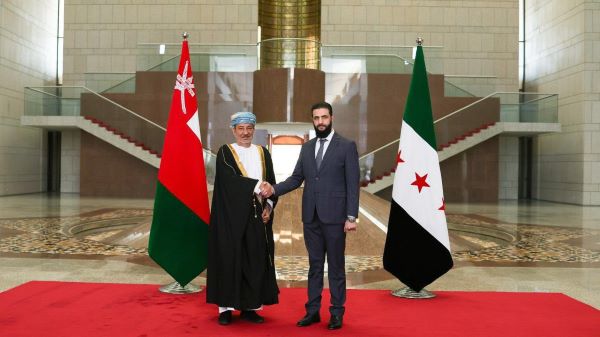
Since the fall of the Assad regime in December 2024, the HTS (Hai’at Rahrir ash Sham – Committee for the Liberation of the Levant) under Ahmed al-Sharaa, also known as Abu Muhammad al-Jolani, has been able to consolidate its power. The hopes that accompanied the fall of the Baath dictatorship and the illusions that existed in view of the moderate tone of the HTS leaders in the first phase of their power were quickly shattered: the new regime is a right-wing Islamist counter-revolution hostile towards secular Sunnis and Shiites, women, religious minorities, social movements and workers. At the same time, it is also attempting to consolidate its power through an agreement with Western imperialism and a rapprochement with the State of Israel. In doing so, it can also rely on Turkey, which supported the HTS’s seizure of power and is counting on the new regime to fight the Kurds’ aspirations for autonomy.
The HTS, a jihadist formation with roots in al-Qaeda, has systematically brought the administration, military and secret services under its control since the power vacuum following Assad’s flight. Gradually, the right-wing Islamist groups of the civil war were integrated into the new Syrian army and the new police and secret service authority, the General Security Service. Two-thirds of the General Security Service’s leadership are former HTS veterans and are under the control of Interior Minister Anas Khattab, a former al-Qaeda member and author of Islamist writings. This organisation, in alliance with Islamist militias, is the main perpetrator of the massacres against ethnic and religious minorities that took place in Syria this year. Today, large parts of Syria are ruled by an authoritarian regime under Sunni fundamentalist leadership, which al-Sharaa refers to as a ‘transitional government’. Sharia law is used as the basis of legal rule, and the dictatorial regime, led by HTS (which first held power in the city of Idlib from July 2018), is gradually being extended to the whole of Syria, contrary to al-Sharaa’s promises shortly after Assaf’s fall. There are neither democratic rights nor social justice – instead, there is a brutal re-Islamisation of society, surveillance, kidnappings, purges and religious-sectarian attacks on minorities.
Massacre of Alawites – silence from the world
In February 2025, a large-scale pogrom against Alawite civilians took place in the coastal region of Latakia. Reactionary Islamist militias, with the tacit approval of the al-Sharaa regime, carried out massacres in several villages and towns. Over a thousand people were killed, others abducted, religious sites desecrated, and tens of thousands displaced. The ‘international community’ – including many bourgeois media outlets – remained silent or relativised the events.
For the imperialist states, the new regime in Damascus is apparently a ‘stable factor’ as long as it does not oppose Western interests. The Alawite-dominated Latakia region stands in contradiction to the goals of the al-Sharaa regime. A secular culture and the coexistence of Alawites, Christians, Shiites and Sunnis, are a thorn in the side of the new government in Damascus. The Alawites, who to some extent represented the basis of the Assad regime and who do not submit to the goals of HTS, are considered a threat to the consolidation of the HTS dictatorship. This is evident in the almost simultaneous teachers’ strikes in Latakia and Idlib at the beginning of the year, which represented the first organised protest against al-Sharaa.
Since the massacres in February 2025, entire neighbourhoods in the city of Latakia and surrounding villages have been ethnically cleansed. New HTS-controlled administrative structures that systematically exclude Alawites have been installed. A two-tier system of healthcare and infrastructure has been established. Electricity and water are arbitrarily cut off in Alawite villages. The police have been replaced by the Islamist General Security Service. Alawite women must fear being abducted in hospitals and taken to Idlib as slaves. The Alawites are treated by the new regime as supporters of Assad, who came from the Alawite religious community, and as an extension of Iranain and Russian influence. The al-Sharaa regime is selling the subjugation of Latakia as a symbolic victory over the supposed enemies of the Sunni majority population.
Druze under siege – the resistance of Suweida
The Druze minority in Suweida is also subject to massive repression. The ethno-religious minority of the Druze were among the first supporters of the Syrian revolution of 2011. However, they withdrew after the outbreak of the civil war, as more and more right-wing Islamist groups gained influence. The Druze developed a degree of self-government and formed self-defence units after the Assad regime smuggled IS fighters into Suweida in 2018 to weaken the Druze self-government. In November 2024, the last troops of Assad’s forces were driven out of Suweida by the Druze, and the Druze militias supported the march on Damascus, which sealed the end of the Assad regime.
However, the Druze remained extremely sceptical of the new HTS government and did not want to give up their self-government. In December 2024, the Suweida Military Council was founded, bringing together the various Druze self-defence forces and declaring the Kurdish self-government in northern Syria as its model. The Suweida Military Council calls for a secular, decentralised and grassroots democratic Syria, which is in direct contradiction to al-Sharaa’s goals.
Since December 2024, there have been repeated protests in Suweida against the new regime and the Islamisation of Syria. Their traditionally independent stance, their resistance to Islamisation, and their demand for self-government, make them a target of the new regime. The al-Sharaa government has systematically infiltrated and undermined local militias, organised acts of sabotage and deliberately provoked inter-ethnic tensions between Druze and Sunni Bedouins. In July 2025, there were targeted kidnappings, bombings, and threats against Druze activists and spiritual leaders, which developed into serious clashes between the Druze self-defence forces and right-wing Islamist militias supported by Damascus. Within a few days, over a thousand people lost their lives. Islamists filmed themselves massacring and torturing Druze and Christian civilians in Suweida. Nevertheless, resistance and protests continue. Thousands continue to take to the streets in Suweida. Their slogans are directed against Islamisation, against the new regime, for social justice, for secular self-determination.
Al-Sharaa and his HTS militias failed due to the resilience of the Druze, and a massacre like the one in Latakia was prevented. However, the current ceasefire that has been negotiated is fragile and provides for a ‘voluntary’ surrender of the Druze’s self-administration. Druze militias are allowed to keep their bases but not extend their control beyond Suweida, while HTS-affiliated forces are allowed to establish their own civil administrative structures. All this without any guarantees for the rights of the Druze. In reality, this meant that HTS secured de facto control through bureaucracy and covert structures. At the same time, the HTS regime evacuated 1,500 Bedouins from Suweida and is using them as a propaganda tool for alleged Druze atrocities to stir up hatred among the Sunni majority population against the Druze.
Israeli air strikes – not an act of solidarity with the Druze
For years, Israel has been carrying out regular air strikes on Syrian territory – officially to ‘prevent Iranian expansion’. Even after Assad’s fall in January 2025, Israel continued its attacks, most recently with increased intensity, and occupied Syrian territory. But despite hundreds of precision air strikes on regular army bases, airfields and radar installations of the former Baath forces, two central forces remained untouched: the new Syrian police and secret service apparatus under the control of HTS and jihadist militias tolerated by the al-Sharaa regime.
This selective attack strategy speaks for itself: Israel is pursuing a geopolitical agenda that considers certain militias to be a lesser evil or even a stabilising factor – as long as they do not cooperate directly with Iran. This cynicism was particularly evident in Suweida and Latakia. While Israel remained passive during the massacres in Latakia, it is now presenting itself as the defender of the Druze. This has little to do with the fact that Israel itself has a significant Druze minority (some of whom serve in the IDF), but rather with geopolitical calculations. The air strike on 16 July 2025 targeted the Syrian military headquarters in Damascus and military units around Suweida. Israel officially justified this as protection for the Druze and a ‘warning shot’ against the Syrian government.
Although these air strikes led to the withdrawal of regular government troops from Suweida, the Syrian police and secret service apparatus and HTS militias remained intact or were strengthened, and Israel did nothing to counter this. The withdrawal of regular troops without simultaneously dismantling paramilitary and intelligence networks created a vacuum in which HTS and other militias were able to expand their power. Israel celebrates itself as the protector of the Druze, but in practice it tends to stabilise militias and power structures that weaken these communities in the long term and lead to the permanent fragmentation of Syria. Furthermore, the HTS regime accuses the Druze of being agents of Israel who want to destroy Syria. This is despite the fact that the Druze and their religious leader, Hikmat al-Hijri, consistently reject the Israeli occupation of parts of Syria and demand the return of the Israeli-occupied Golan Heights to Syria.
This does not mean that Marxists put faith in the Druze leaders however – they do not act in the interests of working class people in Druze controlled areas or promote genuine working class unity across ethnic divisions.
Further escalations
Further escalations by the al-Sharaa regime are already becoming apparent. The ceasefire with the Druze is extremely fragile and could turn violent again at any time. Because many Syrian Christians have declared their solidarity with the Druze, the HTS regime is intensifying its campaign of incitement against them. The Kurdish self-administration in northern Syria also declared its solidarity with Suweida. The Kurdish women’s defence units YPJ even declared their readiness to intervene militarily should further attacks against the Druze occur. Al-Sharaa is now, together with the US, increasingly calling for the disarmament and integration of the Kurdish areas into the Syrian central state. The authoritarian character of the government is being consolidated.
In December, a so-called ‘People’s Assembly’ is to be elected. One third of the deputies will be appointed by al-Sharaa himself. The remaining seats will be indirectly elected by election committees in the administrative districts of Syria. The outcome of these elections under the authoritarian regime of HTS in Idlib and occupied Latakia is already foreseeable. The attacks on Latakia and Suweida also serve to create a parliament loyal to HTS.
Internationalist duty
As socialists, we oppose the HTS regime, just as we opposed the Assad dictatorship which, despite the formal name of its ruling party, the Arab Socialist Ba’ath Party, had nothing at all to do with the genuine ideas of socialism. We oppose all imperialist interference – whether from Russia, Turkey, Israel, the USA or Iran – and advocate the building of a workers’ movement that transcends religious and national boundaries and is based on the common class interests of the masses. We oppose all forms of oppression of workers, women and minorities. The Druze of Suweida, the Alawites of Latakia, the Kurds in northern Syria, the Christians threatened by terrorist attacks, the impoverished Sunnis of the cities, the disenfranchised women, the striking teachers and the persecuted workers – they have our solidarity.
Class politics instead of sectarianism
Neither the old Assad regime nor the current al-Sharaa regime served or serve the Syrian working class. Both regimes – one bureaucratic-state capitalist, the other Islamist and supported by the Sunni petty bourgeoisie in the cities – represent different forms of counter-revolution. The class struggle in Syria has been crushed between these poles – by the strangling of the revolutionary movement that emerged in 2011 through reaction, imperialism and sectarian delusion.
The collapse of the Assad regime raised the question of who would govern the country. One consequence of the years of oppression and the international weakening of the socialist workers’ movement was that there were, and still are, no independent workers’ organisations in Syria that could challenge the different bourgeois, religious and foreign forces leading the struggle for power.
The workers, poor, peasants, women and youth in Syria need their own organisations, including a party that is not ethnically or religiously based, but based on the working class. Only a mass socialist workers’ party can show a way out of the catastrophe and stop the disintegration of Syria.
The CWI calls for:
Stop the attacks on Suweida and Alawite districts immediately!
For an independent investigation led by workers and genuinely cross community organisations into the massacres of February 2025 by democratic civil organizations! For an workers led international campaign to explain what occurred!
Solidarity with all religious and ethnic minorities and workers who resist the HTS regime!
Democratic rights for all! Full equality for women! The right to organize freely!
Building democratic committees of self-defense and self-management from below in Suweida, Latakia and other regions!
For the building of a multi-ethnic workers’ party with a socialist programme
For a democratically composed revolutionary constituent assembly to decide on the future of Syria
For a workers’ government based on the self-organization of the masses and initiating a socialist transformation of Syria
Fight for a socialist, federal Syria as part of a voluntary socialist federation of the Middle East