
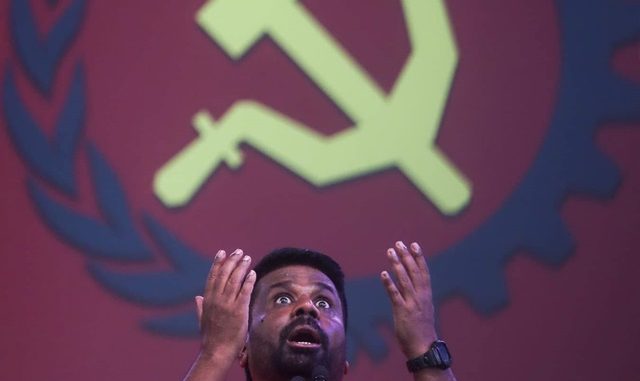
It has been more than a year since the current government, led by Anura Kumara Dissanayake, came to power. Since the National People’s Power (NPP) government took office, there has been ongoing debate about its class character and the kind of socio-economic program it represents. To understand this, it is necessary to examine how the NPP came to power.
The social and political background that enabled this government’s rise was shaped by the 2022 mass struggle. The Galle Face People’s Struggle was essentially an anarchic, middle-class-led movement without a clear objective or program. However, it developed into a struggle against the traditional power structures that had ruled the country until then. Although the NPP had no direct connection to the Galle Face struggle, it managed to capture electoral support by presenting itself as an anti-corruption force, and not connected to the old elite political parties.
The NPP filled the political vacuum with various populist slogans, such as the abolition of the executive presidency. They were well positioned to do so because they did not challenge capitalist policies or nationalist tendencies; instead, they restricted themselves to anti-corruption slogans, which suited the mood of many involved in the struggle.
The United Socialist Party and some others on the left, who were part of the struggle, argued that the movement needed to go further by advancing socialist alternatives to capitalism and building an independent, worker-led party. However, given the cross-class character of the movement and other factors, support for these ideas was limited, although the USP held that the experience of struggle and a new government would create a wider audience for socialist policies. Initially in this situation, opportunist organisations with populist and ‘easy’ slogans gained ground.
The “People’s Power” campaign that Gotabaya used to come to power in 2019 helped the National People’s Power come to power in 2024. It should be understood that this rapidly oscillating NPP has the potential to break down quickly due to its expectation of quick results without a clear political vision. Through this, they were able to win the presidential and parliamentary elections. This political power shift is a decisive power shift in the history of Sri Lankan electoral politics and can be understood as a power shift from the Colombo-centric elite class to a non-elite force with a rural base consisting of several social strata.
The central factor operating within the National People’s Liberation Front (NPP), the JVP, was a party that, on the surface, often proclaimed Marxism-Leninism for about 65 years. It was a party that led two uprisings, in 1971 and 1988–89, mainly in the southern part of Sri Lanka. The NPP, which was built up by middle-class university professors and artists including Harini Amarasuriya, as well as local businessmen, functioned as a backbone around the JVP. In that sense, the JVP–NPP alliance is an alliance built on middle-class radical petty-bourgeois forces. The alliance, despite its commitment to work within capitalism, made a huge number of attractive promises to win the people’s attention and presented a program called “A Rich Country – A Beautiful Life.” However, after coming to power, it is clear that they have blatantly forgotten almost all the promises made to the people because they came to the defence of the capitalist system that is mired in crisis, openly making agreements with the imperialist powers to implement the neoliberal project.
In order to attract the petty-bourgeois youth forces, the emphasis on so-called Marxism and socialism that the JVP had carried out throughout history to deceive the people, was very consciously thrown into the trash. The JVP leadership, including Anura Kumara and Tilvin Silva, used the formation of the NPP to dilute any left policies they still held onto and moved to the right. More than 26% of the country’s population, including the plantation Malayaha workers, live below the poverty line. The latest reports show that child malnutrition is increasing rapidly. The majority of working-class people have had to cut down on their daily food intake due to the economic crisis. Although the government has been in power for a year, it has failed to provide any relief to the lower strata of society.
A large section of this population voted for the compass (their electoral symbol) in the hope of quick solutions to pressing issues. It included many promises such as reducing the 18 percent VAT and removing the VAT imposed on education and medicines, reducing electricity tariffs by 33%, reducing fuel tariffs, repealing the PTA Act, and abolishing the executive presidency. Sunil Handunnetti, a powerful minister in the NPP government, declared during the swearing-in of the cabinet that Anura Kumara would be the last President of Sri Lanka meaning they will abolish the presidency. In the past Nihal Galappatti, who contested the 1994 presidential election on behalf of the JVP, withdrew from that presidential race and supported Chandrika after obtaining a written promise from her to abolish the presidential system. The JVP stood for the abolition of the presidency from that time until it came to power in 2024.
Although every leader who assumed the presidency after 1994 promised to abolish the executive presidency, none of them kept those promises due to the greed associated with the dictatorial power of the executive presidency. All the presidents who promised to abolish the executive presidency and did not fulfill it have now fallen into the dustbin of history. Likewise, it is unlikely that President Anura Kumara Dissanayake will bring a new constitution to abolish the executive presidency fully. If there is a real need to pass a new constitution, this is the only government in recent political life that has a 2/3 majority in parliament. When the government’s cabinet spokesperson was questioned in this regard, he recently stated that the government has given priority to economic development over bringing a new constitution. This is not much different from the rhetoric of the Rajapaksas and Wickremesinghe that was used in the past to deceive the people. National People’s Power is also following the same rhetoric, but not interested in delivering on it as were their predecessors.
National People’s Power, which presented itself as an “elite” or “educated people” government, makes good use of the arbitrary and dictatorial power of the presidency. It is not difficult to understand that Anura Kumara has also contracted the disease of political power greed that afflicted leaders who held the presidency with dictatorial power before him. The way the NPP is working now, there is a big danger of it developing into a constitutional dictatorship to suppress workers and the poor who oppose the government. Anura Kumara’s shameless use of the Prevention of Terrorism Act to hunt down opponents is an example of this.
What is the path of the government
The debate on the nature of the NPP government has now moved towards a clear conclusion. This government has signed agreements to implement the program presented by the International Monetary Fund and the World Bank without a single change. This government is taking urgent steps to fully implement the anti-people program that the Rajapaksas and Wickremesinghe, who were in power before, could not implement due to public opposition. The World Bank, an imperialist financial institution, a few weeks ago praised the NPP government highly, saying that the Sri Lankan economy under the NPP government is very stable. Similarly, the World Bank gave great assurances about the stability of the Sri Lankan economy in late 2021, but it should not be forgotten that the economy collapsed a few months later and Sri Lanka became a bankrupt state.
The economic growth rate, which was 5.1% in 2024, is currently forecast to decline to 3.1% by the end of 2025. Also, although the foreign exchange reserves should be increased to one billion dollars by the end of this year, only 59 million dollars have been accumulated in the foreign exchange reserves in the past 7 months of this year. Therefore, although the leaders of the NPP government are excited and enjoying these World Bank praises, the people of the country are looking at this with serious suspicion. It has now been announced that a cabinet decision has been taken to liquidate 33 state properties. Also, the Electricity Board and the state banks are in the process of being privatized as per the directives of the IMF.
The economic advisors of the government are businessmen at the grant level who worked with Gotabaya and Wickremesinghe. All of them work with financial institutions to implement the neoliberal economic program. Based on all these facts, the National People’s Power government is another capitalist government that is no different from the previous capitalist governments. It is important to understand the statement made by Lalkantha, key leader of JVP an a powerful minister in the government, in a recent discussion. He stated that the National People’s Power is rapidly transforming into a capitalist formation. The recent asset declarations of the JVP leaders that have now become public show that they own properties worth crores. It has also been reported that these people, who appeared as proletarians with no income in front of the public, now have bank accounts consisting of British pounds and American dollars.
It is clear that Anura Kumara’s government is following various strategies for the government’s needs with regional powers India and China. Through the security agreement signed in secret with India, India’s strategic needs were fully supported, and with the signing of the ETCA agreement in the near future, Sri Lanka will become a pawn of India. On the other hand, all the necessary facilities and new laws are being prepared for the Colombo Port City to meet China’s needs, and steps have been taken to turn the Hambantota port area into a Chinese colony. Sri Lanka has fallen into the trap of fulfilling their needs in the large economic space that is being built between India and China. It is a delusion to think that India and China can be used for our needs through such short-sighted actions.
In the meantime, it is important to understand the true meaning of this government’s foreign policy. They act like a pro-American puppet. The government is not ready to go beyond making a nominal criticism against the genocidal war being waged by Israel in Palestine and has provided all the necessary facilities for Israel to operate in Sri Lanka. It is not a coincidence that Anura Kumara’s government, in order to represent American interests, not only did not participate in the BRICS summit held in China at the end of last year, but also did not participate in the Shanghai Cooperation Organization (SCO) meeting held in Tianjin, China this September. It is also no coincidence that Sri Lanka participated in the pro-Western ASEAN summit held in Malaysia in July this year, which further confirms how far they are prepared to bend for the imperialist interests.
The National Question and the Geneva Effect
It is common for Sri Lankan governments to face foreign pressure every September. This is due to the allegations of human rights violations against Sri Lanka at the United Nations Human Rights Council and the proposals being made in this regard. The National People’s Power government is also following the path of the Rajapaksas based on the Sinhala-Buddhist majority ideology, rejecting international commissions of enquiry into war crimes, and clearly stating that it is not ready to move beyond raising the formula of a local mechanism. The so-called local mechanism is also rhetorical and has never been implemented in the past, nor will it be in the future.
Anura Kumara’s declaration in the North that racism will not be tolerated will not help the national problem faced by the Tamil people. Racism is a backward political weapon, and when Sinhala racist elements present their demands to the Tamil people, they brand it as treacherous racism that divides the country. On the other hand, the Tamil people can also be seen responding to the Sinhala nationalists. Therefore, instead of just making meaningless statements about the national issue, they will not come out with any solution. We should not expect bankrupt capitalist politicians to study it in depth and present lasting solutions.
It is clear that all types of capitalist governments that have been in power so far, as well as the National People’s Power government, are based on the majority Sinhala people. Apart from constantly making statements about corruption and theft by the previous government to keep the attention of the people who are drowning in it, no leader in the government since Anura Kumara has been heard talking about solutions to the country’s basic problems, such as the deep economic crisis, or about a program to solve the national question in the country.
Considering these facts, Anura Kumara’s National People’s Power is a very primitive weak government that has no clear idea about solving the national question. The limited economic reforms followed during the Rajapaksa period in the North cannot solve the national problem. The JVP government’s inability to solve the national problem is linked to its inability to get rid of the anti-Tamil (including estate workers) racist politics that flows from its history.
It should be remembered that the JVP leaders alliance with the Rajapaksas against the Tamil people during the war, and the racist rebellion they led in the South in 1988-1989 against the Provincial Council system that the people of the North received through the 13th Amendment to the Constitution, were manifestations of their racist ideas. Moreover, it cannot be forgotten that the JVP obtained a Supreme Court order to split the Northern and Eastern Provincial Councils that were merged under the 13th Amendment to the Constitution.
Therefore, expecting a solution to the national problem from the National People’s Power government is like picking feathers from a tortoise. In this complex political context, it should be emphasized that the United Socialist Party is the only political party that has consistently worked for the recognition of the right to self-determination as an initial step to resolving the national question.
The Failed Opposition and the Challenge of the Working Class
The capitalist parliamentary opposition in Sri Lanka is currently suffering from ideological poverty. The main reason for this is that none of them has a clear alternative program against the neoliberal program being carried out by the current government. Due to the public opposition that has emerged against the pro-imperialist capitalist rulers who have ruled the country for so long not able to implement some policies that are rolled out now. The current National People’s Power government has implemented the neoliberal program that the Rajapaksas and Ranil Wickremesinghe failed to implement, and as a result the opposition has only minor criticisms of the government. The current opposition has become bankrupt without an alternative program.
The Sri Lanka Freedom Party, the United National Party, and the Sri Lanka Podujana Peramuna do not have any different ideologies in terms of policies, except for personal conflicts over the leadership of Sajith, Ranil, and Namal. In this situation, the challenge of building a real active opposition lies before the working class and the left.
The failure of the current parliamentary opposition is the only guarantee for the survival of this government. The people did not give the JVP-NPP a two-thirds parliamentary power with presidential power to walk on the path of the old capitalist rulers who destroyed the country for 77 years, merely wearing a new mask. But the compass is being used not to build a social environment where the people can live by removing the immense tax burden imposed on them, but instead to impose more taxes.
Since the JVP does not have a far-reaching alternative economic program, it has no other path than to remain a bankrupt government dependent on imperialist forces. Bimal Ratnayake, a powerful minister, recently declared that this government will go through the next five years without a crisis and will go beyond that to win the next election.
It should not be surprising that the leaders of this government, who came to power disguised as leftists, have deliberately forgotten the strength of the working class and the people’s forces. In the South Asian region, the people’s struggles that took place in Bangladesh, and recently Nepal following the 2022 Galle Face struggle have sent a serious warning to the capitalist rulers.
In Sri Lanka, a new development in the class struggle is being shown through sectors such as electricity, banks, telecom, railways, insurance, teachers, and postal services. Members of trade unions affiliated with the JVP are facing a severe crisis, and workers in many institutions are showing their involvement in the class struggle despite JVP orders from above.
Unfortunately, the lack of action by trade union leaders to build a united front to win the burning demands of the working class has given the government some comfort. In this situation, the government, which is unable to answer the burning questions of the working class and the people, has started launching state repression in a planned manner.
The repeated public threats by President Anura Kumara and his ministers to workers and trade unions engaged in industrial actions these days is a serious issue that needs more attention. Also, the government has used state forces to incite the people against the strikers, and it seems that the JVP is using the state machinery to suppress working-class actions.
It will not be easy for the trade union leadership to undermine the pressure coming from the lower ranks of the working class to take the necessary steps to unify the class struggle and confront state repression. In this context, the traditional capitalist forces in the failed and corrupt parliamentary opposition, which the people have rejected, must not be allowed to raise their heads again.
For that, it will be our responsibility to campaign for a program that unites the working class under minimum agreed demands. On that basis, uniting the poor peasantry and the youth under a socialist program with a clear vision is an important step.
How Revolutionaries Should Approach This Government
When the earthquake that emerged through the Aragalaya (mass struggle) was transferred to the electoral plane, it produced a stunning victory for the NPP. This in turn paralysed sections of the left. Some who opposed the NPP during the election went as far as supporting it unconditionally after the results. The Frontline Socialist Party (FSP), faced with the dilemma of how to respond to the JVP-led NPP’s popular support, adopted a “lesser evil” position.
The FSP itself was born out of a split in the JVP. At the time, it criticised the JVP’s collaboration with capitalism and even predicted its demise. Yet now, with the JVP having transformed into a populist electoral party and presenting itself as the main “left” alternative in the country, the FSP faces an even greater challenge. They must hold onto their own ranks, who were in the past poorly educated on Marxism and what it means to build a revolutionary party. The FSP has argued that they will not oppose the government with the aim of bringing it down, while at the same time appealing to JVP members and supporters to join them as disillusionment with the NPP grows. Other small left groups, often sectarian, have not been much different in their approach.
It is correct to argue that the corrupt capitalist parties should not be allowed back into power. However, it is wrong to argue that the NPP should be maintained in power for that purpose. In fact, the NPP’s continuation in implementing capitalist policies is precisely what will pave the way for the openly capitalist parties to return. Instead, united front work is needed to build a genuine socialist alternative — not opportunism. Opposition must be based on a clear program and policies that directly challenge capitalism and the NPP’s capitulation to capitalism and imperialism, instead of vague populist demands.
The discontent emerging from the masses will also be used by the capitalist parties to rebuild their support. A significant section of Rajapaksa supporters swung to the NPP in the last election; without a real alternative, they could just as easily swing back. Preventing that requires winning the masses to a clear economic plan and socialist policies. Of course, this is neither automatic nor simple. There are limits to how much mass support can be won for a revolutionary program at this juncture, given the complex conditions and confused consciousness that exist. But shortcuts only lead to the same opportunism that has trapped the JVP. Building a revolutionary force is part of a long-term strategy.
There is also confusion about what kind of united front should be built. Simply grouping together existing left organisations that hold widely different views on the national question and economic policy will not forge real unity. Instead, militant trade unions, rank-and-file workers, and other grassroots activists should be brought together into a democratically organised united front.
As part of this process, it is absolutely necessary to expose the NPP government’s policies for what they are. They must not be allowed to continue without meaningful opposition from the left. There is also a danger that the NPP could turn to repression if seriously challenged. Ranjan Jayalal, NPP member, former prominent trade union leader, and mayor of Kaduwela municipality, recently declared that they are prepared to kill “100,000 more” as was done at the end of the war, to defend the NPP government and maintain authority. Repeated warnings by NPP leaders against unions and the left should not be taken lightly. Revolutionaries must stand firm on principle and win support among the advanced layers of the working class and youth. Can the NPP be pushed to the left? Strong trade union action and the movement from below can force certain concessions. Even then, it is extremely unlikely that the NPP will turn into a “left-wing government”—even to the extent of the left-center coalition in the 1960s, let alone a Marxist one. So far, the NPP’s character has been revealed as that of a placeholder, absorbing the shocks from deprived society and angry youth, only to eventually hand over full control to openly capitalist parties.
Many gave their support to the NPP with enormous hope for real improvements in people’s lives. Many still wait, hoping against hope, that this government will deliver the “Thriving Nation … Beautiful Life” they promised. We appeal to them to come forward, join the discussion, and fight for policies that can truly change society — and to think seriously about what kind of force can implement such a revolutionary, pro-worker program without compromise with rotten capitalism.
There is another way. We can build our own party on a program that defends the interests of workers, youth, farmers, and all the oppressed above the profits of the few. Such a party would put our needs before capitalist greed. Let us come forward and unite on that basis.