
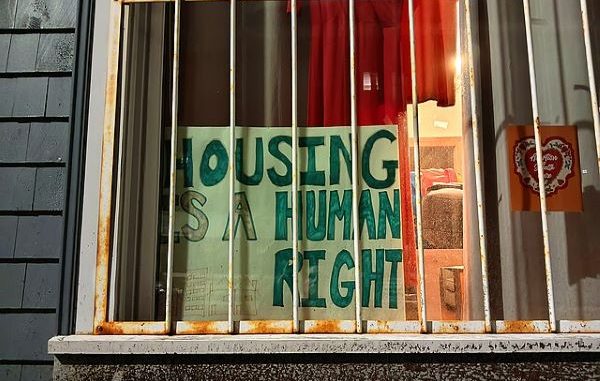
Against the background of rising tensions and protests over the issue of asylum seekers being accommodated in hotels, urgent discussion needs to take place in the workers’ movement to put forward a fighting policy of affordable homes for all. Matt Dobson from Socialist Party Scotland makes the case for socialist policies that should be fought for to cut across racism and division on this vital issue
It is clear from Glasgow City Council’s own reports and figures (Glasgow’s Strategic Housing Investment Plan 20a24/25 to 2028/29) that the city is mired in a housing and homelessness crisis, even leaving aside the issue of asylum seekers.
Glasgow’s homelessness spending is forecast to be £110 million over budget in two years. The city, along now with all major Scottish cities, declared a “Homelessness Emergency” in December 2023.
The causes of this emergency are rooted in a capitalist market-orientated policy towards housing, adopted by successive Labour and SNP council administrations, and Scottish and UK governments.
A major “counter revolution” in housing in Glasgow took place in 2003 when the council’s housing stock was transferred over to Housing Associations/ Registered Social Landlords (RSLs), this was opposed by socialists and housing campaigners. The impact of this hangs over the city today.
The council cannot effectively manage its housing crisis without any real control over the housing stock. Blairite Labour, in power at the time in Glasgow, and Scotland from 1999 until 2007, underinvested in council housing stock for decades.
Tenants were in effect bribed, with the lie that improved accommodation would only come with the stock transfer.
Socialist policy
Only a socialist housing policy, central to which would be councils linking up in a mass campaign in demanding the resources for a huge council house building programme, can solve homelessness in Scotland.
Starmer’s Labour and the Scottish National Party will not do this. The SNP government only commits to delivering 110,000 new “affordable” homes in Scotland by 2032, with only 70% of these to be for “social rent”.
There is widespread coverage of these targets not being currently met. Today, 55% of homes in the city are rented, 19% of those are in the hands of private landlords who have rocketed up rents and downgraded housing quality in the last decade.
In the private sector too, there is a profit bonanza in the building and renting out by multinational companies of student accommodation which has spread across the city.
36% of Glasgow homes are under the control of Housing Associations/ RSLs. According to the strategic report, for every 3-4 bed home let by a HA/RSL there are on average ten applications.
The Glasgow Times reported on an investigation of four HAs in April who control 50,000 homes. Queens Cross, in the north of the city, only allocated ten homes with over 3 bedrooms last year, estimating it would take 137 years before all needs are met.
The limitations of the building programmes of the HAs also fuel the crisis, particularly the largest ones in the city like the Wheatley Group and West of Scotland (WOS). They focus on financial return rather than the city’s needs.
Often their “regeneration” schemes, like the present WOS one at Dundashill, are for mid-market rent inaccessible to the poorest.
Glasgow faces the twin pressures of a growing younger population coming into the city to study or work from elsewhere, wanting to stay and build families and desperate to get out of the private sector, and of families facing overcrowding.
The key pressure demand identified in the council’s strategy document is the lack of three and four-bedroom homes.
It is likely SNP council leader Aitken’s appeals for more funds for Glasgow will be ignored by Starmer’s Home Office.
But the pressures will increase as Glasgow’s population grows and as the international factors that are rooted in capitalism causing the desperation and forced movement of asylum seekers and refugees; war, repression, climate crisis and poverty, worsen.
To cut across attempts at racist division by the right populists and far right, a united struggle for jobs, homes and public services for all is needed.
Aitken argues that Glasgow has been a traditionally welcoming city for refugees and poor migrants. While there is truth to this, including the anti-dawn raids movement in the 1990s and the successful mass protest against the deportation of an asylum seeker in 2021, Glasgow’s history also includes tensions in communities often exploited by reactionary forces when slum like conditions exist and when there is decline and scarcity of affordable housing.
Working-class organisation, for unity against the bosses and the politicians who carry out their wishes, will be key to ensuring the socialist and workers’ movement tradition of solidarity wins out.
Asylum accommodation
Glasgow has the highest number of people seeking leave to remain – 3884 – of all the major UK cities.
It is the largest “dispersal area” of asylum seekers in Scotland with 4500 in privately-run profit-making accommodation waiting on claims to be processed.
Under Nicola Sturgeon, the SNP government abolished the requirement for “priority need” (such as families with children) in 2012 and suspended the requirement for a “local connection” in 2022 when assessing homelessness applications.
Both criteria are still requirements for English local authorities. Once an asylum claim is granted, refugees have only fifty-six days to find their own accommodation or present as homeless to councils.
Yvette Cooper and Starmer’s Labour have mooted cutting the number of days. There has been a 50% increase over a year in homelessness applications from newly approved refugees granted leave to remain elsewhere in the UK seeking housing in Glasgow.
The homelessness crisis in Scotland shows the dangerous effects of adopting a progressive policy, that all who present as unintentionally homeless have the legal right to be housed by councils, which socialists defend, but without the housing and other vital social services to meet demand.
Thousands of refugees have flocked from across the UK to Glasgow to attempt to be housed. They have joined the homeless families and individuals already in a city blighted by all the social ills that feed into homelessness, including addiction, poverty and overcrowding.
Legislation in Scotland stipulates that local authorities have an immediate duty to provide temporary accommodation whilst assessing homeless application – In Glasgow, this hasn’t stopped over 200 legal threats a month over its failure to provide this accommodation to the homeless.
In November 2024, 1086, incidents of applicants not getting accommodation were recorded.
This summer, unlike other areas of Scotland, Glasgow has not seen major anti-asylum protests outside accommodation so far. But right populist Reform councillors (ex-Tories) seeking to carve out a base in working-class areas have sought to whip up tension and small local protests by utilising the housing crisis.
Areas where Housing Associations predominate, but the local community justifiably feels there isn’t enough housing or local facilities such as Carntyne, Castlemilk and Royston have seen outbursts.
This has been over planning applications for empty commercial and residential properties, some of which have been attempts by private contractors to gain permission to make profit out of housing asylum seekers.
Others have just seen a frenzy, often on social media, generated by misinformation fuelled by the far right and Reform.
Even where councillors from the SNP, Labour and the Greens and council officials correct misinformation, often they are mistrusted. Tainted as they are by their record of implementing cuts.
Profit from misery
As well as capitalist politicians, private companies allowed by the Tories and now Starmer’s Labour to make profit out of the human misery of the “asylum system” are also responsible for the current crisis.
Mears have made £1 billion since being awarded the contract to provide asylum seekers with accommodation ranging from HA accommodation to B&Bs, to hotels in Scotland by the Home Office.
Their CEO took home £670,000 last year. They replaced anti-trade union firm Serco, who were only prevented in 2018 from making thousands of asylum seekers homeless by an anti-eviction campaign in which Socialist Party Scotland was involved.
They manage 2,250 properties in Glasgow, including hotels in Erskine and Falkirk. The media is full of reports of the poor quality of rodent and vermin-infested Mears’ accommodation. And of asylum seekers unlawfully being moved between accommodation at short notice having a traumatising effect.
Socialist Party Scotland defends the right to asylum and the homeless to be housed. We oppose the targeting of asylum seekers and migrants.
Anger over the housing and wider social crisis should be directed at the bosses’ politicians, landlords and companies like Mears. As well as opposing racist immigration laws, we oppose the Starmer Labour government’s cynical attempts to ape Reform and the far right, including saying they will shut asylum hotel accommodation by 2029 without solving the housing crisis, in effect legitimising the idea of detention camps.
Also, that they will speed up the processing of asylum claims by undemocratically appointing government officials as decision makers rather than judges whose decisions are subject to appeal.
Control of decisions about whether to grant asylum cannot be left in the hands of a capitalist government. We demand that elected committees of working-class people, including from the trade unions and migrants’ organisations, have the right to review asylum cases and grant asylum.
While Starmer, the Tories and Reform all engage in “stop the boats” rhetoric, they oppose the demands of their own staff in the Home Office and Border Force for decent pay rises and better working conditions, fought for by the PCS union.
We stand for the right of asylum seekers to work. This linked to a demand for the trade unions to fight for the rate for the job and the right to organise in all sectors. This can stop the bosses using migrant labour to undermine wages and conditions.
Socialists also back the fightback against deportation of workers who don’t meet new visa requirements waged by unions like the RMT and PCS currently.
Ultimately, the demand for safe secure accommodation for asylum seekers is linked to the need to fight for decent council housing available to all.
Housing provision must be fully publicly funded and be democratically planned and controlled by the working class.
Funds from the Home Office are limited, with asylum seekers having no real income and therefore often attempting to work illegally, and there is no provision in the funding for the wider community.
Asylum accommodation is widely rightly perceived as only being in the most deprived areas – of course this is where the Home Office and private providers like Mears find the cheapest accommodation.
The trade union and workers’ movement should demand privateers like Mears should be kicked out and the whole asylum system taken back into democratic public ownership.
Council house building programme
Jeremy Corbyn and his new “Your Party” initiative rightly raises the demand for a mass council house building programme in a general sense.
But socialists must explain what this means in detail particularly where there are tensions in working class communities. Rather than over 100,000 homes in Scotland being needed by 2032, the scale of the crisis demands that this number be built or made available every year for a period.
The socialist Liverpool council led by Militant in the 1980s, who defeated Thatcher and rapidly built thousands of high-quality council homes, should serve as an inspiration.
A socialist Glasgow council could set a no cuts budget utilising financial mechanisms while demanding back the close to £1 billion stolen by Holyrood and Westminster in austerity.
The council could appeal to other local authorities for support. This funding could be used to meet the city’s housing needs.
The council could then build housing, implement rent controls, seize properties through compulsory purchases and create jobs through renovation of properties.
It could invest not only in housing but vital community services, social work provision, parks, schools, leisure facilities, cleansing and roads to reverse decades of decline.
A socialist model of council housing would give tenants real democratic control over stock, allocation and planning unlike the top-down bureaucratic mistakes of the post war period.
The Scottish government could also follow such a fighting no cuts policy.
If “Your Party” is to develop into a mass working class party it would alongside the trade unions work to rebuild the tenants’ unions movement and drive out slum landlords.
To decisively end the housing crisis that is rooted in capitalism wider socialist measures are required. Housing Associations should open the books to workers and tenants’ scrutiny.
If they do not implement democratic structures, including workers and tenants control and serve need they must be taken back into democratic public control.
The banks and construction sector as well as the land as a whole must be nationalised under working class control and management.
This would alleviate the pressures of interest rates and mortgage debt on small homeowners. It would also be part of nationalising the top 120 biggest companies industries and banks which would release the resources to provide affordable homes and a future for all.