
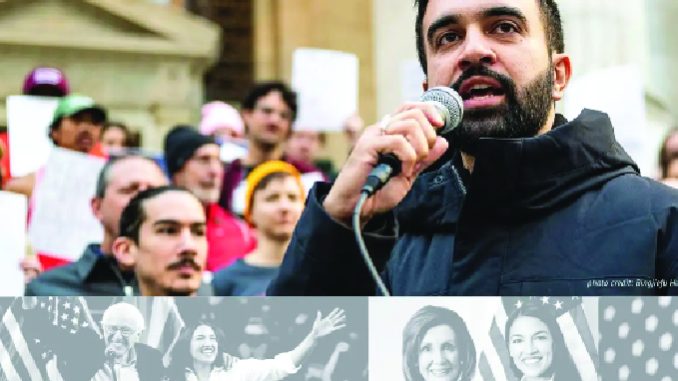
This article was originally published on 5 August 2025, shortly after Mamdani won the Democratic nomination. We are publishing it alongside a companion piece by Frank Merritt, from the CWI’s International Executive Committee, which expands on what Mamdani reflects and the attitude socialists should take towards the Mamdani campaign.
The victory of Zohran Mamdani in the Democratic primary for Mayor of NYC reflects the popularity of demands highlighted in his campaign for “A City That Everyone Can Afford.” The win also shows the hunger for an alternative to corporate politics. Mamdani’s campaign didn’t just highlight demands to address the cost of living crisis, but also was clearly opposed to the Israeli government’s genocidal war on Palestine. Mamdani, a member of Democratic Socialists of America, is the latest “DSA Democrat” to make headlines. Some may see his campaign as a model for how to confront the Trump administration, the right wing, and more conservative Democratic Party politicians. However, since DSA’s growth following Sanders’s 2016 campaign, dozens of “DSA Democrats” have won primary and general elections. Unfortunately, not only the DSA Democrats, but also the whole history of left-wing efforts to use or reform the Democratic Party, demonstrate that there’s no way forward for the working class through the Democratic Party.
The Mamdani Campaign So Far
Mamdani, a Democratic Party NY State Assemblyman since 2021, beat out former NY governor Andrew Cuomo 56% to 44%, running on a campaign platform that called for a rent freeze, free buses and childcare, and increased taxes on corporations and the wealthy. Mamdani is a self-proclaimed democratic socialist and actively campaigned on opposing the genocide. He’s running “to make New York City affordable,” and his demands appeal to working people.
Mamdani has faced heavy attacks for his support for Palestinians, with charges of antisemitism. He is also having to address attempts to discredit him and de-legitimize his ideas through redbaiting attacks, with claims that increased taxes on the rich will drive away businesses and jobs.
Corporate interests and the wealthy are spending record amounts to defeat Mamdani. Fix the City – the largest super PAC ever formed to fund a NYC mayoral campaign – raised a record $25 million to back Cuomo in the primaries. It included $1 million from DoorDash and $8.3 million from Michael Bloomberg. Billionaire hedge fund manager Bill Ackman also contributed $500,000 to the super PAC and is now promising a virtual blank check (“hundreds of millions of dollars”) to anyone who can crush Mamdani.
Democrats Oppose Mamdani’s Program
Despite winning the Democratic Party nomination, Mamdani is facing challenges from his own party. Not only is he running against Republican candidate Curtis Silwa in the general election, but he now also faces both current NYC mayor Eric Adams as well as his defeated primary opponent Cuomo. Both Adams and Cuomo are running as independents, and both carry major scandals and corruption charges that include bribery and sexual harassment. Adams has received support from Trump, and businessman Fernando Mateo is calling on Trump to tell Silwa to step down and give Adams the Republican ticket.
The corporate interests in control of the Democratic Party seek to influence or restrain Mamdani too, as they also try to take him out. The Democrats could very well choke off Mamdani’s access to volunteers, funds, and other resources that the party normally provides to candidates’ campaigns, redirecting those to preferred candidates. Ironically, DSA Democrats often justify running on the Democratic ballot because of access to these very resources that get denied to any candidates straying from a pro-corporate line.
Both the Democratic and Republican parties could also collaborate to back a different candidate. DSA Democrat India Walton’s run for mayor of Buffalo in 2021 was driven into the ground when the Democratic and Republican parties collaborated to defeat her through a write-in campaign for the incumbent Democrat Byron Brown. This was despite Walton having defeated Brown in the Democratic primaries.
While Mamdani has received endorsements from Alexandria Ocasio-Cortez (AOC), Bernie Sanders, Elizabeth Warren, and Jamaal Bowman, many are withholding support, including Chuck Schumer and Hakeem Jeffries. NY Governor Kathy Hochul has congratulated other Democratic Party primary winners, such as Rochester Democratic Party Mayor Malik Evans and Democratic nominee for Albany Mayor Dorcey Applyrs, but has not backed Mamdani. She opposes Mamdani’s plan to increase corporate taxes and impose a 2% income tax on millionaires. In response, Mamdani has stated that he’s “excited to work together” with Hochul and that he appreciates that “she is laser focused on affordability.” Of Schumer and Jeffries, Mamdani said “I’m looking forward to sitting down with both of them because ultimately, what we see in this primary election is an example of how we can also start to unite our party and build our party, such that we can take on and defeat this right-wing authoritarianism we’re seeing in Washington DC.”
Why is Mamdani seeking to run for NYC mayor under the Democratic Party ticket? If Mamdani believes he can change the Democratic Party, he will soon learn better. The individual Democratic Party politician can’t be separated out from the Democratic Party as a whole. As the experiences of other DSA Democrats have shown, the party’s corporate interests and funders have the final say.
Mamdani’s Track Record as a “Socialist” in the Democratic Party
Mamdani started his political career in the Democratic Party and in the Muslim Democratic Club. He cut his teeth volunteering for Ali Najmi’s Democratic Party NYC City Council campaign in 2015 (Najmi is now Mamdani’s election attorney). Mamdani then went on to work as a paid canvass director for Khader El-Yateem’s Democratic City Council campaign in 2017, which was the first NY-DSA endorsed campaign. Following that, Mamdani worked as campaign manager for Ross Barkan’s Democratic Party run for State Senator in 2018, and then field coordinator for Tiffany Cabán’s Democratic Party run for Queens District Attorney in 2019. In 2019, Mamdani ran against then-10-year-incumbent Aravella Simotas in the Democratic primaries for Assembly District 36, campaigning on demands for rent control, guaranteed housing, public ownership of utilities, and increased taxes on the rich. He promised to take over Con Ed and National Grid and to run them as state agencies. He won that primary and subsequently won the general election uncontested in 2020. The following two elections, he also ran unopposed by any other candidates, Democratic, Republican, or otherwise. This shows Mamdani was tolerable as a State Legislator for the corporate backers of the duopoly, the Republican and Democratic Parties.
Mamdani is one of the 9 DSA Democrats in the so-called “State Socialists in Office” bloc that first got started when Julia Salazar was elected in 2018, followed by another 5 DSA Democrats in 2020 (Mamdani, Jabari Brisport, Marcela Mitaynes, Phara Souffrant Forrest, and Emily Gallagher). While the group has raised the need for universal healthcare, “good cause” evictions, and publicly-owned renewable energy utilities, there has been very little progress achieving these demands.
In the 5 years Mamdani’s been in office, his efforts to see through his campaign demands have been limited to support for bills and legislation. He supported the Good Cause Eviction Act which passed in 2024 that limited justifiable rent hikes to inflation, with a maximum cap of 10%, and that allowed tenants to challenge evictions in court and prevented “without cause” evictions. He also opposed the 2023 Con Edison rate hikes authorized by the Public Service Commission which were expected to raise average electricity and gas bills by $64/mo by 2025 (the state still approved a rate increase of 12% over 3 years). He supported the Build Public Renewables Act that tasked the New York Power Authority with making the electrical grid 70% renewable-energy-sources by 2030. That effort has now been delayed by 3 years.
These efforts point in a positive direction but haven’t made any progress on universal healthcare or public ownership of energy utilities. In terms of rent and energy costs, a 10% rent increase and a 12% utility bill increase on top of existing extremely high rents and utility bills reveal the severe limits of staying within the Democratic Party playbook of lobbying and legislation instead of building mass movements to win reforms. So far, Mamdani hasn’t proved so much the Democratic-Party-disrupter he now claims to be, limiting his legislative work to tinkering around the edges of what corporations are willing to give. His strategy is that of meetings and negotiations with “establishment” Democrats and with corporations, instead of mobilizing working people to force a progressive agenda through whatever obstacles the capitalist law-making process throws in the way.
Mamdani has expressed admiration for “establishment” Democrats like Michelle Wu and Bill de Blasio as politicians. Wu, the mayor of Boston, ran in 2021 on slashing the police budget and abolishing the police intelligence center. Since then, she’s supported more funding for both, including a proposed police budget of over $480 million in 2026, and vetoed proposed cuts of $3 million. Despite his populist campaigning, De Blasio received huge donations from corporate forces, catered to developers, supported “Broken Windows” policing, and collaborated with ICE during the first Trump administration. Mamdani, who called for defunding the police in 2020, is now promising not to defund the police, but to keep it at current levels (De Blasio also expressed he’s not worried about the police being defunded by Mamdani). Mamdani also cites Republican NYC mayor Fiorello LaGuardia (1934-1945) as an example of a “socialist” he takes after, despite LaGuardia opposing bargaining rights for unionized public-sector workers, including members of the Transport Workers Union of America.
AOC has stated that “it’s possible” to be a democratic socialist and a capitalist, and that “you can be in the private sector and be a democratically socialist business.” On the campaign trail, Mamdani said he didn’t believe billionaires should exist, and when pushed on what he meant by that, he replied “I look forward to working with everyone, including billionaires, to make a city that is fairer for all of them.” Mamdani’s proposal for “socialism” is in line with that of other DSA Democrats before him. It’s one that doesn’t challenge capitalism.
The DSA Democrat: A Failed Experiment In Reforming the Democratic Party
“I am a Democratic socialist. The first word in that is ‘Democrat.’” -India Walton
The Democratic Party is seeing its lowest level of support (29%) since 1992. Mamdani’s campaign seems to have convinced more voters than usual to vote in the NYC Democratic Party primary, which is a closed primary system that only allows those registered with the party to vote in that party’s primaries. 37,000 people registered to vote in the 2 weeks before the Democratic Party primaries, up from 3,000 in 2021; and this primary saw the largest voter turnout for a mayoral primary since 1989 (1,026,783 total votes cast). The largest age groups that voted in the Democratic Party primary were those 25-29 and 30-34. There were limits to Mamdani’s support though: Mamdani led by 10-13 points among areas where income is over $62,800, while Cuomo led by 13 points among areas where income is lower than $62,800. Mamdani also lost the black vote in the primary by almost 20 percentage points to Cuomo, who won over 51% of black voters.
Still, less than 30% of the 3.3 million registered Democratic voters in NYC even came to the polls, reflecting the historic unpopularity of the party of Clinton, Obama, Biden, and Harris. In NYC, one in five registered voters is unaffiliated, and half of those are under the age of 40. A February 2025 ad by NY DSA urged voters registered as Independent to change party affiliation to Democrat in order to vote for Mamdani in the primaries.
DSA Democrats have helped the Democratic Party shepherd many working people back into voting blue by undermining efforts to build an independent political party and neutralizing socialist demands. Despite being “progressive,” their efforts to reform the Democratic Party have failed and their own track records show it’s impossible to separate the individual politician from the party they’re in. A member of the DSA, Mamdani is echoing AOC’s 2018 campaign, calling on voters to “come home to the Democratic Party.”
DSA Democrats say that the way to make change is only through elections, political dealmaking, compromise, etc. – the same as “establishment” Democrats. When their legislation is blocked by other politicians, they use it to argue the need to get more involved in the Democratic Party, elect more Democrats to replace Republicans, or mount primary challenges to “establishment” Democrats. Ultimately, the DSA Democrats don’t want to mobilize the working class in case the working class moves beyond the limits that the “establishment” Democrats try to impose, fearing that the “establishment” would then punish them. Instead of challenging the capitalist class and its two political parties through independent, working-class electoral campaigns and building working-class power for their platforms through mass movements, DSA Democrats have no problem with channeling working-class demands toward a corporate political party.
Mamdani’s aim is to recruit progressive and left activists into Democratic Party politics in order to try and reform the party. The Independent Socialist Group (ISG), as well as many other groups and individuals on the left, have pointed out that all similar efforts have failed. Mamdani is part of Democratic Party efforts not only to appeal to disillusioned working class people for their votes, but also to place Democratic Party politicians and their operatives in the leadership of anti-Trump and anti-ICE protests, in order to contain them and prevent the protests from going any farther than “Vote Blue, No Matter Who” in the next election. Every activist brought into the Democratic Party sphere of influence stands a good chance of not coming back out, transformed into yet another office-holder or operative for a thoroughly pro-capitalist political party.
Many DSA Democrats have shifted rightward after being elected. In 2020, in the wake of the BLM mass protests, DSA Democrat Andre Vasquez on the Chicago City Council voted for legislation giving $1.69 billion to the Chicago Police. In 2021, the “force the vote” campaign called for “The Squad” to withhold their votes in the Speaker of the House election in order to force a vote on Medicare for All. Pelosi needed their votes, and so “The Squad” had leverage to make demands. Instead they squandered their leverage and fell in line with the rest of the Democrats. Also in 2021, DSA Democrat Jamaal Bowman voted in favor of $1 billion of military aid to Israel. In 2022, Julia Salazar sponsored a bill to create the NYCHA Preservation Trust. More than one hundred and forty NYC DSA members signed a letter opposing the bill for “potentially opening the door to privatization of NYCHA assets.” In 2022, three DSA Democrats in Congress voted in favor of blocking strike action by railroad workers. AOC has become a major fundraiser and booster for the Democratic Party. Recently AOC voted against an amendment to the defense spending bill which would have blocked $500 million in military aid to Israel.
Squad members AOC, Rashida Tlaib, Ilhan Omar, Ayanna Pressley, and Bernie Sanders (a Democrat by every measure except, at times, name) supported Biden’s presidential run in 2020, and all but one endorsed Harris in 2024. They weren’t deterred by Biden and Harris’ support for Israel’s genocide of Palestinians, by their anti-immigrant policies or increasingly militarized policing. None have left the party. After Sanders failed to win the Democratic presidential nomination in both 2016 and 2020, he campaigned for warhawk Hillary Clinton and 1993-Crime-Bill-author Biden. More recently, Sanders was part of the unanimous Senate approval of Marco Rubio as Trump’s Secretary of State.
Socialists running campaigns in the Democratic Party is a nonstarter, a dead end. The Democratic Party will work against Mamdani if he doesn’t moderate his demands, or Mamdani will cave to the huge pressure that the party will exert in order to move him to the right. No matter what, it is key that working class people and organizations in NYC start building mass movements to force through the demands that are at the root of Mamdani’s popularity. The Democratic Party ballot line is not an advantage, as some think, but a disadvantage for those who want to fight for changes beyond the limits of what a corporate party will accept.
Mamdani’s campaign already includes a former spokesperson for Hillary Clinton and digital director for Barack Obama, as well as a former design director for Sanders and current creative director for AOC. Since the primary election, Mamdani has hired Jeffrey Lerner, a long-time Democratic Party establishment operator as the communications director for the general election campaign. Lerner has worked for Cuomo, for the DNC, and for Laphonza Butler, the former SEIU president who worked for Uber to fight against ride share drivers trying to organize a union.
Not only has he employed these longtime Democratic Party staffers: Mamdani has also organized a closed-door meeting with 150 corporate executives in an attempt to cater to their concerns and has made numerous statements saying he is open to working with the NYC Democrat political establishment. Claiming that this is the way to achieve the demands he campaigned on, Mamdani is adopting the failed strategy of AOC, Sanders, and generations of left activists who thought that there is a way forward through the Democrats.
How Can Socialists Run Electoral Campaigns?
The NYC Democratic mayoral primaries shows the strong potential for independent campaigns with progressive demands, including opposition to the genocide. Working people need a way forward to solve the cost-of-living crisis, poverty wages, imperialist wars, deportations and ICE raids, and the crackdown on democratic rights. There’s huge potential for this if it can be organized on an independent political basis. Mamdani’s primary win debunked some conventional wisdom about this potential.
For one, Mamdani’s campaign, which opposes genocide in Gaza, showed that the American Israel Public Affairs Committee and other pro-Zionist groups don’t have a stranglehold on politics. With no end in sight for the devastation of Palestinians in Gaza and the West Bank, many oppose the US government’s support for Netanyahu and want an arms embargo and an end to military aid to Israel. The idea that being anti-genocide means being antisemitic is not holding water. But Mamdani’s campaign begs the question: why run a campaign within a political party that supports genocide?
Secondly, Mamdani’s campaign was able to reach parts of NYC that voted for Trump, winning 30% of the districts that went for Trump in 2024. Progressive and left demands that tackle the affordability crisis through taxes on corporations and the rich to fund public services like transit and childcare convinced many to come out and vote. An independent political party can cut through both corporate parties to mobilize those disillusioned or checked out, including people registered as independent or even Republican who did not vote in the Democratic Party primaries in NYC.
Mamdani’s campaign field director claimed they used “40-50 paid canvassers and 30,000 volunteers” to door-knock. Mamdani went from polling 1% in February against Cuomo’s 33% to 32% against Cuomo’s 35% in June. These paid and volunteer canvassers could have been organized for building a mass movement for a $30 an hour minimum wage campaign that could have complemented and enhanced an independent electoral campaign. A socialist or progressive campaign needs to be building mass movements before, during, and after an electoral campaign. It’s not enough to talk about progressive demands and promises to get legislation passed once in power. Most likely, these attempts at passing bills and laws will fail because the corporate-controlled Democratic and Republican parties fundamentally oppose working-class interests and won’t give in to our demands without mass pressure.
For socialists, election campaigns, win or lose, should be a tool towards the goals of building working-class power, strengthening working-class organization, and winning crucial demands. Electoral campaigns should be part and parcel of a mass movement for a few key demands or issues. Even a run for office that doesn’t initially succeed, can be an opportunity to organize a mass movement for the main demand(s) of the campaign and to help build organization for the next campaign. A recent example of building an election campaign around a key demand was the 15 Now campaign, centered in Seattle, for a $15/hr minimum wage. The 15 Now campaign was built and organized using working-class tactics, then used the electoral campaign of independent socialist candidate Kshama Sawant for Seattle City Council to strengthen the campaign. After winning the election, the 15 Now campaign was well-positioned to force the Seattle City Council to support the legislation for 15 Now, even with only a single independent socialist on a hostile Democratic-majority council.
We Need a Workers’ Party and Socialism
The biggest obstacle to building working class political power in the United States is our lack of a workers’ or labor party, and the ongoing effort by “leaders” of the labor movement and “left” that constantly push protests and working-class movements back towards the Democratic Party. ISG calls on Mamdani to break with the Democratic Party and to run independently. To win his campaign’s demands, Mamdani should leave the Democratic Party and run on an independent basis, organizing with unions, working-class community organizations, left groups, and progressive activists. The immediate goal should be to not only win the mayoral election but to lead an all-out effort to win rent control and a $30/hr min wage in NYC by organizing a mass movement to fight for these demands.
An independent, socialist mayoral campaign could lead to other working-class electoral campaigns, independent of the Democrats and Republicans, and could mobilize workers to win demands and help build the foundation of a workers party. A workers party could be everything the Democrats are not: a help instead of a hindrance to working people’s living standards. Organizing election campaigns with the goal of continuing beyond election day, pooling resources and recruiting working-class members, training activists, assisting union drives, and community organizing are all part of beginning a movement for a workers party. A workers’ party, even a serious start towards one, could organize real opposition to Trump and the far right–adding power to the anti-ICE protests by helping to organize strike action and other working-class action for immigrant rights and working-class unity. A workers’ party can bring broad sections of the working class together and unite the labor movement with protest movements like those against ICE and the genocide, movements for LGBTQ rights, universal healthcare, and public housing to end the housing crisis. A political party for working people can take a major step forward in the US for a mass socialist movement and the fight for a socialist world. “Socialists” in the Democratic Party limit their demands to fine-tuning the boundaries of an economic system which is tearing up nature and society through the daily exploitation of workers and the environment for the private profit of a few. This is not what socialists stand for. We can’t work with corporations, the billionaires, and their political parties to build socialism. Socialists organize for a world run by and for working people, where the working class collectively and democratically owns, runs, and operates the economy in order to meet the needs of all.
Peggy Wang is a member of Massachusetts Teachers Association / Association of Professional Administrators (personal capacity)
Nick Wurst is a member of SMART-TD Local 1473 / Railroad Workers United (personal capacities)