
In the new Romania of acute austerity, the government seems overwhelmed by inner division while locked in a conflict with the judiciary. At the same time, important student struggles have taken place, with mixed results.
A general education workers’ struggle seems to have died stillborn. The union bureaucracy pushed a “boycott” strategy (going to school without actually working, to be done on an individual basis) and was not effective, leading to demoralisation.
Attacks against students, such as cuts in scholarships, led to one protest organised by the formal students’ organisations, known by most students as “bootlickers”, with links to the university leadership.
In such a climate, the prospect for a strong movement united between students and workers was postponed until the end of the school year (June) during the exam season, considered more timely for a strike.
When students returned to class a few weeks ago, a militant student movement looked unlikely. But the powder-keg was ready to explode in a faculty at the Babes Balyai University (UBB) in Cluj. The Faculty of Mathematics and Computer Science (FMI) has been lacking its own building for years now. While students were rightfully displeased with the fact they had to run to multiple locations for one week of studies, no one requested to be moved to Chinteni – a village located one and a half hours by bus from the city of Cluj.
Cluj students struggle against relocation
Nearby Chinteni village a site called Lomb hill, where buildings were constructed. Known now as the CREIC and TEAM complexes, they became the property of the Cluj town hall through questionable means. To not draw attention to this fact, Emil Boc, the long standing national liberal mayor of the city, struck a deal with Babes Balyai University. This couldn’t have been very hard given the fact Daniel David, the current Education Minister (nicknamed by education workers, “the gravedigger of education”), and still de-facto rector of UBB, is also part of the same National Liberal Party.
The result of what was quickly understood as a real estate fraud was that the FMI got a highly dysfunctional building, with faulty walls, no place to buy food or other necessities, in other words, no proper conditions. On top of that, the somewhat unstable soil it was built on posed a danger of a landslide. But probably by far the most outrageous aspect is the building’s location away from the city, forcing students, professors and other staff to take three hours just to get to and from the place.
This situation quickly lead to a huge discontent, which boiled over into what became known as the “boycott”. Taking inspiration from the (pre-university) education workers, the students started a students’ strike, refusing to attend any classes at CREIC. At the height of the action, an overwhelming majority of the students, over 80%, refused to go to school in protest.
The most radical amongst them quickly linked their situation as part of the broader attacks against the working class and the youth, showing an unambiguous anti-capitalist consciousness.
In late August, an informal group called ‘The Students’ Committee of Cluj’ (CSC) was formed as a front for all students interested in attending the union marches and protests that were about to take place in early September against austerity measures in education. Initially started by the local branches of a few leftist organisations, and left-leaning students, this Committee quickly became the rallying point for the anti-CREIC movement.
Student members of the CWI have been involved with the group since the beginning, raising the need for a militant students’ alternative to the “official” students’ organisations, without any links with the university authorities’ leadership. We also focused on students’ energy in the direction of the working class struggle, with strikes being the strongest weapon the youth and workers have against austerity and the bosses inside and outside of the university. We emphasise the need for unity with every worker in the university, an orientation to the broader workers’ movement, and that any cuts are an attack against us all.
After the beginning of the student’s strike during the first week of university, the mood inside of the Students’ Committee was going in favour of such a militant alternative, that should take roots in the city, gathering students regardless of university towards a common struggle against austerity and for better conditions.
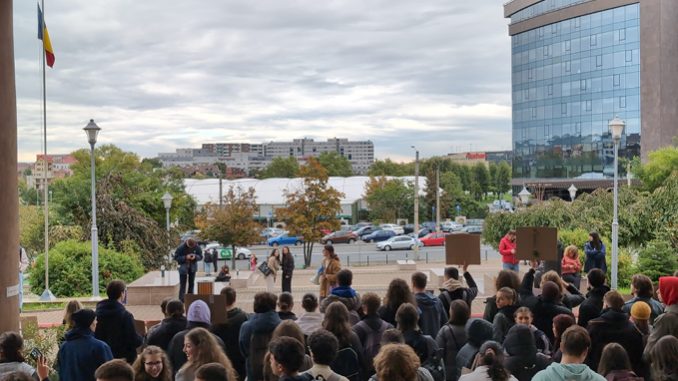
Despite attempts from the “official” student organisations to calm down the movement from within, the majority of people who attended the protest on Wednesday, which was organised by the CSC, chanted slogans against Daniel David, as well as, “We won’t fold, we’ll boycott”. The protest itself was declared in support of the professors who disagreed with the new location, in the hopes it will encourage them to vote for classes to cease there.
Instead of supporting this protest, the “official” student organisations organised a separate protest the next day, without even a mention for the other one, in an attempt to side-line the striking students. The day of the protest was not on Friday, the same day the austerity Prime Minister, Ilie Bolojan, was present in the main university building for an official meeting. As a response to this, at the Wednesday protest, a speaker asked everyone present to join the protest on Thursday to make sure the movement’s demands are not misrepresented. Later that day, the protest hour was delayed by two hours, creating pointless confusion.
At the second protest, these organisations barely tolerated the same slogans listed above, with the striking students having to shout down the leader of one of the organisations, who led the chanting, trying to keep control over the flow of the protest. The message however got through very clearly; the students are against the austerity education minister, and they would not cease the “boycott”. For this reason, the next Saturday, the third protest took place, specifically against Daniel David, who was visiting the university for a cultural event. This was advertised as a ”debate”, but turned out to be a monologue.
A student militant, Vlad, gave us his opinion of Daniel David: “On Saturday, the former rector of our university, who is now the education minister, came to our city and after three hours of protest we managed to get an audience with him, behind closed doors and with no press. But despite this ‘negotiation” out of nowhere the NGO linked to David’s party, posted an instagram story. In my opinion, they are like the university HR department, ‘independent’ of them only on paper. The same political party has influence in the university and this NGO – these are open secrets. ”
The first step towards union-inspired students’ organisations was made the following week, with the declaration of ‘The Math and Computer Science Students’ Committee’. During its founding meeting, a police car was seen patrolling nearby, and some university security workers asked the students’ if they had an “approval” for the meeting. Being wage workers hired for small wages by the university, they left us reassured that the meeting would be quiet. Despite this, the fact that the university leadership considered the meeting a threat shows that even the idea of a real opposition, which they can’t buy or control, has the potential to mobilise the student masses, and force the will of the majority against the profit interest.
All these actions led to an extremely polarised vote on the question of abandoning CREIC. One of the “official” student organisations held a poll for students. The overwhelming majority of respondents (approximately 1100 out of 1500) voted for a complete abandonment of the building and for a return to classes in the city.
Following this, the FMI leadership finally folded, announcing they would move every class back in the city “in due time”. Despite the fact this was considered a victory by most students, the CSC remains vigilant, calling on the striking students to keep staying at home if an online alternative is not provided for the classes still held at CREIC.
For us, student members and supporters of the CWI, it’s clear what needs to be done further: building the Committee as a union-like militant students’ group, united with similar struggles at the national level, like the protest against mandatory attendance taking place in Brașov this week, with which discussion channels have already been opened.
A national organisation of militant students would have to build strong links with the working class movement; marching in solidarity with every workers’ strike, pushing for the unions to demand higher scholarships, better conditions and an end to the austerity that affects all of us!
Solidarity with similar movements in the Balkans, and a clear position against corporate interests, and the logic of the market in the universities, and fighting for democratic student and worker rule in higher education, are just some of the goals such a national organisation should adopt.
Aided by the experience of our comrades from Socialist Students in England and Wales, and Jugend für Sozialismus in Germany, the CWI supporters in Romania will continue to play an important role in fighting for such an organisation.
Our tradition of orientation towards students and more importantly young workers is crucial for the revival of the workers’ movement as the force that can get rid of austerity and poverty.
Education is never safe while the profits of the few overrule the needs of the majority. Universities shouldn’t be ruled as an elitist institution following business interests, but by the students’ and employees that make them run, and made as accessible as possible. For this we need an alternative to capitalism, a socialist world ruled democratically by workers and youth.
Update, 9 March 2026: The following article was written in October 2025. At the time CWI Romania, as well as few other people who shared our position, were hopeful of the direction the Student’s Committee could develop in. By the end of November it was clear it instead developed in another direction completely, due to a rejection of democratic political discussion in favour of a false unity around unclear possitions. CWI Romania left the CSC back in December. We remain open to working with the CSC, on a principled basis, provided they depart with “civic activist” methods and start orientating towards students from a working class background as well as the union rank-and-file.