
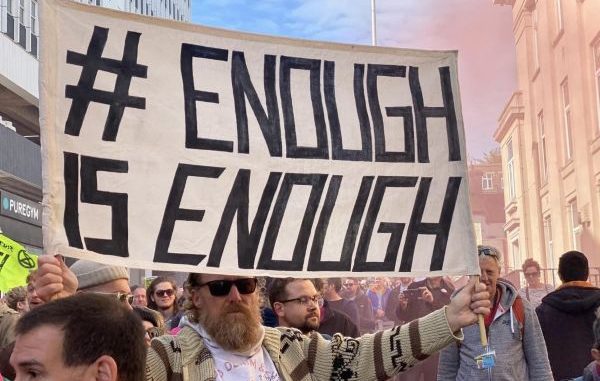
The formation of ‘Your Party’ was announced just five months ago. Now, thousands are preparing for its founding conference in Liverpool 29-30 November. The conference is likely to involve around 4,000 attendees, short of the 13,000 originally planned.
This smaller scale conference reflects that some of the shine has rubbed of Your Party since its first announcement. Only around 50,000 have actually joined, compared to the 800,000 who originally joined its mailing list.
Disagreements between those in the leadership, including between Jeremy Corbyn and Zarah Sultana, have become very public. A stark example being that Jeremy and Zarah will speak at rival pre-conference rallies.
The huge initial Your Party enthusiasm confirmed what the Socialist Party has been saying since Jeremy Corbyn was ousted from the leadership of the Labour Party after the 2019 general election; a new political voice of the working class would be extremely popular. We raised that such a party could quickly become the biggest party in Europe. However, despite its potential, as it stands, the founding conference will not launch Your Party as the party of the working class that is needed.
Unfortunately, neither those organised in support of Jeremy or Zarah are calling for what is needed to establish Your Party as a workers’ party. Zarah’s call for socialist policies and increased members’ democracy is positive. Equally, it is undeniable that Corbyn has huge authority from his time as Labour leader.
Many of those who signed up to Your Party will have also been mobilised by Corbyn 1.0, either voting for him, or joining the Labour Party because of his anti-austerity programme. At the height of enthusiasm for it in the summer, one poll found Your Party polling first among 18 to 24-year-olds, who would have been 14 years old or younger when Corbyn first became Labour leader.
The legacy of Corbynism is really from the demands which Corbyn stood on in the 2015 leadership election and the manifestos from the 2017 and 2019 general elections. Demands such as bringing in a decent minimum wage, nationalising the utility companies and for free university education. It was this programme which mobilised millions of people to support and vote for Corbyn’s Labour.
That’s why a clear anti-austerity programme which challenges the dire situations faced by big sections of the working class today, should be central to Your Party.
May elections
In May 2026, thousands of council seats will be up for election, including all in London, as well as seats in the Welsh and Scottish parliaments. Your Party should stand widely, and against austerity – pledging that its candidates will fight for councils to set needs-based budgets, a policy supported by local authority workers in the three largest council trade unions.
Standing for needs-based budgets would mean committing not to pass on any further austerity measures, and instead demanding that central government coughs up the money needed to fund services. Successive Tory and now Labour governments have presided over slashed local government funding.
When Corbyn was Labour leader, the fact that Labour councils around the country continued to close libraries, sports facilities, and dismantle important services undermined Corbyn’s anti-austerity message.
Unfortunately, such a bold stand is not clearly outlined in the Your Party ‘organisational strategy’ document which attendees are set to discuss at the founding conference. The document says “Your Party will seek to support all Independent socialist candidates.” To take advantage of so-called ‘fair media coverage’, which entitles parties to an election broadcast and the chance to argue for fair representation in ‘legacy media’, Your Party candidates need to stand under a single electoral registration; that does also allow for different descriptions. It would make it harder for the establishment media to ignore the stand. Appearing as simply ‘independent’, or as part of a local independents group, for example, would not cohere a nationwide stand against austerity.
Trade unions
Increasingly there is a discussion taking place among trade unionists regarding their union’s relationship with the Labour Party, questioning, ‘why is our union supporting a party and candidates which attack our members?’ How can that discussion be ignored when there are examples like Birmingham Labour council’s attempt to slash £8,000 from bin workers’ pay? There, the council has hired scab labour, fought in the courts to prevent bin workers picketing and spent hundreds of thousands fighting this action. It was because of Labour’s attacks on the Birmingham bin workers that Unite conference voted overwhelmingly, in a motion put forward by Socialist Party members and supporters, to reexamine its relationship to Labour.
There is a glaring contradiction, between the policies of Labour in government and the demands of most trade unions. At this stage, the majority of trade union leaders either defend their link to Labour, arguing that at least they get a seat at the table, using the threat of Reform to argue for continued support for Labour. Alternatively, facing the growing anger at Labour from their members, they argue that trade unions should ignore politics and simply fight industrially, or that rather than being affiliated to a party, it is best to seek support from any politician willing to support them. But none of these positions answers the crucial question of a political voice of the working class.
And so far, those at the top of Your Party have assisted the trade union leaders in ignoring the issue. As the Your Party founding documents stand, a trade union would have more rights in the Labour Party of today than it would in Your Party – even after the gutting of trade unions’ collective voice in Labour.
Your Party should instead make real the assertion in its political statement that it will be a party with the “working class at its heart”, by allowing for trade unions – locally, regionally and nationally – to have a collective democratic voice in Your Party. It should be approaching the executives of the trade unions asking for a discussion about how Your Party politicians can best fight in their members’ interests.
Socialist Party members have been part of organising discussions of trade unionists in 11 different unions, to discuss how to fight for the unions to take steps towards building their own political party.
There are those who argue that right-wing union leaders would use affiliation to hold back Your Party. But the right-wing trade union leaders were not able to hold back the wave of strikes in 2022-23. It was that wave of industrial action which has most recently won concessions from the then Tory austerity programme.
There are many examples of workers holding their leaders to account, pushing for the action needed. Your Party was announced just three days after a meeting of over 1,000 trade unionists preparing the fight for a new party in their unions. This was not a coincidence; the collective pressure of the workers’ movement was being felt by Corbyn and Sultana, who both addressed the meeting.
However events in Liverpool transpire, the struggle for a new mass workers’ party has begun. By basing itself on the trade unions as the existing mass organisations of the working class, Your Party can develop into the new mass workers’ party needed, which would be a huge step forward in the struggle for socialist change.