
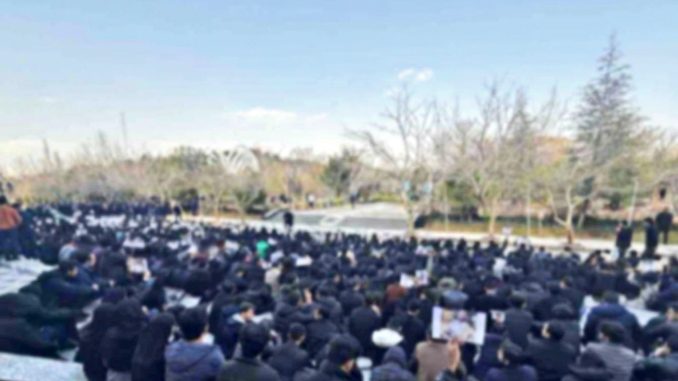
Iran started the year with a mass uprising as its long-standing economic crisis collided with popular anger. While the scale of repression has intensified, the decisive question is whether resistance can develop the structures and political alternative needed to confront an entrenched authoritarian state.
The recent protests arose from a prolonged social crisis that has steadily narrowed the space for survival. Inflation, unemployment, and permanent insecurity have become structural features of life, while sanctions have deepened volatility without so far weakening the regime’s coercive capacity. These sanctions, imposed by imperialist powers, have amplified inflation and scarcity, hitting ordinary people hardest while giving the regime a pretext to blame external forces, and a tool for social control. The decisive moment came with the collapse of the currency, which transformed chronic hardship into immediate social emergency. This rupture became visible in the bazaar, not as a unified social actor, but as a space where merchants and wage workers alike were pulled into crisis, signalled that even mechanisms traditionally stabilizing the regime were failing.
The protests that followed took a decentralized and uneven form, shaped by local conditions rather than a unified national framework, revealing cracks in system’s ability to guarantee basic economic stability. Unrest spread persistently across regions and social layers: smaller cities and peripheral regions mobilized decisively, while universities and working-class neighborhoods became centers of resistance. The protesters were once again united by rejection of the regime rather than a fully formed political program. In response, the regime brutalized protesters with communication blackouts, indiscriminate violence, and aggressive repression extending into hospitals and private spaces. Horrifying numbers of tens of thousands of dead and incarcerated activists have been reported. This signals a state willing to mercilessly defend its power.
Political confusion
What threatens the movement is not suppression alone, but political confusion. The authoritarian regime sustains itself through a permanent apparatus: armed forces, prisons, propaganda, and a clear chain of command. Figures like Reza Pahlavi, son of the ousted Shah, claim transitional leadership, without offering democratic structures or, obviously, a break with the capitalist system which they support. The working and poor masses should trust their own power and fight for their independent organisations – as difficult as that is under the present conditions. The regime might consolidate its control for a time, but that won’t last.
A socialist way forward must be built around the independent political power of the working class. This means for example the formation of democratically elected workers’ committees and councils (shora) in workplaces, neighborhoods, and universities, capable of coordinating struggle and taking collective decisions. Unified regionally and nationally, such organs can organize general strikes to develop the struggle and appeal to the lower ranks of the state apparatus to break with the regime. This could paralyze the regime economically and politically, paving the way for its overthrow.
A revolutionary socialist party, which needs to be built urgently, could find a big echo in such committees as the aim must be to expropriate political and economic power from the ruling elite and place it under the democratic control of workers and the oppressed in order to guarantee a decent life to all. International solidarity should strengthen this process by opposing imperialism while materially and politically supporting self-organization of workers in Iran.