
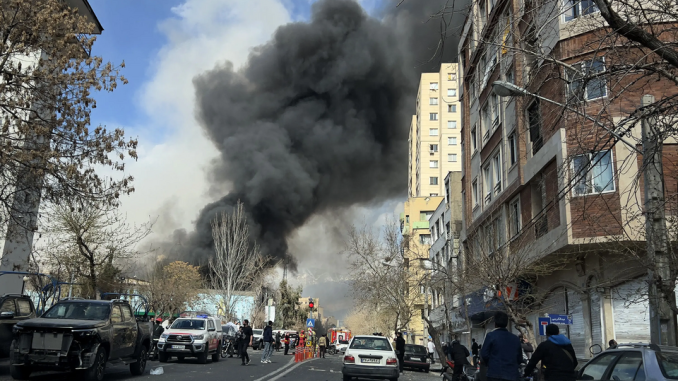
The onslaught against Iran, soon followed by Israel’s renewed war in Lebanon, has witnessed another round of lying and hypocrisy from the imperialist powers.
For a second time in less than a year, Netanyahu and Trump have started a war during a pause, not a breakdown, in negotiations with Iran.
Other imperialist powers have criticised this “war of choice” not from a principled viewpoint, but because they view it as an unnecessary step which opens great dangers for them on many fronts domestically, regionally in the Middle East, and globally.
This division is why Trump has, so far, failed to form a coalition of imperialist powers to provide warships defending shipping in the Persian Gulf and Strait of Hormuz. The other powers fear being dragged into a longer and extremely hazardous conflict and do not want to suffer casualties, which would be unpopular, in helping Trump sort out his “war of choice”.
But this war is not unique, it is the latest in the long series of imperialist military interventions and wars in the Middle East. For years, different imperialist powers, particularly the US, Britain and France, have sought to control the region by force, sanctions and bribery. This history plus the cynical way this war was started, and the bloody background of the over 75,000 killed by Israeli action in Gaza, has contributed to majorities in many countries, including in the US, opposing this war.
Continuous imperialist hypocrisy
Facing worldwide opposition to starting this war, the Trump and Netanyahu administrations have sought to justify their actions on the basis of the repressive and brutal character of the Iranian regime.
Netanyahu regularly speaks of the “terrorist regime” in Iran, yet it is clear that he does not condemn all ‘terrorists’. His attitude to the right wing and bitterly anti-Palestinian terrorists of ‘the Irgun’ is very different. The Irgun was the armed wing of the ‘Revisionist’ Zionists who fought both the British colonial authorities and Palestinians in the 1940s. The ‘Revisionists’ originally argued for an Israel that included Palestine and what is today Jordan, dropping their demand for Jordan after the 1967 war.
Nearly 80 years ago, the Irgun blew up the King David Hotel, then the British military headquarters in Palestine, killing 96 people. Sixty years later, Netanyahu attended the 2006 celebration of that attack. Netanyahu’s attendance was not surprising as Begin, Irgun’s leader, was one of the co-founders in 1973 of the movement that later, in 1988, became his party, Likud. The holding of the 2006 celebration led to the British Ambassador to Israel stating: “We do not think that it is right for an act of terrorism, which led to the loss of many lives, to be commemorated”. Maybe this year Netanyahu will miss any 80th anniversary celebration.
The British Ambassador’s complaint was only because Netanyahu and co were celebrating a terror attack that had British casualties. Britain and most other imperialist countries are effectively silent on the Gaza massacre, considering it a ‘justified’ response to 7 October, or now on Israel’s latest invasion of Lebanon – which has as one of its objective the ethnic cleansing of Muslims from the southern part of that country.
Significantly, Trump does not make any mention of democracy in regard to Iran. Obviously that would not be welcomed by the Arab regimes neighbouring Iran as none of them are even formally democratic. They are mostly vicious dictatorships run by semi-feudal rulers with restrictive nationality rights and immigrant labour, often working in semi-slave conditions. Saudi Arabia is an absolute monarchy without any pretence of democracy. While the UAE holds some elections, they are only for half the parliament and, most significantly, the rulers of the seven emirates in the UAE themselves choose the members of their emirate’s electoral college who officially ‘elect’ the parliamentarians.
While not mentioning general democratic rights, all the imperialist powers fall back to justifying themselves on the basis of the repressive character of the Iranian regime and hoping to whitewash the past and present policies of themselves and their allies.
What is also significant is that when leaders like German chancellor Merz and British prime minister Starmer say that they will not join in the US-Israeli attacks on Iran they do not call for the attacks to stop.
During last June’s Israeli-US war on Iran, Merz blurted out the truth that the bombing was “the dirty work Israel is doing for all of us”, adding that he had “the utmost respect for the Israeli army and the Israeli leadership for having had the courage to do this [bombing]”. The fear now of Trump’s capitalist critics is that he launched into this war with no idea where it could lead.
Now frightened of the spreading consequences of the war and worried about the war’s unpopularity within the US itself, Trump, despite his talk of ‘winning’, is desperately looking for allies from amongst countries he recently hit with increased tariffs.
The inter-imperialist debate and divisions on this war are significant but do not mean that the motives of those members of different ruling classes opposing Trump can be ignored. These divisions reflect both national rivalries and differences over tactics, not principles.
How to oppose the war
Socialists’ opposition to this war is because it is an attempt by the Trump faction of US imperialism to remove an obstacle to its plan for the Middle East and to limit the role its rivals, starting with China, can play in the region. In effect, the aim would be to turn back the clock to when Iran was one of its main allies in the Middle East. As co-leader of the Russian revolution Leon Trotsky explained when Italy invaded Ethiopia in 1935, imperialism does not play any progressive role and its defeat in a colonial adventure can undermine its rule. Although Trump’s regime is not fascist, it is increasingly authoritarian and it could be fatally undermined by the failure of its Iranian “little excursion”.
However, there has been long-standing debate on whether solidarity campaigns should comment on the situation within countries that come under imperialist attack.
Many just say that slogans like ‘Stop the war’ or ‘hands off country X’ are enough. However, on their own, these say nothing about the situation within Iran itself.
The imperialists, both those for and against this war, present themselves as opposing the oppressor regime in Iran but, as we have shown, do not even consistently stand for democratic rights.
The workers’ and socialist movement should be very clear in opposing the capitalists’ hypocrisy and showing that it stands in solidarity with the struggle against repression in Iran, alongside supporting those fighting against capitalism in Iran and internationally.
Without this being done, not only it is easier for imperialism to confuse the anti-war movement but also it helps the monarchist pro-Shah movement with its false claim to stand for democracy.
But some on the left argue that as Iran is under attack from a major imperialist power, it is enough to oppose and even imply that activists living in imperialist countries should not say how they think that struggles in oppressed nations under attack can be conducted. Such an approach runs against the whole history of the socialist movement being an international one of equals and genuine collaboration. Socialists have always sought to learn lessons from each other’s experiences and the study of the past, particularly of big class struggles and revolutions, as an important part of preparing for future upheavals.
Some just simply say that the ‘the task of dealing with this regime is the task of the Iranian people, and the Iranian people alone’. That is of course true for socialists, but what does it concretely mean today?
The issue facing Iranian revolutionaries today, apart from survival in a war situation, is a programme that combines opposition to the imperialist attack with opposition to the regime.
Despite its ‘revolutionary’ phraseology, the Islamic Republic is fundamentally a counter-revolutionary regime. The Islamists’ counter-revolution in Iran after the 1979 revolution was not restoring the Shah but imposing its own dictatorial and capitalist-based rule. Rapidly, the Islamists began concentrating power in their hands and limiting debate while the 1980 US-backed Iraqi invasion of Iran aided the regime’s consolidation during the subsequent eight-year war.
This was helped by those sections of the left, like the Tudeh party, that were in coalition with the Islamists, until they were crushed in the early 1980s. Today, while the Islamic Republic still has a basis of support, recent semi-free elections in Iran have shown that the regime does not have majority support.
At the present time, both as a result of the crushing of the protests earlier this year and the impact of the US-Israeli attack, it is very difficult for opponents of the regime who are faced with surviving both the imperialist attack and the regime’s repression. Clearly at this moment there are limited possibilities for activity, but that will change in the future.
Politically, now the challenge is to prepare as much as possible for the future events. Back in 1907 the Socialist International, then a Marxist-based international that included a number of mass socialist parties, agreed that, in the event of war, working-class organisations should “employ all their forces to utilise the economic and political crisis created by the war in order to rouse the masses of the people and thereby hasten the downfall of capitalist class rule”.
The task today is to combine opposition to imperialism, particularly challenging illusions in the capitalist ‘democrats’, and also to the Islamic oppressors who use the banner of religion to justify authoritarian rule.
A socialist approach
Socialists would argue that the key to defeating imperialism lies in breaking with capitalism in Iran through the establishment of a democratically based workers’ government, a government which could appeal to workers, the oppressed and those seeking change in other countries to follow their example. This would be the basis for ending imperialist wars.
Right now there is the horror of war which poses its own questions like food, shelter, health and later reconstruction. But there can be no doubt that when, not if, there is a decisive change in Iran – through the collapse, overthrow or split in the regime – there will be an enormous struggle over what happens next. Already different forces are preparing. Some forces, like elements in the US and Israel, are backing the monarchists, although Trump is right, for once, as he doubts their popularity and prefers an ‘internal’ movement.
Socialists must also prepare with a clear programme, building roots in the working class and oppressed and learning from previous revolutions, in Iran and internationally, the need to avoid the trap of joining pro-capitalist governments and how to win majority support for socialist revolution.