
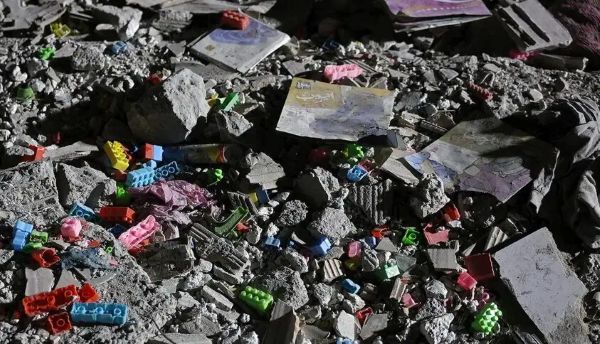
The regional war that has opened as a result of the Israel–US attack on Iran is shaking the region and sending shockwaves across the world. Tens of millions in Iran, Lebanon and throughout the Middle East are under the terror of the bombings and the war. The imperialist offensive, whose leaders threaten that may continue for weeks longer, is already a catastrophe on a massive scale. Thousands killed, tens of thousands wounded, over 4 million displaced, enormous environmental damage, a global energy crisis, a rising likelihood of recession in the world economy, and even warnings of a food crisis and expanding hunger worldwide due to impact on the fertiliser industry.
At least 3,220 have been killed in Iran (as of 20 March) in the bombings carried out on the orders of the governments of Israel and the US, including around 1,400 civilians, among them at least 210 children, according to the Iranian opposition human‑rights activist network HRANA.
“They are striking buildings where families live. After each explosion, people rush to help — and then another bomb hits the same area”, testified Kamran, a resident of Tehran, describing “double‑tap” bombings in an interview with the British Telegraph (3 March). He explained: “Many people are trapped under the rubble. Hospitals are filled with injured patients, and staff are overwhelmed. They [the Israeli and US militaries] are even striking hospitals where the wounded are being treated”. The World Health Organization (WHO) confirmed damage to 18 hospitals and clinics (as of 11 March) in the Israel–US attack on Iran, including the Gandhi Hospital in Tehran, whose operations were completely shut down. Eighteen medical staff were killed in the bombings, according to a statement by the Iranian Medical Association. “If they don’t stop now, Tehran will turn into Gaza”, said Farzad, 36, who fled Tehran (Guardian, 6 March).
In addition to the bombing of residential neighbourhoods, the Israel–US offensive targeted civilian infrastructure, including the desalination facility on Qeshm Island, which led to disruption of the water supply to around 30 villages in the area. The offensive is a mega‑attack on a regional scale. Among other things, the top ranks of the Israeli military, under the direction of Netanyahu’s government, carried out an environmental and economic attack when they bombed dozens of fuel reservoirs and a refinery in Tehran on 7 March. The prolonged giant fires released clouds of oil that created toxic acid rain falling on an area where millions of people live. The World Health Organization clarified that the damage to soil, water, food and air pollution will have long‑term health and environmental consequences. Over 3 million people in Iran have been displaced from their homes by the terror of the US and Israeli bombings.
Meanwhile, in Lebanon, over a thousand have perished, including women and children, and dozens of medical and rescue workers, in the bombings led by the Israeli death government since the beginning of the month. More than 1.3 million people, around a fifth of Lebanon’s population, have been displaced from their homes under expulsion orders by the Israeli army. Residential neighbourhoods in Beirut were bombed, buildings flattened. But the death government threatens to carry out an even larger bloodbath on Lebanese soil, while expanding the Israeli occupation in southern Lebanon. The Israeli war minister Katz threatened that “Lebanon will lose territory”. At the same time, Israeli occupation forces continue to deepen intervention in Syria, and dozens have also been killed in Israeli and US bombings in Iraq.
The Iranian counter‑offensive, despite the arrogant war propaganda of Netanyahu’s regime, shows no signs of subsiding even around the start of the fourth week. In the territories controlled by the State of Israel, the strikes included symbolic hits on the Bazan refinery in Haifa and in the area of the nuclear reactor in Dimona. The cluster munitions, even if they cause far less damage than the firepower the Israeli army has been raining down for around two and a half years on the heads of civilians across the region, tend to penetrate through missile‑defence systems. So far, 15 people have been killed within the Green Line, including 4 migrant workers, and in the West Bank 4 Palestinian women were killed by an Iranian launch that struck the town of Beit ʿAwwa near Hebron — where Palestinian residents under occupation have no sirens or protection at all. Within the Green Line, more than 3 million civilians have no access to proper protection, with the Palestinian Arab public facing the most severe hardship — only 0.5% of public shelters within the Green Line are located in Arab local authorities.
In the Gulf states, more than 20 people have been killed so far in the Iranian counter‑offensive. Saudi Arabia, the United Arab Emirates and other Gulf states hit in the counter‑offensive are threatening to join the military campaign against Iran. Such a scenario would of course be yet another significant escalation in the regional military confrontation.
The intensification of the attacks in Gaza and the West Bank under cover of the regional war
The regional campaign is a continuation of the war of annihilation in Gaza that the death government opened through the cynical exploitation of the 7 October massacre. Under the cover of the fog of war, the attacks in Gaza continue and intensify; Israeli army forces have killed 45 Palestinians in Gaza since the beginning of the attack on Iran (as of 19 March), according to reports by the Palestinian Ministry of Health. The siege has been tightened, and the number of aid lorries permitted to enter the Strip has plummeted by around 80%. Food prices have soared and shortages have been reported in products such as cooking oil and tinned goods — and there is growing fear of the return of mass hunger — as well as a worsening shortage of medical equipment. The closure of the Rafah crossing since the beginning of the attack on Iran has completely halted the already‑limited exit of critically ill and wounded patients who require urgent medical treatment outside the Strip. Around 18,000 of them have been waiting for months for approval, and for many the damage caused by the denial of treatment is irreversible, sometimes fatal.
In the West Bank, the terror actions of settlers and the army are receiving a tailwind from the regional imperialist offensive, as part of a campaign to uproot the Palestinian population and push it into a more restricted area, while establishing new settlements and “outposts”. A pogrom by a Kahanist terror gang against the Palestinian community in Khirbet Ḥumṣa in the Jordan Valley on 13 March included tying up families, beating girls and boys, severe sexual assault, and threats of murder and rape “if you don’t leave”. The shooting to death of four members of the ʿOdeh family in Ṭammun — two parents and two children — by the Israeli army again demonstrated that the bulk of the massacres and terror against the population is carried out by the army itself.
Global energy crisis
The Iranian regime made clear in advance that it would respond by striking targets within states in the region that host US army bases, and even that it would close Hormuz — a central artery of the global economy. Despite the unequal military balance of forces, so far the armies of the global superpower and the strongest power in the region have failed to prevent the closure of the strait. Even after the destruction of most of the Iranian fleet, Iran is halting the passage of goods in the strait using missiles, UAVs, unmanned vessels and naval mines. In normal times, around a fifth of the world’s oil and gas supply passes through Hormuz. Now that this enormous quantity of oil and gas has been cut off from the market, energy prices have soared and the effects on the global economy are immense.
The economies of East and South Asia are being hit the hardest, with almost 90% of Gulf oil exports going to them. In Bangladesh, Sri Lanka, Thailand, Myanmar, Vietnam and the Philippines, governments are already taking steps to reduce fuel and electricity use, including in some cases imposing travel restrictions, partial shutdowns of public institutions, and even quotas limiting fuel refilling and planned power cuts. Recently Slovakia also announced fuel rationing for citizens — the first country in Europe to do so, in light of the spike in energy prices on the continent.
Fuel prices in the US have risen by 30% since the start of the war. Thirty‑one member states of the International Energy Agency, including the US, have opened their strategic oil reserves in the hope of curbing the price rise, but the process will take time and the results are limited. The Trump administration has even temporarily lifted sanctions on Russian and Iranian (!) oil tankers.
The bombing of Iran’s giant gas field “South Pars” — the largest of its kind in the world — by the Israeli army on 18 March damaged around 12% of Iran’s gas output, worsened Iran’s internal energy crisis and led to the shutdown of gas exports to Iraq (around a third of whose energy needs come from Iran).
The Iranian regime responded with strikes on energy facilities in the Gulf states, including the port of Yanbu in Saudi Arabia on the Red Sea coast, which is Saudi Arabia’s only oil export point that bypasses the Strait of Hormuz.
In the strike on the Bazan complex in Haifa, damage was caused but hazardous materials did not leak (at least according to the authorities). In the “12‑day war” in June, the complex was hit and two workers were killed by a missile strike. Since the beginning of the current offensive, all of Israel’s gas rigs have been pre‑emptively shut down in order to prevent their ignition and destruction in counter‑attacks by Iran and Hezbollah — and electricity production has shifted largely to more polluting and more expensive alternatives, especially coal.
The war and the closure of the Strait of Hormuz are also paralysing a huge part of the global fertiliser industry in the middle of the planting season in the world’s main growing regions, which is expected to lead to rising food prices and even to damage to crop yields later on. The UN has warned that a prolonged war could increase the number of people suffering from extreme hunger worldwide by tens of millions.
Trump initially promised that the US navy would escort and secure ships in the strait, but in practice the US army currently has no ability to guarantee safe passage. Trump’s attempt to appeal to Japan, South Korea, Britain, NATO states and even China to create an international coalition that would send military forces to open the strait — failed. Despite economic damage, even the US’s allies do not believe it would be worthwhile for them to become entangled in the military campaign of US imperialism and the Israeli regime against Iran.
Public opposition to the war is a significant factor restraining the joining of some of those regimes. Thousands demonstrated against the war in Britain, Greece, Italy, Spain and France. Hundreds demonstrated in Seoul against responding to Trump’s call for South Korea to send military forces to the Strait of Hormuz. Public opinion in Italy against the war even forced Giorgia Meloni, the far‑right prime minister, to distance herself from supporting the war.
Ground forces and public opinion in the US
The US army bombed the military facilities on Kharg Island, from which 90% of Iranian oil is exported, and Trump threatened that if Iran did not submit to his dictates and open the Strait of Hormuz, he would destroy the oil facilities on the island and thereby inflict a fatal blow on Iran’s economy. But even according to the logic of the imperialist aspiration to replace the regime in Iran with a puppet regime of the US and Israel, it will be necessary to preserve economic infrastructure for the sake of “the day after”. This may be the reason that Trump and his partners are considering, in their words, the possibility that the US will not destroy the oil‑export infrastructure on the island but will seize it.
US Treasury Secretary Scott Bessent referred to Kharg Island in an interview with Fox Business: “We will see what happens, whether that becomes eventually a US asset”. In Tehran they threatened in response that an attack on the island would be met with an expansion of operations to the point of blocking trade routes in the Red Sea — another important artery of the global economy. In addition, occupying the island would require sending ground forces, and holding it over time would make US army forces more exposed to attacks from Iranian territory. It was also reported that the Trump administration is considering the possibility of a military takeover of the Iranian coastline in the area of the Strait of Hormuz, which could lead to greater losses for the US army and entanglement in a prolonged ground war.
The assessments are that around 450 kg of weapons‑grade enriched uranium required for developing a nuclear weapon are buried beneath a mountain in Isfahan, after in the “12‑day war” in June US army bombings collapsed the entrance tunnels to the site. In Washington they are considering carrying out a complex, and potentially lengthy, military operation during which ground forces would invade Iran to extract the uranium from the ground and thus deny future access to the Iranian regime — or at the very least produce a propagandistic victory image regarding the supposed denial of future nuclear capabilities from the regime. The potential for entanglement in any of these ground operations is very great, and the consequences for escalating the bloodbath are expected to be dramatic.
Already now the rise in fuel prices in the US may increase opposition to the war, and raises the chances of losses for the Republicans in the midterm elections in November. Most polls show that a majority of the public in the US opposes the war. Among registered voters, support is slightly higher, and among Republican voters there is indeed a majority that supports the war, but even this support is relatively fluid and not unconditional. Thus, a poll published on 18 March showed that among Trump voters a solid majority supports the decision to go to war, but 58% oppose sending ground forces to Iran, 55% are worried about rising fuel prices as a result of the war, and 79% would support “a decision by Trump to declare victory in Iran and quickly end this war”.
Joe Kent, head of the US Counterterrorism Centre, who belongs to the separatist far right and the Trumpist MAGA movement, resigned from his position in protest against the war in Iran, in a step that indicates a growing dispute among US government officials in light of the prolongation and entanglement of the war.
Netanyahu retreats rhetorically: “Regimes fall from within”, “threats rise and fall”
On the first day of the offensive (28 February) Netanyahu indulged in pompous declarations: “The day is not far when Israel and a free Iran will join hands for the sake of security and peace, for the sake of progress and prosperity”. But at the press conference two weeks into the war, in response to questions, he already sounded different: “We are creating the optimal conditions for the fall of the regime, but again, I’m not denying that I cannot tell you with certainty that the Iranian people will topple the regime. Regimes are ultimately toppled from within”.
The imperialist offensive by Israel and the US does not assist the struggle of the Iranian masses but sabotages it. “This war will not bring us democracy. At best, it will lead to half a century of dictatorship under the US and Israel, if it does not end in civil war”, explained Mona, a teacher from Tehran, an opponent of the regime and a supporter of the “Woman, Life, Freedom” uprising (Le Monde, 8 March).
But even regarding the promises of “removing the threat” and achieving security for ordinary Israelis, Netanyahu admitted at the same press conference that he no longer promises that this will be the last war with Iran. “Threats rise and threats fall — but when we become a regional power, and in certain areas a global power, we have the ability to push dangers away from us and ensure our future”. In fact, he clarified that further rounds will come. Regarding the current bloodbath he said at the latest press conference (19 March) in English that the war would end “much faster than people think”, apparently in order to deflect pressure on him and on Trump from public opinion in the US and Europe, but in Hebrew he said at the same press conference that the war would continue “as long as necessary”, as part of his attempts to persuade the Israeli public to pay the price over a prolonged period supposedly for the sake of a more secure future.
Amit Segal, Channel 12’s commentator and in practice one of the main spokespeople of Netanyahu’s camp, referred to the Israeli military spokesperson’s claim that the Iranian regime can no longer produce new missiles and said: “This is a statement that needs to be tested… we are sceptical, we want to see it on the ground. Second, the question is whether they cannot produce now under the fury of the war but when it ends they will renew [their capabilities], or whether their production capabilities will be fatally damaged even after the war, and that is what will determine whether in 8 months we will have another round, or whether this time the land will be quiet… not for 40 years, but we’ll gladly buy even two or three”.
The assumption that the Israeli and US regimes will succeed in doing in Iran — a state spanning a vast territory with a population of 90 million — what they have not succeeded in doing elsewhere, including in the Gaza Strip and Lebanon, is absurd. It is clear that if the Iranian regime has motivation — and the imperialist offensive provides it in abundance — it will also find ways to rearm. But Segal, an enthusiastic supporter of the war, aligns with Netanyahu in the assessment that even if there is military success from the perspective of the death government’s war machine, the next round will arrive soon. This is what an eternal war looks like; this is the Super‑Sparta vision, which Netanyahu and co. would be delighted if “we gladly buy”.
The additional layer of the super‑Sparta vision is the combination of soaring living costs with austerity policies to fund the war machine. Thus the government approved cutting hundreds of millions more shekels from welfare, health and education as part of a 1.7‑billion‑shekel across‑the‑board cut to fund the war machine, in addition to cuts defined as a “bridging loan” for “security procurement”. The price of the war is imposed on ordinary people from all communities, both in the severe harm to personal security and daily life, and in economic living conditions. Workers are being thrown under the wheels, the scale of the damage to livelihoods is extensive, and it joins the cumulative harm of two and a half years of war. Conversely, some capitalists are rolling in record profits — the banks, the retail chains and of course the arms companies.
The government tried to speed up the reopening of the economy, under pressure from employers, but the attempt to normalise wartime routine is shattering on the rock of reality. Workers are required to come to work under sirens and without solutions for children, while face‑to‑face schooling has not resumed in most of the education system, and was frozen again due to the strikes in Dimona and Arad (21 March).
Ground invasion of Lebanon
In the government and in the military high command they have made clear that they are planning an extensive campaign in Lebanon that will very likely continue even after the war with Iran ends. After almost a year and a half of a “ceasefire”, which was in fact unilateral and included daily Israeli bombings in Lebanon, Hezbollah renewed its fire following the opening of the comprehensive offensive on Iran and the assassination of Supreme Leader Khamenei. The organisation has indeed remained weakened in the Lebanese political arena and has experienced a retreat in its military and organisational strength following the “66‑day war” in 2024, the fall of the Assad regime in Damascus and the shift in the regional balance of forces, but it is still managing to launch relatively extensive barrages of rockets at the Galilee and the centre. Politically, while the Lebanese government was pushed to officially declare the organisation’s military activity “illegal”, the Lebanese army has no ability to disarm it by force, and such an attempt could lead to the renewal of a sectarian civil war.
The expansion of the Israeli occupation in southern Lebanon is expected, in fact, to enable Hezbollah to recruit support anew by strengthening its image as the sole force defending against Israeli aggression and as one fighting to liberate the residents of southern Lebanon from the occupying force. Hezbollah in the first place grew in the 1980s as a result of the Israeli occupation of Lebanon. Even in an unlikely scenario in which it “disarms”, another long‑term occupation, as promoted by war minister Katz — with the support of the Knesset “opposition” leader Lapid, who called for action to “scrape away Lebanese villages” — may produce in Lebanon new armed forces, of one kind or another, that will grow out of public resistance to the Israeli occupation and from a readiness to avenge the bloodbath.
Enough with the lie of security and liberation — what the real aims are
The reason Netanyahu and Trump are leading this war is not a desire to promote regional peace or security for ordinary people, not even in Israel. They are striving to change the regional balance of forces in favour of their interests and those of their capitalist oligarchies. In fact, not only Netanyahu, but the Israeli capitalist regime as a whole is interested in maintaining exclusivity in holding nuclear weapons (without oversight) and ensuring that there is no rival force in the region that can limit it, including in the context of imposing the dictatorship of occupation on millions of Palestinians. US imperialism, precisely out of the weakening of its hegemony globally and in the region, is being pushed under Trump to demonstrate military power in an attempt to shape the regional order according to its dictates.
Bombings by imperialist powers will not bring liberation from a tyrannical regime. Mass expulsion and rivers of blood will not bring security on the other side of the border. The US invasion of Afghanistan and the holding of occupation forces on the ground for two decades ended with the Taliban’s return to power. The bloody invasion of Iraq dismantled the state for years and produced ISIS forces and other reactionary elements. The declared aims of the Israeli invasion of Lebanon in 1982 were to stop the Katyusha fire of the PLO from Lebanon and to push the organisation north of the Litani River. At an enormous cost in blood, including tens of thousands of Lebanese and Palestinians, the PLO leadership was indeed expelled and moved to Tunisia. But the Israeli occupation in southern Lebanon produced Hezbollah as a political and military force that recruited support on the basis of resistance to the foreign occupation.
A handful of billionaires, generals and nationalist capitalist politicians may profit from this bloodbath. But the masses in the region, ordinary people — Iranians, Lebanese, Palestinians, Israelis and others — are paying the price. Along with hundreds of millions more around the world who are already affected by the catastrophe.
Struggle to stop the war and advance an alternative
The first demonstrations organised so far in Israel against the war, with the participation of hundreds of people in total, reflect only a small part of the potential for the development of long‑term public opposition to the war. Support for the current offensive indeed remains high, especially among the Jewish population, but trust in Netanyahu’s right‑wing government is low, and the weariness from a reality of endless war, social hardship and economic suffocation is also expected to return to the picture as the current chapter of the war drags on. While around 66% answered positively to the question “Are you satisfied with Israel’s achievements in the war with Iran” compared to 27% who answered negatively (N12, 19 March), the picture was reversed among those who do not have accessible protection (millions, as noted): among them only 23% said they were satisfied with the “achievements” compared to 51% who answered negatively.
Netanyahu is not at this stage managing to reap significant political gains from the war or to change the bloc map. The coalition parties’ bloc is still around 51–53 seats, far from a horizon for forming a new government with a majority in the Knesset after the elections expected around June–October. But the establishment parties of the “opposition”, from Bennett to General Yair Golan, are not offering a real alternative to the super‑Sparta vision, only a different way to manage it.
The political force missing in the arena is a socialist class‑based left opposition, which will offer a way out of the blood crisis and a horizon for a struggle for deep change in living reality. To achieve a future of security and peace, it is necessary to struggle against the root causes, to struggle for the security and welfare of all communities, to oppose all forms of national oppression, and to build a revolutionary struggle for socialist change and the overthrow of all regimes of oppression in the region. Including, decisively, the most dangerous and destructive force in the region today — the Israeli capitalist regime and the dictatorship of occupation and siege it imposes on millions of Palestinians.
No Orwellian war propaganda by Netanyahu will help — there is no horizon for real security without regional peace, and no horizon for regional peace with occupations, imperialist offensives and capitalist oligarchies.