
Lessons on the character and limits of right-populism in government in Europe
Viktor Orban has conceded defeat in Hungary’s parliamentary elections, ending the first and longest ‘experiment’ in right-populist government in this era. At the time of the election on 12 April, Orbán was the longest serving leader in the European Union. Steve Banon, the far-right podcaster and former-advisor to Donald Trump, once described him as “Trump before Trump”. Many of Trump’s domestic policies, especially in his second administration, were pioneered by Orbán (see here). But the ‘endorsement’ of right-populist politicians, including the high-profile eve-of-election visit to Hungary by US Vice-President, JD Vance, counted for little in the end.
The scale of Orbán’s defeat is huge. In the party-list component of the election, his Hungarian Civic Alliance party, known as Fidesz, contesting in alliance with the Christian Democratic People’s Party (KDNP), lost over 800,000 votes compared to the 2022 elections, falling from over three million votes to 2.2 million. In total, Fidesz-KDNP lost 79 seats in the 199-seat parliament. This was on an 80% turnout, the highest in the history of capitalist democracy in Hungary, introduced in 1990 after the end of Stalinist one-party rule.
The opposition Respect and Freedom party, known as Tisza, has secured a super-majority of 136 seats, i.e. over two-thirds of the seats in parliament. This gives it the power to amend the constitution. This was a position enjoyed by Orbán in all four of his parliamentary terms too. He used it to make substantial changes to the Hungarian capitalist state and its laws in order to build a so-called “illiberal democracy”. However, Tisza has exceeded even Fidesz-KDNP’s highest vote by over 50,000. The verdict on ‘Orbánism’ after sixteen years in power is that it failed to solve any of the fundamental issues confronting post-Stalinist capitalism in Hungary.
Why Tisza?
The removal of Orbán is viewed as a victory by millions of Hungarians. This much was evident in the footage from Budapest on election night. People were celebrating and shedding tears of joy as they watched Orbán’s concession speech. Tisza has been the beneficiary of an electoral revolt, driven primarily, but by no means exclusively, by the younger generations in the cities and big towns. Despite increases in average wages and a decline in unemployment during Orbáns rule, a cumulative inflation since the Covid-19 pandemic of 57% has weakened or wiped-out many of the gains. Corruption scandals became more frequent and more scandalous towards the end of his rule whilst the wealth of a section of society with connections to the government was exposed. Linked to this there has been significant deterioration in public services. All of this has led to a mood of frustration and anger which was able to coalesce around Tisza because it appeared ‘new’. It positioned itself firmly against Orbán and Fidesz, but also against the established opposition parties. Most of its MPs will be new to parliament.
However, whilst Tisza was a new choice on the ballot paper, and its MPs will be new faces in parliament, the politics behind Tisza are anything but ‘new’. Péter Magyar, the leader of Tisza is a former Fidesz politician and Tisza largely a personal vehicle tightly controlled by him. The party was registered to contest the 2022 elections by two ‘political entrepreneurs’ who then failed to stand. Put in storage as a ‘shelf’ party, Magyar took it over to contest the 2024 European elections. In these, Tisza won nearly 30% of the vote and gained seven MEPs, including Magyar himself. (Tisza’s origins and rise are analysed in greater depth in our pre-election article.)
Tisza’s election manifesto promised a domestic policy focused on tackling corruption, improving healthcare, education, welfare, child protection and transport. It also included proposals on a wealth tax and tax cuts for those on low incomes. However, this is a right-wing political project, at best an ‘Orbán-lite’. Magyar sang from Fidesz’s anti-migrant song sheet during the election campaign. He has also been silent on LGBTQ+ rights and whether a Tisza government would repeal Fidesz’s anti-LGBTQ+ legislation. In the European Parliament, Magyar and his six other MEPs, are part of the European People’s Party, sitting alongside the German CDU, France’s Republicans, the Austrian People’s Party and Silvio Berlusconi’s Forza Italia – in other words Europe’s traditional right-wing parties. The size of Tisza’s landslide has resulted in a parliament in which only three parties have seats, all of which are on the right. In addition to Tisza and Fidesz’s 56 MPs are 6 MPs from the far-right Our Homeland Movement (MHM) which won nearly 6% of the vote. However it might postures now, this parliament will develop as an enemy of the working class.
Why did Orbán accept defeat?
The emergence of right-populism into the ‘mainstream’ of capitalist politics in so many countries has raised fears in society, especially amongst young people. Alongside anti-democratic and reactionary rhetoric, when in government, right-populists introduce anti-democratic legislation and attack the rights of minorities, for example migrants and LGBTQ+ people. They back this up, sometimes brutally, with the repressive powers of the capitalist state. Understandably, many wonder how far this process can go, asking, “is this the road to a fascist government?” This idea is actively encouraged by some liberal capitalist commentators who have now had no choice but to express their surprise at Orbán’s muted reaction and willingness to surrender the government. Those on the left, including some who claim to stand in a Marxist tradition, who also encourage the idea that right-wing populism is a ‘twenty-first century fascism’, will also now struggle to explain what has happened. This is because they have substituted the rhetoric of the right-populist brand of capitalist politics for a serious analysis of the balance of class forces (see footnote) in each country where they have seen a growth in support (also see here).
Across capitalist governments of all political shades there has been a trend towards increased repression and attacks on democratic rights. This is generally sharper under right-populist governments, its politicians unapologetic about it, with some, like Trump, or Orbán, embracing their ‘strongman’ role. When talking about capitalist democracy and democratic rights they use a political vocabulary sharply at odds with the well-established – and thoroughly hypocritical – ideas of universal freedoms and universal human rights used by their liberal capitalist rivals and even traditional conservatives, behind which the ruling classes have cloaked the dictatorship of capital for decades. This is a conscious political choice to emphasise right-populist parties’ distance from the ‘old’ political establishment.
Upon winning the 2018 elections Orbán declared that “The era of liberal democracy is over”. He continued, “We have replaced a shipwrecked liberal democracy with a 21st-century Christian democracy, which guarantees people’s freedom, security.” The following eight years of Orbán’s rule, not to mention his acceptance of electoral defeat in these elections, shows that whatever he intended by his remarks, Orbán was not declaring the end of capitalist democracy. This did not of course mean that democratic rights were ‘safe’ under Orbán. Throughout his sixteen-year rule his governments gerrymandered, manipulated state institutions, appointed ’loyalists’ to key public offices, and used the law and repressive apparatus of the capitalist state to intimidate opposition and attack minority groups. But as the CWI has pointed out before, right-wing populism does not stand for the destruction of the workers’ movement or the abolition of democratic rights and elected governments in general (see here). Using Fidesz’s supermajority to replace capitalist democracy with a fascist dictatorship was never floated, despite the formal opportunity with the introduction of a new constitution in 2011.
This is not least because right-populism in Europe is primarily an electoral phenomenon. One of the roles that right-populism attempts to play in this era is to rally a social base for capitalism that the traditional capitalist parties have been incapable of maintaining. They do this with an appeal to conservative social and family ‘values’, nationalism and other backward ideas. In Hungary, for example, Orbán expanded the franchise to all ethnic-Hungarian populations in neighbouring countries. Initially at least, these groups were more likely to vote for Fidesz-KDNP, who postured as the ‘defenders’ of ethnic-Hungarian minorities. Simultaneously, right-populists posture against out of touch ‘elites’, including capitalism’s traditional political representative, giving some outlet to the class anger in society. The strength of the different ingredients in this reactionary cocktail varies from country to country depending on the national situation.
But right-wing populist parties are not engaged in charity-work for the capitalist class. They are also building their own electoral base from which to wrest the management of capitalism from its traditional political representatives, the parties and politicians whom the right-wing populists hold as responsible for leading capitalism into crisis. An electoral mandate from ‘the people’ is considered crucial by right-populists for their legitimacy as the real representatives of ‘the nation’. This electoral legitimacy also serves as a social base, albeit a shallow one, that allows them to deal more decisive blows against their capitalist rivals than they could otherwise. Odious as it is, attacks on the rights of minorities, such as migrants or LGBTQ+ people, and increasing repression against different anti-government protest movements, are used to rally and consolidate the ‘real nation’ as a social base for capitalism and an electoral base for right-populist government in particular, not as a step toward the abolition of democratic rights and elected government in general. Gerrymandering and other forms of electoral manipulation, including intimidation and suppression, has always been a feature of capitalist democracy. It is increasing everywhere under the pressure of the crisis of capitalism and is firmly part of the right-populist ‘playbook’ too. But this has definite limits at this stage which are shaped by the balance of class forces in each country and globally.
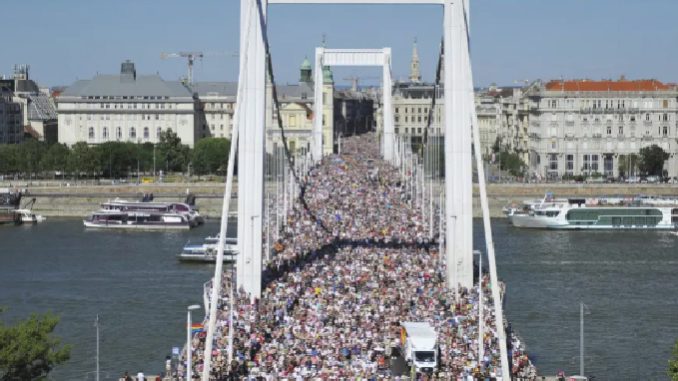
Orbán, when in opposition, manoeuvred Fidesz into a prominent role in anti-government protests between 2006 and 2010. But like all right-populist politicians, and capitalist politicians of all ideological shades in general, he prefers politics to be limited to a spectator sport. Only the political elite are meant to play on the field. If Orbán had attempted to defy what was clearly a decisive electoral revolt against his rule he would have guaranteed a pitch invasion by the spectators – in other words he would have provoked a mass movement. This is what happened in South Korea in 2024, stopping an attempted military coup. In Hungary, Budapest Pride went ahead in June 2025, with over 200,000 attending, despite having been banned by Orbán’s government. This mass civil disobedience would have been nothing compared to the response any attempt to defy the election outcome would have provoked. All mass movements have the potential to threaten the stability of capitalism and the wealth and power of the ruling class. In Hungary, this would have included that of Orbán and his clique. When it came to it, Orbán conceded defeat before ballot counting was even finished. In a short speech he said he had already congratulated the winner and reassured those listening that “…no matter how it turned out, we will also serve our country, and the Hungarian nation, from the opposition.”
However, the CWI has warned that there is a ‘grey zone’ connecting right-populist parties and far-right and fascist groups. The latter do build their organisations with a perspective for eventually waging a ‘battle for the streets’ through mass mobilisations and the building of armed wings. Emboldened by the growth in electoral support for right-populist parties these groups can lead an increase in political violence and attacks on minority groups. The balance between the populist-right ‘mainstream’ and this far-right ‘fringe’ can of course change in the future as the crisis of capitalism deepens and class struggle escalates. In the 1920s and 1930s capitalist politicians of all ideological shades acted as handmaidens for the formation of fascist governments when the alternative was the overthrow of capitalism by the revolutionary working class. But this is not the balance of class forces in Europe at present.
Sixteen years of Orbánism confirms the CWI’s analysis that right-populist government does not yet mean a qualitative change in the form of capitalist rule in the way that fascist regimes and Bonapartist police or military dictatorships do. However, Marxists do not deal in rigid and fixed categories. There are elements of Bonapartism in every capitalist democracy. These elements can become more dominant, producing regimes of parliamentary or presidential Bonapartism. In these, repression plays a greater role, democratic rights are more restricted, and the institutions of bourgeois democracy are increasingly sidelined, subordinated or neutralised. Orbán travelled a considerable way down this road during his sixteen years in power.
Hungarian Capitalism
In the transition from Stalinism to capitalism the only road open to the Hungarian elite was integration into the US-led unipolar world order. This meant membership of the European Union and NATO. In return, a Hungarian capitalist class would be fostered, accumulating sufficient wealth to buy social peace in the new capitalist dispensation with rising living standards and other concessions to the working class. This strategy ran aground on the rocks of the 2007/09 world economic crisis which hit Eastern Europe hard. This was the context in which Orbán and Fidesz returned to government in 2010 after eight years in opposition. However, there were already serious frustrations within the new small capitalist class and those groups expecting to be elevated into their ranks. The large share of foreign ownership of the ex-state industries that resulted from integration into European markets meant these layers felt shortchanged of what they had been promised. This was reinforced by the 2007/09 crisis forcing Hungarian capitalism to turn to the EU and IMF for strings-attached bailouts.
Reflecting these frustrations, Orbán pursued a new policy that sought to strengthen and expand the Hungarian capitalist class. In time-honoured fashion control of the capitalist state was the only lever possible. In key sectors, foreign ownership was displaced by Hungarian. Those multinationals allowed to operate in Hungary were required to make secretive agreements with the government. Many of the changes made by Orbán to the capitalist state and its laws were to facilitate this ‘class project’. This is what the dominant ruling classes in the EU object to most in ‘Orbánism’. That it uses modern versions of policies that they themselves used to build their wealth and power historically. With EU rules written to defend the ‘incumbents’, many of Orbán’s policies bent or broke EU laws, which were denounced hypocritically as ‘crony capitalism’.
To get around this, Orbán prioritised efforts to access markets outside of the EU. More possibilities opened for this in the increasingly multipolar world that took shape in the years after the 2007/09 crisis. Orbán attempted to lean on increasingly assertive Russian imperialism against “Brussels”. His governments also tilted toward China, with Hungary becoming the first EU member country to sign up to its Belt and Road Initiative in 2015. However, ultimately, the Hungarian capitalist class is too weak to pull-off such a balancing act indefinitely. The Putin regime’s invasion of Ukraine in 2022 ratcheted up tensions between Orbán’s government and the EU, which froze the disbursement of more and more ‘development funds’. These are a major source of inward investment and profit for Hungarian capitalists. Between 2013 and 2020 these funds were equivalent to 4%-6% of GDP in Hungary each year. However, Orbán ‘doubled-down’ on his policy, blocking EU aid for the Ukrainian Zelensky-regime and blocking new rounds of sanctions on Russia. This in turn deepened divisions with the Hungarian ruling class. Reflecting this, Magyar made balancing back towards European capitalism central to his campaign.
Sixteen years of ‘Orbánomics’ has led to a greater ‘Hungarianisation’ of capital in the country. But it has not resulted in a fundamentally stronger position for the Hungarian capitalist class globally. It is no more capable of forging an ‘independent’ policy in the world than it was sixteen years ago. In that sense, Orbánism has failed for the capitalist class too. In 2024, Hungary still accounted for just 1.15% of EU GDP and remains hugely dependent on EU markets for its exports, especially Germany. That Orbán never took any serious steps in the direction of withdrawing from the EU (or NATO), despite railing against “Brussels” throughout his rule, underlines the lack of options facing the Hungarian capitalist class. Magyar’s promise to improve relations with the EU (and NATO) suggests that a section of the new ‘Orbánite’ capitalist class has reached this understanding too and concluded that Orbánism has run its course. A timeous ‘banking’ of its gains may be the most prudent immediate step.
This does not however mean that the Hungarian capitalist class will fully ‘recapitulate’ to “Brussels” under a Tisza government. The times have changed. The crisis of European capitalism has entered a qualitatively new phase. The new government’s priority will be ‘unlocking’ the frozen EU funds but that does not rule out continuing to strengthen ties with China and Russia, especially as Hungary remains dependent on Russian oil and gas imports. Magyar has already said he opposes any moves toward rapid EU membership for Ukraine, which will appease the Putin government even as it shrugs off the loss of its ally, Orbán.
What happens next?
In the short-term, Orbán’s defeat is a boost for the pro-war European ruling classes’ militarisation programmes and determination to wage war in Ukraine against Russian imperialism. Magyar is unlikely to continue with Orbán’s policy of delays and vetoes to block military aid to Ukraine or additional sanctions on Russia. This did not mean that Orbán was ‘the peace candidate’, despite trying to posture as such during the election campaign, cynically playing on legitimate fears in Hungarian society. Orbán’s policy toward the Ukraine war amounted to a back-dated cheque for Russian imperialism’s war of territorial conquest and an acceptance of its right to annex territory by force. This is not a ‘peace’ policy.
We are in an era where capitalist democracy is in crisis. Orbánism was both a product of that crisis and, during its sixteen years in power, accelerated it. One of the functions of capitalist democracy, as well as easing the tensions between the classes, is to allow the disagreements between the different wings of the capitalist class to be mediated. One of the means of doing this is changing governments following an election. In periods of relative capitalist stability, this was a relatively straightforward technical task governed by rules that all political parties abided by and facilitated by a professional cadre of capitalist technocrats. This is increasingly breaking down and changing governments becoming an increasingly fraught and contested process. Rather than lowering the temperature of class anger and reducing the pressures in society, a change of government today can also pave the road to fresh political and constitutional crises. This is just one of the many ways that right-populism is a source of instability from the point of view of the capitalist class. It also increases polarisation in society more generally adding to the difficulties of achieving stable capitalist political rule.
Poland is another ex-Stalinist country that is today part of the EU and has seen a right-populist government come and go. The right-populist Law & Justice party (PiS) was in government for two terms between 2015 and 2023. Like Orbán it too made substantial changes to the capitalist state and its laws before also stepping aside from government. However, the coalition of capitalist parties that replaced PiS failed to secure a supermajority and lacked the legal power to remove PiS loyalists from key positions in the capitalist state. Crucially, PiS still controlled the presidency and its veto powers. Their willingness to use these positions to frustrate the new government has led to political deadlock. Rapid disillusionment with the new government allowed PiS to retain control of the presidency for another five years in elections in 2025. This leaves the country hanging on the precipice of a political or even a constitutional crisis.
Back in Hungary, Magyar has already called on Fidesz appointees in key positions in the capitalist state – including the highest courts and state prosecutor, the audit, competition and media authorities, as well as Hungary’s president – to resign before their terms of office end. It is unclear whether they will heed this call. Fidesz may be out of office, but it may not wish to surrender all the reins of power it has gathered, especially with the possibility of an anti-corruption drive leading to prosecutions. If they do not resign, Magyar would be faced with the choice of accepting some level of political deadlock or using his supermajority to enact constitutional changes to make their removal possible. However, this ‘majoritarianism’ is precisely the ‘crime’ Magyar accuses Orbán of! In every scenario, the Hungarian ruling class is unlikely to avoid some degree of political or constitutional crisis in the future as a legacy of right-populist government. As we have pointed out in relation to the US (see here), in this era, control of the capitalist state – the executive committee of the ruling class – is contested between its different wings in a way not seen in generations. This is another potential source of major instability for capitalism. The social ferment provoked by political and constitutional crises – splits in the ruling class in other words –are fuel to the class struggle and can pave the way to mass movements and even revolutions.
For Independent Working Class Political Struggle
In Hungary, as elsewhere, the working class and middle classes are again dissatisfied, frustrated, and seething with anger. The same moods that swept Orbán and Fidesz into power have now swept them out again. Peter Magyar and Tisza will not be spared this anger either when their pro-capitalist policies inevitably lead to disappointment. Confidence in capitalist political parties and the institutions of capitalist political rule has been undermined everywhere. In Hungary and other ex-Stalinist countries these were introduced within living memory, their social roots shallower than in many other capitalist countries. It is the ‘underwriting’ of the profit-system by the stronger European capitalist classes that dominate the EU that brought Hungarian capitalism into existence and sustains it.
The biggest factor keeping it alive is the huge political vacuum that could be filled by an independent mass working class political party. The defence of democratic rights against the right-populists and other reactionary pro-capitalist political forces that can grow in their wake is crucial in this era. But this struggle needs to be conducted under the leadership of the working class independent from all wings of the ruling class. Only a political alternative on this class basis is capable of solving the crisis of capitalism in the interests of the majority in society. This will require a program for the replacement of capitalism by a democratic and working class-controlled socialism.
***
[1] By ‘balance of class forces’ Marxists mean the relative strengths of the contending social classes in society and how this shapes each class’s ability to defend and advance its interests. No class has unlimited ‘room for manoeuvre’.
The ruling capitalist class faces a constant dilemma: how does a tiny exploiting minority secure the exploited majority’s acquiescence to its rule? Control of the state alone, with its repressive apparatus, of laws, courts, the police and the military, although a powerful weapon, is not enough. The capitalist class cannot rule for a day without finding a social base – a footrest – within society amongst the middle classes and sections of the working class and poor. However, to do this, the capitalist class must perform a constant balancing act. The interests of the capitalist class and the middle classes do not fully coincide and the interests of the capitalist class and the working class clash on the most fundamental level. These class ‘contradictions’ are the motor of the class struggle. The working class plays the key role in the capitalist economy, producing wealth and keeping society running. In the advanced capitalist countries, it is an overwhelming majority of the population. However, without independent political organisation, leadership and a programme clearly formulating its interests as a class – a socialist programme – the working class is, as Karl Marx explained, “raw material for exploitation”. That this is weak or missing in most countries at this stage is the capitalist classes’ greatest advantage.
The balance constantly shifts in the class struggle to the advantage or disadvantage of one or other of the contending classes. How this happens, the methods and tactics used to advance different class interests, the level of organisation of the different classes, the politicians and parties used as vehicles by the different classes, the victories and the defeats in class battles, the growth or loss of confidence of one or other class as a result etc. etc. All of this is the crucial day-to-day detail of ‘politics’. From these, Marxists strive to make an assessment of the balance of class forces. This informs what we propose to the working class at each stage for it to strengthen its position and advance its interests, culminating in capitalism’s overthrow and the building of a socialist society. Assisting the working class to solve this problem is the key task confronting revolutionaries in this era.