
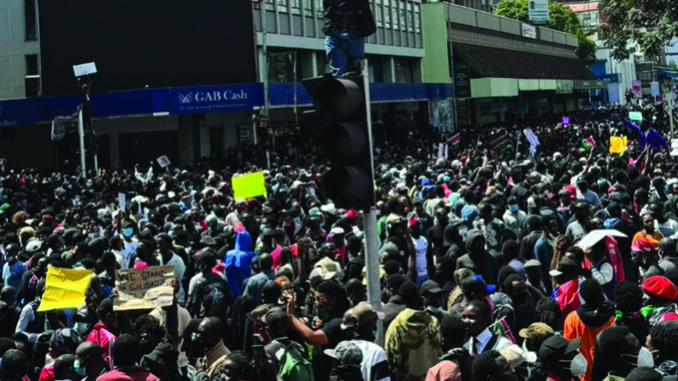
Monday July 7 saw 31 people killed, over 100 injured and over 500 arrested as mass protests erupted again across Kenya, driven by widespread anger at a government assault on the living standards of ordinary people. These protests were first sparked off last year in response to the heavy taxation policies of President William Ruto—nicknamed “Zakayo” by demonstrators, referencing the biblical tax collector Zacchaeus. These figures, published by the state run Kenya National Commission on Human Rights (KNCHR), give a glimpse of the government’s repression of what it correctly sees as a challenge to its rule.
Last month at least 11 were killed by state forces on June 25 against actions to mark the first anniversary of last year’s #RejectFinanceBill2024 protests that itself saw many killed, injured or abducted. Now demonstrations have swept across at least 17 of Kenya’s 47 counties, with tens of thousands participating. On “Saba Saba Day,” a historically significant day that commemorates 7 July 1990, the start of the 1990s struggle for multi-party democracy, the protests surged again, affirming the long-standing resistance tradition among Kenya’s working people.
What distinguishes these protests is the character and composition of the movement. It is overwhelmingly led by young people from urban centres, many of whom are unemployed or struggling with the high cost of living. Mobilisation has been swift and dynamic, largely coordinated through social media platforms like TikTok, with videos and calls to action going viral in hours. Despite the absence of formal leadership or coordination with established political parties, the movement has rapidly gained momentum. Indeed, many journalists and observers on the ground note that the protests have bypassed traditional political structures entirely—a sign of deep disillusionment with all wings of the ruling elite.
Fearful of this grassroots rebellion, the Ruto government has responded with increasing repression. Activists have been abducted in extrajudicial operations and subjected to unlawful interrogations. Armed gangs, described by protesters as government-hired thugs, have attacked demonstrators using clubs and whips. Police have unleashed tear gas, water cannons, and live ammunition against largely peaceful gatherings. To clamp down further, the government has ordered media outlets to stop broadcasting the protests live—an attempt to suppress the growing tide of dissent.
However, rather than cower in fear, Kenyans have responded with even greater determination. The brutal killing of teacher and activist Albert Ojwang while in police custody, along with footage showing an unarmed street vendor being shot at close range, have become rallying points for a movement that sees itself as standing against not just one administration, but a corrupt and exploitative political system.
Importantly, cracks are appearing in the state apparatus itself. While the government is attempting to deploy security forces to crush the protests, many police officers and soldiers come from the same communities as the demonstrators. In time, sections of the armed forces may refuse orders or even align with the movement.
This isn’t the first time Ruto’s administration has been forced into retreat. In 2024, the government withdrew a set of deeply unpopular tax hikes and dismissed several cabinet ministers following weeks of protests. Those demonstrations reached their peak when protesters stormed parliament and set parts of it alight, forcing unpopular politicians to flee through tunnels, a period now remembered as the “Seven Days of Rage.” Yet, in 2025, the government has returned with a repackaged set of economic attacks—this time targeting basic necessities such as bread, mobile transactions, and internet usage in a new tax bill.
Ruto, a wealthy businessman, has made these decisions under pressure from the International Monetary Fund (IMF), which is driving an austerity agenda linked to a $3.6 billion bailout package. One of the bailout’s main conditions is to increase tax revenues while slashing public spending. The Kenyan government is currently spending nearly 38% of its revenue on debt repayments, according to the World Bank. A weakening Kenyan shilling and rising interest rates due to global capitalist turmoil have worsened the debt burden, and in early 2024, Ruto’s government narrowly avoided default on a $2 billion Eurobond issued in 2014 by borrowing yet another $1.5 billion from the IMF—at interest rates exceeding 10%.
This imperialist debt-cycle has forced Kenyans to pay more, earn less, and endure public service cutbacks—all so that international creditors and bondholders can be repaid. Foreign aid, too, is drying up. Donald Trump’s cuts to USAID have already reduced payments to Kenya, hitting crucial sectors like healthcare the hardest. In 2023, Kenya received $850 million in aid from the U.S., with nearly half allocated to health services.
Capitalist institutions are openly worrying about the stability of Ruto’s rule. The Financial Times criticised Ruto’s tax policies as ‘poorly designed’, while The Economist urged him not to stand in the 2027 elections. Discontent is spreading regionally. In Uganda, youth protests against President Yoweri Museveni have led to arrests, while in Nigeria, the #EndBadGovernance demonstrations against President Bola Tinubu, that were also against corruption, misgovernance, and inflation, and have been met by state repression.
However, Ruto and the Kenyan ruling elite will not surrender easily. They will attempt to wait out the storm, revise their strategy, and reintroduce their unpopular measures in another guise. That is why the movement must evolve from spontaneous protest to structured resistance. The youth should take the lead in forming democratic action committees in schools, universities, and neighbourhoods. These bodies should appeal to the broader working class and poor to similarly organise themselves and join in building a united front capable of challenging the status quo.
Already, some calls for a general strike have emerged from the protests—a significant step forward. A one- or two-day nationwide shutdown could serve as a powerful show of force, bringing new layers of society into the struggle, in particular the working class, and putting pressure on all levers of state power. Unity across ethnic and tribal lines is especially critical, as Kenya’s political elite have often used such divisions to distract and weaken opposition movements. Encouragingly, this wave of protests appears to have cut across those divisions, underscoring the shared economic pain felt by the majority.
Ruto once campaigned on a promise of lifting ordinary Kenyans out of poverty. But since assuming office, he has done the bidding of global capital and local elites, imposing policies designed to satisfy IMF and World Bank requirements. While coming from a poor background, and once being a bit of a populist, Ruto is now tied by a thousand threads to the interests of Kenyan capitalism and world imperialism. Kenya has joined the growing list of neocolonial states caught in spiralling debt, forced into austerity, and facing growing popular backlash.
The crisis highlights the urgent need for a revolutionary political alternative. None of the current opposition leaders offer real change—they, too, serve the same capitalist class. In countries like Chile, Sri Lanka, and Bangladesh, mass movements succeeded in toppling governments only to see the old or different pro-capitalist forces come to power due to the absence of a coherent revolutionary socialist party capable of organizing the next steps. Even in Kenya, ministers forced to resign last year have since been reinstated—an indication that without structural transformation, nothing truly changes.
The only way forward is for the working class and poor to organize independently, aiming to form a government rooted in socialist policies and democratic control. Such a government would break with the failed capitalist model and reject the dominance of imperialist institutions like the IMF. It could redirect national wealth toward healthcare, education, housing, and job creation rather than debt payments and elite enrichment.
A new political party—revolutionary, democratic, and grounded in the everyday struggles of the Kenyan people—is urgently needed. As the movement reflects on its victories and setbacks, the need for a political vehicle to consolidate and deepen the struggle is clear. This question must become central to ongoing debates about the future of the resistance.
Only through such organization can Kenya’s working masses transform spontaneous outrage into revolutionary change that would inspire the working masses and poor throughout the continent to follow a similar course.
- Don’t pay the debt! IMF out of Kenya! Nationalise the Kenyan banks and financial system under democratic workers’ control.
- No to austerity in any form – no tax increases and no wage or spending cuts! Organise mass struggle against each and every policy that attempts this. For price controls on all basic commodities determined democratically by communities.
- Continue the protests! Organise linked-up committees of struggle in communities, workplaces, universities and schools to democratically organise and plan the movement’s next steps.
- Ruto must go! Against all pro-capitalist, pro-imperialist and pro-IMF political parties, politicians and MPs. Start to build a mass party of the working class armed with a socialist program to break with capitalism and imperialism. For a government of workers and the poor.