
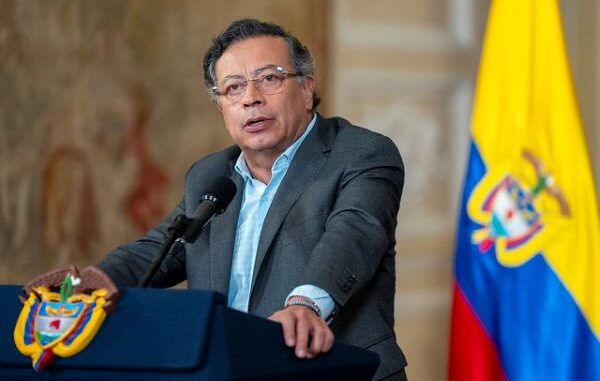
Three years after the election of left-wing candidate Gustavo Petro as President of Colombia, the country is in crisis. Following the failure of negotiations with the ELN guerrilla group, the assassination attempt of right-wing presidential candidate Miguel Uribe, and the escalation of violence in various regions, many people fear a return to the country’s dark years. Meanwhile, right-wing parties are waiting in the wings to take back control in 2026.
Until 2021, Colombia was considered a safe haven for US interests in Latin America. But when the ruling elites planned a tax reform that would further erode the already low standard of living in the country with the highest social inequality in Latin America, the people had had enough. Massive protests shook society. In the 2022 presidential elections, former guerrilla fighter, Gustavo Petro, prevailed. He became the first social democratic president in the history of Colombia; a country where trade unionists are regularly murdered by paramilitaries and entire trade union structures have been dismantled.
Petro’s election raised enormous hopes that the country would develop in a positive direction for the majority of the population. Petro promised far-reaching reforms during his term in office that would massively improve the lives of ordinary people. Some on the left hoped that Colombia would transform itself from a vassal state of US imperialism into a modern capitalist state with extensive workers’ rights. But Petro’s government had to contend not only with resistance from the old elites, but also with the crisis of global capitalism, in a country that is particularly hard hit by US tariffs.
Workers’ party & bold socialist policies needed!
When Petro was elected, we declared that a plan of struggle was needed to implement the programme on which he was elected. The mobilisation for the election campaign and the previous mass protests against President Iván Duque should have been used to build a mass party of workers and youth. Instead, Petro relied on top-down politics, hoping that the office of president would be enough to push through the necessary changes. No independent role was envisaged for the mass of workers. The right-wing opposition has tried to prevent all of the government’s reforms. Whenever tactical manoeuvring and negotiations failed, Petro called for protests to demonstrate support for his programme and break the right-wing blockade. However, far-reaching concessions to the pro-capitalist opposition meant that the reforms were only adopted in a watered-down form.
Ordinary Colombians fear that in the elections next March, the right wing will turn back the clock and a representative of the oligarchy will once again be at the helm of the country. But it is not too late to build a workers’ party. Time and again, young people and the working class have shown that they support Petro’s progressive measures, even if disillusionment and disappointment are spreading. Most recently, the trade unions supported the labour reform with a 48-hour strike, and Petro threatened to push the reform through by referendum, bypassing the Senate. The intensification of the political struggle should be used to transform the short-term mobilisation of the masses into the long-term organisation of the class. The trade unions and left-wing sections of Petro’s electoral alliance of progressive organisations – the Pacto Historico (Historical Pact) – must take the initiative to build a workers’ party with socialist policies. Such a party could turn the tide in the upcoming elections.
Lessons
In such a party, activists, trade unionists, workers and young people could exchange experiences, coordinate and plan the next steps in the struggle for social justice and equality. This also includes taking stock of the last few years. Petro’s government not only shows the limits of a politics that focuses on one person as a saviour, but also that the conditions for profound change do not exist within capitalism. The experiences of left-wing governments in countries such as Venezuela, Bolivia, Ecuador and Peru, in the past, show that without a break with capitalism, the living conditions of the masses cannot be fundamentally improved. This also applies to Colombia.
The ruling class and its political accomplices have shown that they will fight tooth and nail against any reform, no matter how small, that is in the interests of the majority of the people. They are prepared to stop at nothing to achieve their goals, as the history of Colombia has shown. In order to defend what has been achieved so far and to break the power of the oligarchy, we must pull the rug out from under their feet.
Socialism
The struggle for democratic reforms must be linked to the struggle for socialist change: a programme for the nationalisation of banks and corporations under democratic control and management by the working people, as well as the redistribution of land to poor farmers. Only such a socialist programme can provide the basis for uniting the vast majority of workers and poor people in a party, and the implementation of this programme is the only starting point for Colombia’s development.