
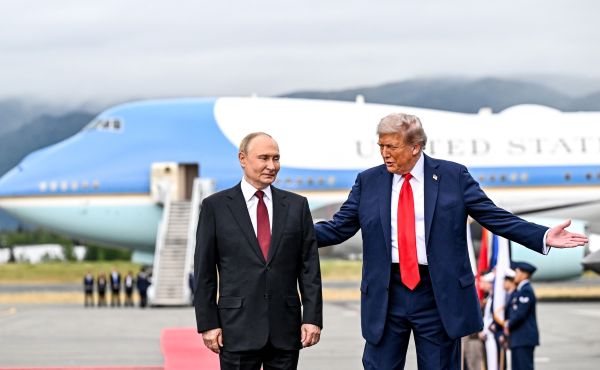
The recent summit between President Trump and President Putin, held in Alaska under the guise of “peace diplomacy,” and the hurriedly convened meeting of Ukraine leader, Vladimir Zelensky, and leading European powers at the White House on 18 August, both revealed the cynical manoeuvres of imperialist nations. In line with imperialism’s historic carving up of the world throughout the ages, these powers take a top-down, self-interested approach towards the fate of the suffering people of Ukraine and across the region.
Much to the huge frustration of the European powers, Trump brought Putin back in from the cold. Not so long ago, the Russian president was cast as a pariah, thrown into outer darkness from the so-called ‘international community’, and he remains wanted for war crimes by the International Criminal Court. In Anchorage, however, Trump rolled out the red carpet for Putin and applauded him. Putin emerged emboldened from the meeting, reiterating his propaganda that Russia’s invasion was justified on security, military and ideological grounds.
Prior to the talks, Zelensky and other European leaders – who were excluded from the Anchorage meeting – lobbied Trump not to make any deals with Putin that involved “land swaps”. They called for Trump to push for a ceasefire (with the Ukraine army losing a lot of ground to Russian forces, a ceasefire has become a key demand, which would allow Zelensky and allies time to regroup).
Zelensky and other European leaders were initially relieved that Trump did not attempt ‘another Yalta’ (i.e. carving up territory with Putin over the heads of Zelensky and European leaders in the manner of Roosevelt, Churchill and Stalin). But it later emerged that Trump’s overtures to Putin included willingness to consider a “comprehensive peace deal” that effectively accepts Russia’s territorial gains. Trump also called on Zelensky and European powers to drop the demand for a ceasefire before a deal being made, also aligning with Putin’s demand.
Sanctions against Russia were not explicitly stated during the summit, but later Trump suggested on his Truth Social platform that the US would not follow through on threats of new sanctions against Russia.
The outcome of the Anchorage talks drew sharp criticism from Ukraine politicians and army staff. Ukraine officials asserted that Zelensky would not agree to hand over Donetsk and Luhansk but would be “open” to discussing territory in a future trilateral meeting with Trump and Putin. Kyiv is strongly opposed to giving up a heavily fortified string of cities in the Ukrainian controlled part of the Donetsk region. The Ukraine government argues this would allow Russia a springboard for future offensives.
Alarmed, several European leaders and Zelensky scrambled to meet with Trump in the White House on 18 August. Their main aims were to push again for a ceasefire, to stop the idea of Ukraine ceding land still under its control to Russia becoming a prerequisite for a deal, and to pin down what the US is prepared to do to help “guarantee Ukrainian security” after a peace deal is reached.
Fawning European leaders
Despite their fawning around Trump, the US president reiterated that Ukraine would need to accept the loss of Crimea and give up territory in the Donbass region, and repeated that Ukraine will not join Nato. In a television address after the Washington talks, Zelensky indicated that he will have to accept the loss of territory when he said “the issue of territory will leave to me and Putin.” For most of the war, neither he nor his European allies have publicly countenanced any territorial losses.
Trump talked about a subsequent bilateral meeting (Putin and Zelensky meeting) and “trilaterals” (US, Ukraine and Russia talks), but nothing is firmly decided.
Trying to salvage something from the Washington meetings, Zelensky and European powers are talking up Trump’s vague promise of US “security guarantees” for a post-war Ukraine. But Trump has stated that Europe will have to “take much of the burden in a security arrangement”. This is a far off from full-throated Nato support and protection for Ukraine. The US envoy, Steve Witkoff, spoke last week of making a “concession” to Ukraine that would see the US provide “Article 5-like protection”, in reference to Nato’s mutual defence clause. But this is an infamously imprecise clause, obliging a Nato member to “take such action as it deems necessary” to come to an ally’s aid.
Since the Washington meetings, Trump restated that Ukraine “is not going to be part of Nato, but we’ve got European nations, and they’ll frontload it [security]”. Trump has only promised that the US could play a role “by air” in a “post war security guarantee”, without going into specifics. He also spoke about European troops “on the ground”. In turn, Russia restated it will not accept any Western troop presence in Ukraine.
Trump is guided by the fact that Ukraine is losing the war, even with the enormous military aid of Nato and financial help from the European powers and the US. For the Trumpian wing of the US ruling class, they want to pivot US power towards China and the South China Sea. The rising power of China, both economically and militarily, is their main concern. Trump also hopes that an end to the war in Ukraine will open the way for lucrative trade and economic deals between the US and Russia, and a prising away of Russia from the orbit of China.
For the main European imperialist powers, Russia is their focus of concern. Since the dissolution of the former Soviet Union, a drawn-out struggle over natural resources, territory and influence has unfolded between the capitalist powers in the region. Over decades, Nato provocatively expanded eastwards, much to the consternation of Russia, which rearmed and eventually invaded Ukraine in 2022. Socialists opposed this reactionary and unjustified war of aggression by an oligarchical capitalist state.
Trump’s second term in office marked a sharp break from the Biden policy on Ukraine and Nato. Trump’s ‘America first’ policy also sees punitive tariffs imposed on his supposed European allies.
The main imperialist states in western Europe abhor the idea of a de facto Russian victory in the Ukraine war. It would embolden Putin to take further military action against other pro-Nato bordering states, they claim, as well as conducting “asymmetrical warfare” further afield, such as making devastating attacks against Western digital infrastructure.
Capitalist hypocrisy
Despite their rhetoric about upholding ‘democracy’ and ‘sovereignty’ against Putin, these European powers have no qualms about aiding and abetting Israel’s occupations and invasions of Palestinian lands and genocidal policies in Gaza. And the same powers opposing Russia’s aggression invaded and bloodily occupied Afghanistan, Iraq and other parts of the Middle East at enormous costs in human life and resources.
Given the approach of Trump and Russia’s military gains, Zelensky does not have a strong hand. On the battlefield, Russia has made more gains during its summer offensive. Recently, Russian military made a ten-kilometre advance near the coal mining town of Dobropillia. In the sphere of drone war, Russia has had superiority for some time.
On top of this, Ukrainian troop morale is reportedly low, and many Ukrainians oppose the military draft. Zelensky’s personal standing has taken a blow recently after large street protests met his attempts to abolish state anti-corruption bodies that were closing in on figures close to the president.
Zelensky is also under pressure from hardline nationalists in Ukraine, and he is aware that concessions on territory to Russia could amount to his political suicide.
European powers are talking up how they will step into the breach left by the Trump administration. Under Trump’s pressure, larger spending commitments have been made by Nato countries. The ‘Weimar Plus’, which includes France, Germany, Poland, Italy, Spain, the EU and the UK, and the ‘coalition of the willing’, initiated by the UK, have emerged to co-ordinate ‘support for Ukraine’. Europe is now sending more money and more military equipment to Ukraine than the US. For all that however, the European states are not able to replicate the key role of the US military in supporting Ukraine’s war with Russia.
Furthermore, increasing defence spending is going together with attacking the living conditions of working-class people in Europe. “It’s warfare versus welfare,” blurted out General Sir Richard Barrons, former UK commander of joint forces command and one of three experts who conducted Britain’s recent strategic defence review.
The European ‘big three’ of Starmer, President Macron of France and Friedrich Merz, the German chancellor, leading the European opposition to Russia are all unpopular domestically, while demanding sacrifices from the working people of their countries on military spending.
And the European Union is not at one on the Ukraine war. The governments of the Baltic and Nordic states neighbouring Russia, maintain a tough posture towards Moscow. Poland has also taken that approach during much of the Ukraine-Russia war but did not send a representative to Washington on 18 August. This reflects the domestic divisions between the pro-western prime minister and the new right-populist Polish president. Some other European countries, including Spain, Italy, and Portugal, are less inclined to make Ukraine a key focus. And the governments of some former Stalinist eastern-bloc countries, such as Hungary and Slovakia, lean towards Putin.
The Trump–Putin summit in Alaska drew mixed reactions in the US, with Trump’s MAGA base largely supportive. But Republican Party sentiment toward Ukraine has shifted recently. A poll showed that 51% of Republicans now support continued military aid to Ukraine, up from 30% five months ago. Republican Congressman Brian Fitzpatrick and Senator Lindsey Graham emphasised that any peace deal must include Ukraine and “uphold its sovereignty.” However, if Trump can appear to be on the path of forcing Zelensky to agree a truce to end a war that is unpopular in the US, Trump’s standing on Ukraine can rise.
From a Marxist perspective, the war in Ukraine is a proxy war between competing imperialist and capitalist blocs, each seeking to expand their influence and access to natural resources and markets at the expense of rival powers and, of course, of workers’ lives and livelihoods.
The working class in Russia, Ukraine, Europe, and the United States must reject the false choices offered by their ruling elites and their aim to carve up territories over the heads of working people in Ukraine and the region. Trump would no doubt wish to strike a deal with Putin over the heads of the Ukrainian people. A deal that entrenches militarism, nationalism, and poverty in a war-ruined country.
Cynical attrition
The approach of the imperialist European powers, of convincing the US to continue funding and arming Ukraine in a bloody war of attrition with Russia, with the hope that Putin’s regime is eventually exhausted and isolated, is just as cynical.
The only path forward lies in building independent, internationalist socialist movements that oppose both Putin’s aggression, Nato expansion and the cynical manoeuvrings of all the capitalist powers.
Workers’ organisations, with independent class policies, can play a central role in this struggle. The Anchorage summit and scenes in Washington should be used to expose the imperialist nature of both camps and to raise demands for an end to the ‘meat grinder’ war, for military withdrawal, and workers’ solidarity across borders.
In the US, worker-activists must oppose the self-serving Trumpian nationalist rhetoric and actions. Socialists and the workers’ movement in Europe need to resist the warmongering rhetoric and actions of European governments and demand an end to war profiteering. In Russia, anti-war workers and socialists must continue to oppose the war and the repression of dissent. In Ukraine, the left must fight for a programme that opposes Russian aggression and defends national self-determination, while rejecting capitalist exploitation and foreign imperialist domination. This also entails supporting the right of the ethnic Russian-speaking minority in the east of Ukraine and in Crimea to determine their own future, free of all coercion.
The Trump–Putin summit and hurried talks in Washington signal a new phase of imperialist realignment. It will not bring lasting peace but lays the basis for divisions on national and ethnic lines, further militarisation, future wars, economic crises, and increased authoritarianism. Socialists need to expose the bankruptcy of capitalist diplomacy and build an alternative rooted in the international solidarity of the working class.
As Leon Trotsky wrote in the aftermath of World War One: “The epoch of imperialist decay is also the epoch of proletarian revolution.” The challenge for the workers’ movement is to ensure that the working class does not remain a passive spectator to the deals of billionaires and generals but struggles to build its own powerful organisations, not least in Ukraine and Russia, and becomes the decisive force for opposing war and capitalist barbarism and for socialist transformation.