
The following thesis on perspectives for world capitalism was agreed at the 14th World Congress of the Committee for a Workers’ International, which convened in Berlin, Germany, from 27 to 31 July 2025. Delegates attended in person from Europe, Asia, Africa and North and South America and online from Australia. The Congress also hosted guests from Israel-Palestine, Kazakhstan, Romania and Sweden.
The coming to power of Trump 2 has ushered in an entirely new period. There are few alive today who have experienced the conflict, instability, uncertainty and polarisation that the new world now heralds. It is necessary to have lived through the inter-imperialist wars period from 1918 to 1939 to have experienced the degree of social upheavals, instability, polarisation and conflicts that are taking place – more of which are pending.
This does not mean that the events between 1918 and 1939 will be repeated, as crucial differences exist between then and now. This includes the crucial factor of the absence of a workers’ state (albeit increasingly degenerated), a widespread socialist consciousness and mass political organisations of the working class.
Another important difference is that today there are not the mass fascist organisations that developed in that period. The social basis for such organisations is not present today. The right-wing populist parties that have emerged, coming to power in some countries, have a different character, although some do include a fascistic element. These have grown because of the crisis of capitalism, the bourgeoisification of social-democratic parties, alongside most ‘communist’ parties and, due to the failure of the populist left movements which emerged following the 2008 crisis, or before it in some countries.
How can we characterise this new period? We are in an era of dramatic social, political and economic polarisation, shocks, instability and uncertainty, the degree of which have not been experienced for generations. A new world, of a protracted death agony of capitalism is unfolding. There is revolutionary potential and optimism involving a glimpse of a new world. This has been reflected in important class and social movements that have erupted. Even greater class battles and social upheavals are pending in the new era we are now in.
At the same time, the death agony of capitalism has many dystopian features. Alienation, desperation, lack of hope and an epidemic of psychological problems confront millions, especially of the younger generation. In this new period, what was impossible in the post-Second World War period now becomes possible. What was implausible becomes plausible.
Marxists must not view world events and the class struggle today through the prism of yesterday, in a fundamentally changing world situation. The need for an alternative social system – socialism – is both possible and more urgent than ever.
The collapse of the former Stalinist states in 1989-91 broke the post-1945 relationship of power that existed between two rival social systems – capitalism and Stalinism. This had decisive consequences for the world situation and the organisations of the working class and political consciousness. The CWI was among the first to recognise the decisive historical consequences of these developments.
Despite those historic changes, western imperialism broadly maintained a consensus in geopolitical relations, dominated by US imperialism, despite some differences and divisions. The broad agreement amongst the western imperialists continued in the period after the collapse of the Stalinist states from the end of the 1980s onwards. For a time, this allowed US imperialism to be clearly the dominant world power. Yet this was undermined by China’s rise and other developments. Now the coming to power of Trump 2 has decisively broken the previous consensus between the older imperialist powers.
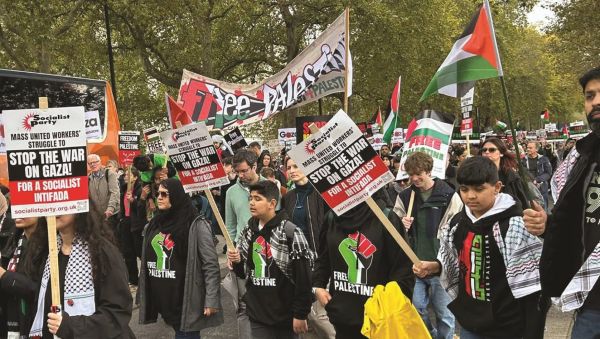
The character of the new era is epitomised in the genocidal war that the Israeli regime launched against the Palestinian people in Gaza and the West Bank following the 7 October 2023 attack led by Hamas. This war of extermination, as we explained at the time, is not a simple repetition of previous attacks against the Palestinians. It is of a different order, with massive regional and global consequences.
Global capitalism now faces a series of multiple crises – economic, political, social and environmental. Climate change and other catastrophic environmental crises are now impacting on every aspect of the world situation. They are provoking famine, violent storms and flooding, fuelling increased migration, and worsening the economic conditions of millions. These horrors can only be resolved through global planning, something which is impossible within capitalism. Degrowth and the “green economy” can offer no way forward or solution. The urgency for a democratic socialist plan is reinforced by the climatic crisis.
Breach Amongst Imperialist Powers
The breach which has taken place in imperialist and geopolitical relations is not merely the product of the whim of this or that individual political leader or the coming to power of right-wing populist nationalist regimes like Trump’s. Reflected in this development are deeper political and economic processes. A crucial factor is the emergence of a multipolar world flowing from the historic decline of US imperialism and the rise of China. This has been accompanied by a strengthening of some other weaker capitalist powers, such as India.
The breaking of capitalist equilibrium and severe erosion of the political infrastructure and institutions that the ruling classes previously rested on is a decisive feature of this era. The institutions capitalism has rested on, e.g. the traditional political parties, the church, judiciary, police and other state institutions, and internationally bodies like the WTO and the UN, are severely weakened. In some cases, they are totally discredited or shattered. This historic change is irreversible. The genie cannot be put back in the bottle.
The clash between the Trump regime and Europe over protectionist measures and military expenditure marks a historic break from the post war consensus that existed between US imperialism and Europe. Behind this lies the economic clash of interests and a divergence in geopolitical goals and interests. Trump has attempted to wean Putin away from China’s orbit. Something which, despite some friction between Russia and China, he has so far failed to do.
The situation in Europe has fundamentally changed. It is increasingly intertwined with the Chinese economy. China is crucial for the EU. The Chinese car market is vital for Germany. Volkswagen has over thirty plants in China. And now Europe is also a growing market for China. Whilst Chinese shipments to the US fell by 34.5% in May 2025, exports to France increased by 24.1% and to Germany by 21.5%. However, the US at this stage remains the largest export market for the European ruling classes.
The expansion of the EU has been combined with the coming to power of the far-right populist Orban regime in Hungary and, in different ways, the growth of right-wing populist parties in Poland, Romania and elsewhere. In various forms there has been the growth of right-wing populism in most of the EU countries. Together with political crisis at the centre of the EU in Germany and France, Europe is not the same Europe as it was in the previous period. This feeds the crisis and instability which exists. The sharp tensions within the EU raise the prospect of its possible break up or reconfiguration, possibly around the euro currency or the entire structure of the EU, as the global crisis develops further, although this process has been more protracted than we anticipated originally.
Militarisation and Wars
Inter-imperialist geopolitical conflicts have centred on the major wars in Ukraine and Gaza, both of which have assumed a global dimension. Yet the centre of gravity of such conflicts is not static or fixed. Major devastating wars are also being fought in Africa and Asia. Others can erupt in major flash points such as Taiwan, or conflicts in the south China sea, in Kashmir – as witnessed in the recent clashes between India and Pakistan, the Balkans, various parts of Africa and even in South America.
The Israeli attack on Iran, followed by the US bombardment, something that the CWI has raised as a serious threat in our previous analysis, illustrates the nature of the period we are in, in terms of global relations. This attack further intensified the crisis throughout the Middle East, plus its global consequences. The present dynamic is towards the outbreak of a regional war or wars at a certain stage, despite the highly unstable “ceasefire” that has been brokered. The underlying causes of the crisis remain unresolved and cannot be resolved within the confines of capitalism. The potential for such major wars reflects one aspect of the new period we are now in. Generally, world capitalism is now in an era of wars – both economic, trade, political and military to a degree not witnessed since 1945.
Even during the post-war upswing major wars and conflicts erupted, for example in Vietnam and Korea. Often these were the result of a revolt against colonialism. Today, however, there are fifty-two military conflicts taking place – the highest since 1945. Ninety-two countries are involved in conflicts outside their national borders. The global rearmament programmes that are being implemented in all the major imperialist powers and others have their own dynamic.
Global military expenditure reached an all-time high of US$2.7 trillion in 2024. Although as a percentage of global GDP (which is not the only measure) this is still less than at the height of the cold war, the trajectory is upwards and on current trends it will surpass that level in a few years. Wars and conflicts will intensify in this era. The global explosion of militarisation and military expenditure has both been in the form of nation-states’ military hardware and the plethora of privatised mercenary forces fighting proxy wars.
The worldwide militarisation alongside the economic and military wars reflect the fundamental changes taking place in the world economy and international relations. The decisive over-arching issues globally are the protracted decline of US imperialism, the rise of China and the weakened position of European capitalism. The balance of power amongst the imperialist powers is in the process of undergoing historic changes. It means that no one power will rule or dominate as in the past – like Britain in the nineteenth century and then, more briefly, the US.
The sharp integration of the world economy and dominance of globalisation which took place in the 1980s was rapidly accelerated following the collapse of the Stalinist states. This process went a long way. Some wrongly concluded that it was irreversible and that the nation-state was becoming a historic relic, as capitalism was in the process of outgrowing it. The CWI argued that this was not the case and that with the onset of a new structural crisis of capitalism the process would go into reverse. The globalisation and integration of the world economy that took place in the early part of the twentieth century gave way to the First World War in 1914, as capitalism then entered a new era of crisis and clashes of national interests.
Today, as recent events have illustrated, the hyper-globalisation of the 1990s has been slammed into reverse gear when compared to that period when the euro was introduced and speculation was rife about the EU evolving into a nation-state. That period has now given way to trade wars and a resetting of the integration of the world economy. The fragmentation of the world economy, accelerated earlier by Covid, is deepening, with trends of ‘de-coupling’, ‘friendshoring’, etc., as capital is forced to rely more on the nation-state. With this, a further undermining of the feeble international ‘rules-based order’ is taking place. This does not mean the end of some features of a globalised world economy.
Protectionism, Regional Blocs and the Economy
Protectionism, nationalism, rivalries and conflicts between the powers are now the dominant trend. This does not mean a total breakdown of the interconnection or integration of sections of the world economy. However, the trend towards more regional blocs, sub-regional blocs and trade patterns is emerging and will develop further. Reflecting this process, albeit on an unstable basis, it is significant that the BRICS now account for 35% of world GDP compared to 30% for the G7. The BRICS include over 40% of the global population and is growing as a bloc. Other smaller blocs and trade alliances exist. New ones can emerge. The rivalry and unstable situation can lead to shifting alliances within and between all the blocs which already exist, or new ones which can develop. The world situation is thus poised to become even more unstable, with heightened tensions and clashes of all kinds, rather than less.
There is no prospect of a return to the period of ‘hyper-globalisation’ that rapidly followed the collapse of the Stalinist regimes. This would need a sustained period of economic growth and upswing. Capitalism is not in such a cyclical phase. Rather it is in a protracted death agony. One that is marked by stagnation and recession, or at best short-lived, feeble, unsustainable, limited growth. It is marked by unprecedented and growing inequality and polarisation between the super-rich and the rest.
The world economy has seen expected global growth in a downward spiral this year to its lowest level since 2008, according to the World Bank’s latest ‘Global Economic Prospects’. In fact, illustrating the era of capitalist crisis, growth in world trade has been steadily falling for the last twenty-five years. In the 2000s it grew by 5% on average, in the 2010s by 4.5% and in the 2020s by 3%. Global economic growth in the first seven years of the 2020s has thus far been the slowest since the 1960s.
The world economy currently has unsustainable features which are a prelude to a deeper crisis. The lurch to protectionism under Trump, which Biden had also resorted to, reflects the decline of US imperialism. The fact that in the most powerful imperialist power, manufacturing only accounts for 10% of US GDP, down from 16% in 1997, illustrates the decline which has taken place. The rise of finance capital and the service sector in most of the western imperialist powers is a key aspect of the current period in which capitalism finds itself. Within this, the new sectors of high-tech and AI have strengthened their position, reflecting a certain change in the composition of the ruling class.
Manufacturing is now overwhelmingly concentrated in Asia where an enormous industrial working class now exists. This is crucial for future developments in the class struggle. It is estimated that in China over 200 million workers are employed in the manufacturing sector, in Indonesia 18.8 million and in India 60 million. The crisis in these countries is certain to lead to the outbreak of massive class battles. The political and ideological expression these take is something we must be attentive to, and be prepared to audaciously intervene in, and be open to learn from. This does not mean that the working class in the older imperialist powers in Europe or the US will not play a central role in the global revolutionary process.
The shrinking of the manufacturing sector in the US and other western imperialist powers is one factor which has triggered a lurch to protectionism by Trump and sections of the ruling class. One of the preoccupations of the ruling class in some countries is that the decline of manufacturing weakens the capacity of the ruling class to rapidly switch to armaments production should they need to. The prospect of a full global trade war, or even one concentrated in specific regions or countries, is one element threatening the prospect of a serious downturn and recession in the global economy in 2025 or 2026.
As already illustrated, the level of tariffs that are applied will oscillate, as will the intensity of the trade war, depending on specific economic and political factors. Although there will be no outright winners from this conflict, China has key advantage points – not least its concentration of rare earth mineral mining and processing. China’s president Xi Jinping got the upper hand in recent negotiations with Trump. To one degree or another trade wars are now an established part of the world economic situation in this period. In some countries in the neo-colonial world, they are having devastating consequences and can trigger defaults and revolutionary upheavals as we saw in Sri Lanka.
The staggering levels of global debt – unprecedented in capitalism’s history – are unsustainable in the medium and long term. They threaten to trigger crises, especially given the rise in financial speculation and now crypto ‘assets’. The debt repayments are having disastrous consequences in swathes of the neocolonial world which have no, or little, manoeuvrability on this issue. Twenty of the poorest countries spend more than 20% of government revenue on paying interest on debt.
The larger imperialist economies are also impacted by the debt crisis but have some manoeuvrability. The question of the massive debt levels is not just confined to the neocolonial world. It is crucial in the two most powerful world economies – the US and China. Japan kicked the crisis down the road and sustained a massive debt to GDP ratio (which reached 263.9% in 2022) for decades. Some argued that this illustrated that such a development was indefinitely sustainable. It resulted, however, in falling conditions for millions and a declining population. Now its economy is on the brink of a new crisis which is a warning for the other larger economies.
The crucial issue of the global debt is one factor, together with others, that can trigger a new financial and systemic crisis, deeper than in 2008. The possibility of a financial collapse cannot be ruled out. In the 2008 crisis the capitalist classes globally stepped in to prevent a total global financial meltdown. In this, the US and China played a central role. Today’s world is very different to 2008. The surge in protectionism and nationalism will make a global response more difficult and may mean state intervention is more national or regional than global as it was in 2008.
The contradictions and systemic crises of capitalism historically have meant that an economic reset is periodically needed. This historically has led capitalism to embark on a destruction of value, as Marx explained. This has been done through recessions, factory closures, war and even world wars. Through this, a rebooting of the economy could be possible that may create conditions for a renewed upturn or boom. This however was not automatic. The destruction of value during World War I for example did not prepare the conditions for an upturn or boom of the economy post-1918. Today, there is an element of the destruction of value taking place in the wars being fought which some capitalist sections will attempt to profit from.
Recovery from wartime destruction could stimulate some economic growth in some countries. On a larger scale the rebuilding after the Second World War did this for some countries. But this was not the only factor that prepared the way for the post-World War II upswing. The existence of the Stalinist regimes and other factors were also crucial. The fear of bankrupted states falling out of the orbit of capitalism and into the Stalinist ‘camp’ after the Second World War was an important factor that drove US imperialism in particular to bankroll massive investment in the productive forces – the Marshall Plan – which underpinned the post-war boom. Such measures are not available today, for the US or any other imperialist power.
Today, the destruction of value will not be through the medium of an all-out world war. It will be partially through regional wars like those being fought in Ukraine, Gaza and elsewhere, recession, factory shutdowns and other attacks on the working class. This process is at the beginning. But this will not prevent the ruling classes making brutal attacks against the conditions and living standards of the working class and masses globally. However, it will not be sufficient in the current situation to allow a reboot of the global economy and a new global upswing.
The element of the destruction of value is being done in a protracted drawn-out manner today. An all-out world war today would mean a nuclear cataclysmic event that would obliterate the working class, the productive forces and the capitalist class. The capitalist classes at this stage are not contemplating a nuclear Armageddon. For this to take place an entirely new world situation would be necessary involving the defeat of the working class in key countries and the coming to power of extreme Bonapartist authoritarian regimes. At this stage, the ruling classes – although fearing mass movements and uprisings – are not threatened immediately with the threat of socialist revolution. This is due to the throwing back of political consciousness and absence of mass political organisations of the working class. The destruction of value is thus being carried through by stealth.
The development of AI and new technology is a very significant development and will have a big impact in some sectors of the economy in some countries. It shows the enormous potential, but there is the class question of who gains from it. Unprecedented profits and massive investments are taking place in this sector. However, AI’s full development and application, especially throughout the global economy, will be restricted by the limitations of capitalism and it is not yet fully clear which capitalists will profit from it.
The Collapse of Rome and Capitalism
It is striking that many of the internal factors that led to the collapse of the western Roman Empire are present in the current protracted death agony of capitalism. Constant wars and overspending on the military; power struggles, corruption, and a succession of weak emperors and rulers; massive inequality and a chasm between the ruling elite and the poor giving rise to social unrest and climatic changes and disease; all contributed to the fall of western Rome. These are all symptoms of a social system that is rotting, putrid and decaying from within. Feudalism suffered the same fate in its bloody death agony. Social systems approaching their exit from the stage of history are riddled with such features. Yet for a period they may not immediately be confronted, overthrown and replaced by a new social system on a higher level of progress.
The slave-based economy of Rome meant that there was no class capable of overthrowing the old system and taking society forward. Thus, it disintegrated and collapsed. Feudalism allowed the emerging bourgeoisie, with the support of other social forces, to eventually carry through the various bourgeois revolutions and replace feudalism. Capitalism will not simply step aside and depart from the historical stage; it will need to be overthrown.
The very decomposition of capitalism is however preparing the way for such a challenge, led by the working class. The massive polarisation, wars – both economic and military – and growing alienation in capitalist society are beginning to forge a new generation of fighters that are looking for an alternative to the dystopian future that capitalism now offers. The decay in some areas of the neocolonial world however, due to the lag in the socialist revolution, is already leading to social disintegration and collapse.
Right-Wing Populist Regimes
The coming to power of a series of right-wing populist regimes, including now in the largest imperialist power, has enormously compounded and destabilised the world situation. These regimes assume Bonapartist, authoritarian methods. The ascent to power of such regimes is a product of a crisis of liberal bourgeois democracy which has offered no solution to the crisis that capitalism has plunged planet earth into in this era. They are also a product of the ideological implosion of the socialist left since the collapse of Stalinism and the throwing back of political consciousness which has taken place. They have come to power on the back of everything else having failed – including the left-populist forces that developed in some countries. In the imperialist countries, the Bonapartist, authoritarian features of these regimes have been in the form of parliamentary or presidential Bonapartism at this stage. Often, they have used the judiciary as a weapon to impose their agenda.
However, it is not only the right-populist regimes that have turned to the use of Bonapartist methods and more authoritarian measures. Other bourgeois regimes, like Macron in France and Starmer in Britain, have also increasingly adopted these methods. In some areas of the neocolonial world, it can and has assumed the character of military coups.
Attempts at imposing Bonapartist regimes can trigger mass social upheavals as we saw in South Korea with the unfolding of a mass movement and general strike. At the same time, these Bonapartist regimes can offer no solution or way out. They become regimes of crisis sooner or later as we are beginning to see in the US under Trump 2. The challenge for the working class and Marxists is to build an alternative. For this to take place a series of mass class battles are needed for a new generation of activists to be forged. Crucially, an ideological struggle is also essential to put the idea of socialism back into the equation – of an alternative social system and the programme necessary to achieve it.
The roots of the major wars currently being fought in Ukraine, Palestine and the Middle East, like many other conflicts are unresolvable under capitalism. They reflect one aspect of the character of the era – the increased capitalist competition and changes in the world balance of forces, and the character of the regimes that exist in both Russia and Israel. Russia is ruled by the nationalist, Bonapartist, authoritarian regime of gangster oligarchical capitalism of Putin. The Israeli capitalist state, while it has always been under variants of fundamentally right-wing bourgeois regimes of Zionist nationalism, is presently ruled by an ultra-right coalition with an unprecedented weight of far-right elements including some fascistic ones. Both wars are being fought by these regimes for their own strategical, economic and political interests. One factor, although not the dominant one, is that they are to various degrees motivated partly ideologically.
This is especially the case in Israel. Netanyahu, Likud and their ruling coalition are driven by a thirst for a ‘Greater Israel’, while militarily asserting Israeli capitalism as the dominant power in the region and the obliteration of the Palestinians as a nation. This is why a section of the Israeli ruling class wants to physically remove the Palestinians from Palestine. After 7 October 2023 they saw an opportunity to partially achieve this goal (which is contentious within the Israeli bourgeoisie) – they unleashed the war in Gaza which we said as it broke was not a mere repetition of previous wars in the Middle East.
Putin and his autocratic regime is partly driven by a longing to regain dominance in at least eastern Europe, which was lost with the collapse of the former USSR, the perception of the security threat posed to Russia by western imperialism’s expansion, and the idea that Ukraine, as a nation, should not exist. In its propaganda the Putin regime presented it as a war against fascism, almost a re-run of the Second World War. The invasion of Ukraine by Putin has led to the outbreak of a proxy imperialist war being fought on the backs of the Ukrainian and Russian peoples.
Gaza and Iran Open the Gates of Hell
The need for an independent class position is essential in the conflagration taking place in Gaza and the crisis erupting in the Middle East, North Africa and the Persian Gulf. A new stage was opened by Israel’s massive mid-June aerial bombardment of Iran, followed by the US, attacking over one-hundred targets, including nuclear facilities as well as a civilian centre, and assassination of senior military commanders (including the Chief of Staff of the armed forces). It dramatically escalated the crisis throughout the Middle East. The gates of hell have been opened in Gaza and elsewhere in the region. US imperialism, although initially not supplying the bombers, was aware the attack was imminent and did nothing to prevent it. As the CWI has warned, both Netanyahu and Trump have had regime change in Iran in their sights through one means or another. However, the fears of other US allies, especially the Saudi regime, resulted in a pause in mutual attacks.
The threat remains of a regional war at a certain stage, because of the dynamic of the crisis. This is despite the desperate attempts by the Arab elites, western imperialism and most of the Iranian regime to avoid it. The underlying causes of the crisis remain. The attacks can assist the Iranian regime’s use of nationalist propaganda to temporarily shore-up its position. For how long this will last is another question. There is mass opposition to the Iranian regime. This has been reflected in the important ‘Woman, Life, Freedom’ social movement of 2022-23, the revival of the workers’ movement since 2017 and the historic low turnouts in elections. These struggles were blunted in the face of the bombings but can erupt again on a higher level, possibly provoked by an ongoing water shortage, or by the hundreds being executed for opposition to the regime for “spying”.
The ethnic cleansing by the Israeli regime in Gaza is putting massive pressure on the Saudi dynasty and other Arab and Gulf states from the ‘Arab street’ demanding that something should be done. The bourgeois democratic revolution has not been completed in the Middle East and the threat of overthrow of the regimes can increase as the crisis intensifies. This may not be immediate, but this dynamic is present in the situation. Such revolutionary developments would be faced with the tasks of the permanent revolution – combining bourgeois democratic and socialist demands.
The attack on Iran followed the genocidal war the Israeli regime is waging on the Palestinian people. The bloody slaughter of the Palestinian masses, including brutal repression and the use of famine, is aimed at carrying through a policy of ethnic cleansing; driving the Palestinians from Gaza and the West Bank and creating a Greater Israel. This has been combined with further bombings and advances in Lebanon and Syria.
The desperation of the Palestinian people can result in them fleeing Gaza, which is already largely unhabitable, storming towards the Egyptian border to force the Egyptian, Jordanian or another state to accept them. Capitalism has witnessed such a mass displacement of a peoples historically – in India/Pakistan, Armenia, Greece/Turkey and elsewhere, especially after the First and Second World Wars.
It is not excluded that the Israeli regime will succeed in this objective or at least herd the mass of the Palestinian people into what will amount to what the former Israeli Prime Minister, Ehud Olmert, referred to as a “concentration camp”. This policy can provoke mass movements throughout the Middle East, Persian Gulf and north Africa especially at a certain stage, as the rage felt by the masses ignites into a social explosion. There is no solution to this cataclysmic massacre and displacement while capitalism exists. Even if Netanyahu is removed and the Israeli bourgeois opposition takes over, the brutal repression would still be prosecuted, although probably in a different form.
An independent class programme is essential to resolve the crisis, in opposition to capitalism and imperialism. A central part of the programme of the CWI in relation to the genocidal war against the Palestinians is for the withdrawal of all Israeli occupation forces, an end of the war and the right to self-determination of the Palestinian people, including the right to form their own state in their struggle for their liberation. A mass movement of the Palestinian people with a revolutionary socialist programme is necessary, linking together with movements of the working class and poor across the region. Based on capitalism there is no solution to the crisis, including two capitalist states. At the same time, it is important to recognise the right and support amongst the Israeli population for their own state and to support the demand for urgent socialist change in Israel. Replacing the Zionist capitalist state which currently exists is the only way to end oppression and poverty. The consequences of the crisis of capitalism in Israel, and internationally the struggle of socialist and workers’ forces, can assist sections of the Israeli working class and youth to begin to oppose the Israeli capitalist state. At this stage this is a small minority. This can grow because of experience and the deepening crisis. Such an independent workers’ and socialist movement will also require rejecting national chauvinism and adopting an independent programme that opposes oppression of the Palestinians in Israel/Palestine along with all forms of oppression throughout the region.
Russian Invasion of Ukraine – an Imperialist Proxy War
Western imperialism initially tried to ingratiate itself with Putin but then blocked and provoked his regime. The expansion of NATO eastwards and blocking of Russia had the effect of provoking the “Russian bear”. This was something that some western capitalist advisers warned against historically. Even today, some are questioning the hostility to Putin and raise the prospect of some collaboration and agreement with Russia as being more beneficial to their capitalist interests, especially against China.
Western imperialism, through NATO, has in effect been conducting a proxy war against Putin as he now threatens their interests. NATO forces, under Biden, were not only supplying weapons to Ukraine but worked hand in glove with Ukrainian commanders on intelligence and advising on planning operations. Putin’s adventure has been bloody, costing Russia probably hundreds of thousands of casualties plus tens of thousands more on the Ukrainian side. Putin at this stage seems determined to prosecute the war further, to try and secure more territory than the approximately 20% of Ukraine under Russian control.
Despite recent Ukrainian drone attacks deep inside Russia and attacks on the crucial bridge to the Crimea, Russia is making military advances in the east of Ukraine. A frozen war is possible. Neither side is likely to formally compromise its claim on Crimea. Putin’s threat of using a tactical nuclear weapon has receded as Russia has made gains; however, this could change. The threat of such a horrific development globally has increased in the recent period. This horror can emerge in other confrontations involving authoritarian, Bonapartist regimes that already exist or other rogue regimes which are likely to seize power in some other countries.
It is not excluded now that Trump and the US will step back further from the war. This would weaken Ukraine and provoke divisions within the EU about how to respond to such a situation. In any event, even with a patched-up ceasefire the conflict is set to continue in one form or another. The importance of socialists adopting an independent class programme in this and other war zones is crucial.
US Polarisation and Class Struggle
The massive polarisation and crisis unfolding in the US is crucial for how events develop internationally in this era. A social, political and economic tsunami is hitting the most powerful of imperial powers. The processes unfolding in the US illustrate what is developing on every continent in one form or another. Trump 2 has ushered in a new world situation and an entirely new domestic situation in the US.
Trump, at the head of a right-wing nationalist populist movement, mobilised a base and stepped into the vacuum that existed. His movement and election victory are a product of the failure of everything that preceded it, particularly the bourgeois Democrats and the old Republicans pushed aside by MAGA. This failure includes the repeated refusal of Sanders and the “left” to break with the Democratic Party and take the steps necessary to build a mass workers’ party. The processes involved are also a product of fifty years of stagnation, and for millions, decline, in real wages and living standards – a consequence of the slow decline of US imperialism which is now accelerating.
The Trump regime, although continuing some aspects of the policy of previous right-wing presidencies like Reagan’s, is accelerating the processes begun earlier. His regime is taking them to a higher, more acute level. Quantitative measures introduced by earlier administrations have now reached a qualitative change in the situation under Trump. This is against the background of an entirely changed world situation where he has intensified the trade war – despite oscillations in the tariffs to be imposed – and ripped-up the post-war consensus between the US and Europe. His regime has moved in a more authoritarian direction and encompassed strong features of Bonapartism, enhanced by the Supreme Court decision giving presidents immunity for all “official” acts. It is further illustrated by Trump’s bombing of Iran without the approval of Congress, in defiance of the War Powers Act of 1973. This is inherent in all presidential systems, however Trump has accelerated the process and taken it to a higher level.
This is reflected in the deployment of the National Guard and the Marines in Los Angeles – a step of doubtful legality given Trump’s reluctance so far to invoke the Insurrection Act. The seizure of people from the streets of many cities by masked and unidentified ICE and other operatives illustrates this. Trump’s defiance of the court ruling heralds the likelihood of an historic constitutional crisis. It is important to recognise that the Democrats have also deployed the National Guard against other movements in the past. The actions of the Trump regime – including the arrest of a senator, a New York mayoral candidate, attacking and killings of Democratic politicians and growth of arms sales – all illustrate the massive divide opening up. The mass protests and opposition in parts of Los Angeles to the deployment of ICE and the National Guard in that city, illustrates the massive polarisation and potential for action which is now interwoven into the fabric of US society. The killing of the CEO of one private health company, which got widespread sympathy amongst some layers, illustrates the anger and the potential for actions of individual terrorism to develop in the US and other countries, especially if there is a delay in big movements of the working class in struggle.
The degree of polarisation constitutes one aspect of the tendency towards elements of civil war, in a modern form – developments that will intensify as events unfold. This does not mean a repetition of the 1861-65 US civil war as such, but entrenched polarisation, clashes, including armed clashes, in the US. This is something rooted in the history of the workers’ struggles in the US, especially in the 1921 ‘Battle for Blair Mountain’, involving 10,000 armed coal miners and 3,000 law enforcement personnel and strike breakers, the largest military clash on US soil since 1865. It is also something which is not totally unheard of recently in advanced capitalist countries as shown in Ireland from the late 1960s until 1998 and the more recent clashes over the national question in Catalonia. One aspect of this is the prospect of deepening centrifugal tendencies in the US between some states and the federal government. Events in California have illustrated this.
As already seen, the Trump regime will be one of crisis and divisions. At a certain stage it will collide with massive opposition, most importantly from organised labour and crucial social movements such as the migrant population, women, LGBTQ+, environmental and others. This is being enforced by the massive upward distribution of wealth and social cuts to basic services as shown in Trump’s “Big Beautiful Bill”. These will provoke mass opposition at a certain stage.
The growth in some sections of trade union membership is a harbinger of big class battles that will erupt and is very significant. All the polls indicate massive support or sympathy for the idea of trade unions and organised labour. Yet this process is at an early stage and is uneven. A struggle to transform the trade unions into combative fighting organisations is crucial in order to capitalise on the potential. Despite the surge in support for the idea of trade unions this is not transformed into reality. Trade union density is thus the lowest for one-hundred years and remains at 10.7% of full-time workers. The trade union bureaucracy, in the main, has proved incapable of capitalising on the potential which exists.
An important factor here is the composition of the working class. Sections of the middle class are in the process of being proletarianised in terms of conditions, both at work and in society. This will develop further, especially as AI increasingly encroaches on these layers. The strikes of screen writers at Hollywood were significant in this respect. At the same time, an explosion of precarious jobs, agency and self-employed work has taken place. This is an important factor and is an international trend. New methods and forms of organisation are essential to deal with this in the multiple workplaces that millions are now compelled to work in to make ends meet.
Revolution and Counter-Revolution
In the US and globally we are seeing a struggle between elements of revolution and counter-revolution being fought-out. Globally this takes many forms. However, the world situation is now marked by this process. At this stage it is not the threat of socialist revolution that is immediately posed, due to the subjective factors of the absence of mass revolutionary parties, the throwing back of political consciousness and the ideological collapse of most of the socialist left. Objectively the conditions for socialism are rotten ripe. However, the subjective weaknesses become intertwined with the objective situation and are thus interlinked.
These processes have resulted in an era of populism of both the right and the left. The recent period has ideologically been one of populism. The failure of the left-populist movements in Europe, the refusal of Sanders and co. to break from the US Democrats, the betrayals of the first ‘pink wave’ in Latin America and then its paler version, have allowed the populist-right to step in and electorally largely gain the momentum. This is having devastating consequences, provoking further polarisation and conflict. Attacks on the working class, not least under the pretext of debt and militarisation, have been accompanied with an ideological counter-offensive by the ruling classes that has particularly targeted immigrants, but also LGBTQ+ people and women’s rights, alongside anti-‘progressive’, and anti-socialist rhetoric.
Reaction, while having a devastating effect on the lives of many, and often a complicating effect on consciousness of sections of the masses with the whipping-up of chauvinism and prejudice, has nevertheless been further propelling polarisation, crises of legitimacy of governments and state institutions, development of class antagonism and radicalisation among sections of the working class and youth. A backlash against the right-populist movements and regimes will erupt.
The mass social uprisings that we have already seen and significant upturn in the class struggle in some countries are a harbinger to even greater social uprisings and battles in this era. General strikes have developed in a series of countries, from Argentina to Morocco to India, from Belgium to Serbia, as part of resurgent working class militancy. A deep ingrained hatred of the “establishment”, the rich and the rulers is to be found in many countries. The far-right and populist-right have echoed this in a cynical manner.
The devastating crisis in the neocolonial world is leading to explosive developments. The regime in Burkina Faso signifies an important development. A regime denouncing imperialism has significant support at this stage. It has echoes of Cuba in the very early stages of the revolution. Yet reflecting this era, it is not, at this stage, posing the question of socialism, even in the very vague and loose way some nationalist movements raised it in the past.
The Gaza solidarity movement, involving sustained mass mobilisations and some bold working class actions, as well as militant student protests, has been a major focus of radicalisation among sections of the working class and youth. This has involved a recognition of the reactionary role of US and Western imperialist governments – which have often aggressively suppressed protests – and corporations and has been one of the important arenas of intervention for socialist forces over the recent period.
Political consciousness amongst the working class and the masses does not develop in a constant line of ascent. Steps and leaps forward can take place. We saw this during the mass uprisings in Sri Lanka, Sudan and Chile despite the limitations which existed. Yet, as we have seen, this can be followed by regression. Yet this is not the end of the process. A series of crises will be met by mass movements involving bitter class struggles, in which it will be necessary to forge a new generation of fighters that draw socialist and revolutionary conclusions.
The formation of new mass parties of the working class can be an important step in this process. Such developments would signify the working class becoming a class for itself, rather than a class in itself. Bitter class struggles are crucial for this process to develop, and it will be posed in this era. At the same time, the role of the subjective factor is crucial. The process can be even more protracted than it has been, due to the weakness and ideological shallowness of the ‘left’ that acts as a break on the process.
It is important to stress that even with such a delay, a significant layer of workers and youth can be drawn directly to support and join a revolutionary socialist party and international. New broad mass socialist parties of the working class would represent a big step forward in class consciousness and as a part of the struggle to build revolutionary socialist parties. However, it is important that the building of revolutionary socialist parties is not dependent on new broader parties of the working class being formed.
This era is already resulting in ethnic clashes, wars and in some areas of the neocolonial world disintegration and social collapse. Yet it can also produce mass revolutionary explosions even without mass parties or revolutionary socialist parties. New regimes in some countries can be thrust into power that seriously encroach on capitalist and imperialist interests. In the past such regimes could have been drawn into the orbit of the Stalinist states and overthrow landlordism and capitalism. Today, with the collapse of the former USSR it is more likely that such regimes would be short-lived, unless the socialist revolution developed elsewhere. Developments more akin to a modern version of the Paris Commune are not therefore excluded. The CWI must be prepared for such explosive developments.
Role of the CWI
We are now in a new era. What previously was viewed as possibilities in the future, is unfolding today. In that sense the future is now. We need to embrace it, warts and all. We need audacity in active intervention in the class struggle and struggles of the masses. One aspect of this is the need for audacity of thought to conduct an ideological battle. The CWI in many respects ideologically faces similar challenges to those that confronted the First International. The Second International propagated the idea of socialism, which we also need to do today. Yet it was soon comprised of large or mass organisations and the idea of socialism as an alternative social system was more widely part of the political consciousness of the working class. However, the mass organisations of the Second International and those later formed by the Third International did not change the world.
Today, it is essential we train our cadres in the method of Marxism and apply it to a new world. More than ever before, routine repetition of formulae is not applicable to this era. We should consciously challenge any conservative repetitions of formulae that no longer correspond sufficiently with developments and tasks. At the same time, we should be mindful of the dangers of over-abstract, vague notions of a need for ‘something new’ stemming from false perceptions of conservatism – not least under the influence of bourgeois and petty-bourgeois ideological pressures. If we combine all the important tasks facing us, we can be confident that the CWI can take steps and leaps forward in the struggle to build a revolutionary socialist international, which is an indispensable tool for world socialism.
Appendix
Elaboration on the Middle East, extracted from proposed amendments by visitors to the CWI Congress from Socialist Struggle Movement in Israel-Palestine
Genocidal Onslaught on Gaza and Regional Showcase Bombings Fuelled by Washington
The Israeli government of Netanyahu and the far-right is predominantly driven by aspirations of expansionism and ethnic cleansing between the river and the sea, with the logic of obliteration of the Palestinians as a nation, while militarily asserting Israeli capitalism as the dominant power in the region under the auspices of US imperialism. They have unleashed, with the decisive backing of Washington, one of the worst catastrophes on the planet in this century, including massive extermination and destruction, and the use of famine, in the pursuit of driving the Palestinians from Gaza and large areas of the West Bank, generally striving to advance annexations in one form or another towards a ‘Greater Israel’.
On the one hand, divisions in the Israeli ruling class have been significant and rife, reflecting strategic dilemmas in the face of a profound generalised crisis, including concerns around the ideas of pursuing entangling annexations and a recolonisation project of Gaza, along with opposition to a range of government policies. This went as far as an open alliance by key forces of capital and senior former officials from the military-security elite and state apparatus with the General Histadrut’s leadership around two protest labour general strikes against government policies, including one in the context of the highly contradictory Israeli protest movement for the return of hostages (where left and socialist forces demanding an end to the genocidal onslaught in itself are in a minority). This is a sign of a degree of desperation of the Israeli ruling class, relying on it legitimising methods that may potentially be turned against itself in the future. But nevertheless, the bulk of the military campaign by the Netanyahu government involved carrying out geostrategic aspirations of the ruling class at large, in its extremely cynical exploitation of the Hamas offensive of 7 October 2023.
It is only recently that some Israeli bourgeois spokespersons began criticising ‘war crimes’ by the Israeli government. This reflects their fear of the potential global and regional longer term political fallout, while public opinion about Israel is in a sharp decline even in the US, and it is also Western governments that are pushed to attempt to restrain or softly challenge the Israeli regime to politically camouflage their ultimate complicity in the genocidal onslaught against the Palestinians via symbolic measures, including some support of ICJ and ICC nominal procedures on the charge of genocide.
Globally, the genocidal onslaught on the Palestinians and the massive regional aggression have further propagated reactionary phenomena of chauvinism, antisemitism and Islamophobia. But also the explosion of the international solidarity movement, which has been a worldwide rallying call, and despite systematic repression has been more enduring internationally than the movement against the invasion of Iraq in 2003. In some countries it became a significant factor in the dynamic of elections and pressure on governments.
Generally, the question of Palestinian liberation is bound to remain an important focal point for mass radicalisation and mobilisation, both in the imperialist countries and the neo-colonial world. It is the task of Marxists to energetically intervene and assist also in overcoming limitations through pointing out a way forward for effective mobilisation of international working-class solidarity — including building on the marvellous examples of militant actions by dock workers across several countries — for organising, and for pointing the way forward programmatically for working-class struggle to overcome imperialism, the oppression of the Palestinians, and the regimes of oppression across the region.
The roots of the historic bloody crisis in Gaza have been first and foremost the extreme oppression and dispossession of the Palestinians. 7 October occurred in the context of important shifts in global and regional relations. The regional Arab–Israeli ‘normalisation process’ — in fact, normalisation of the occupation and subjugation of the Palestinians — that has been integrated in Washington’s broader strive to obstruct advancement of Chinese and Russian rival imperialist interests in the region, was about to yield an official agreement with Saudi Arabia. Hamas, lacking any genuine strategic outlet to fundamentally challenge the occupation, capitalism and imperialism, attempted to cut across the process and bring back the Palestinian question to the centre of world attention.
For the Israeli ruling class, 7 October, with the mass Israeli shock from accompanying acts of murder and kidnapping of civilians, was seen as a historic opportunity to unleash massive firepower to qualitatively reshape the region to their will. That is, carrying out by ‘other means’ the fundamental logic of the diplomatic ‘normalisation process’, delivering a historic blow to the Palestinians, and undermining the regional posture of the Iranian regime and its allies.
The Israeli government was seeking mass uprooting of Palestinians from Gaza from the outset, but met the resistance of Arab regimes, ultimately reflecting pressures of mass rage and the underlying class power balance regionally. However, Trump’s backing has re-boosted their determination in this context, with a plan for a giant concentration camp to serve in preparation for ‘voluntary’ emigration. Given the super-extreme conditions under the constant barbaric attacks by the Israeli occupation, mass desperation can result in a section of the population conceding to either a ‘voluntary’ uprooting, or even to episodes of storming the border with Egypt.
This spectre of another mass uprooting from historical Palestine, is reminiscent of the catastrophic mass exodus of 1967, and of course of the original colossal ethnic cleansing in the events of the Nakba of 1948. It is not excluded that the Israeli regime will succeed in this objective. However, not with a complete depopulation of Gaza, and not without evoking further mass rage across the region and globally.
The mass solidarity with the Palestinians across the region and the deep antagonism by the masses towards US imperialism are putting massive pressure on the pro-US Arab regimes in the region to camouflage their strategic convergence or outright alliances with the Israeli regime, to suppress independent protests, and to rhetorically pose as echoing mass rage and ‘doing something’.
Over the last decade and a half, processes of revolution and counter-revolution have developed across the Middle East and North Africa in a more generalised manner than in other regions, not least as expressed in the so-called ‘Arab Spring’ revolutionary wave of 2011, with an important incipient role played by sections of the working class, but also in consequent episodes of mass uprisings, often on a higher level, drawing out lessons from earlier experiences.
The bourgeois democratic revolution ultimately cannot be completed in the neo-colonial countries of Middle East and North Africa in the era of imperialism, with sharp class contradictions posing a potential existential threat to the interests of the capitalist class, landlords and military generals. While the ‘normalisation’ of relations with the State of Israel has been deeply unpopular before, it is now even more acutely so, and the mass rage over Gaza, even in countries where independent protests have largely been suppressed such as Egypt, is another important factor in the development of simmering mass antagonisms that are bound to re-erupt sooner or later.
The deposing of the Ba’ath regime of Assad, although not by the masses and for a new dictatorial capitalist regime, nevertheless reflected an entirely eroded social base for Assad, and posed once again, albeit in a completely deformed form, the idea of the feasibility of overthrowing longstanding dictatorships. Further new episodes of mass movements and revolutionary crises would be faced with the task of rebuilding mass independent fighting organisations led by the working class, drawing out lessons of the past, and pursuing the tasks of the permanent revolution combining democratic and socialist demands.
The idea that some combined force of several Arab regimes in the region, with or without collaboration from the deeply unpopular Palestinian Authority, would enter Gaza to locally govern the population instead of Hamas, as a subcontractor for the Israeli occupation, would meet, as another foreign occupation force, renewed resistance, but also may ‘infect’ the ranks of any such Arab force with revolt against the regimes in their home countries.
In any scenario, the Palestinians themselves will continue to pursue liberation and challenge the occupation. Recent protests by surviving residents in Gaza itself, for ending the Israeli genocidal aggression but also against the dead-end policies of Hamas for the liberation struggle, implicitly pose the necessity for an alternative, independent socialist voice to be organised and show the way forward. There is no solution to the entrenched occupation and oppression of the Palestinians while capitalism exists. While the Israeli occupation forces are set to potentially remain in parts of Gaza for years, the current extensive hyper-intense phase of the genocidal onslaught may give way to attempts to restructure the occupation and stabilise the situation. It is mass interventions globally, regionally, and locally that may push back the brutal war machine of Israeli capitalism, its Western imperialist backing, and force concessions.
An independent class programme is essential to resolve the crisis in opposition to capitalism and imperialism. A mass movement of the Palestinian people with a revolutionary socialist programme, linking together with the movements of the working class and poor across the region, is necessary . Under influence of domestic crises but also global and regional development of independent left and socialist forces among the working class, sections of the Israeli working class will in the future also move more decisively against Israeli capitalism, which will require breaking with national chauvinism and adopting an independent programme that fully challenges all forms of oppression and dispossession of the Palestinians, for full national and social liberation.
This would provide a basis for a necessary future unity in a struggle to overthrow Israeli capitalism, the Arab elites and the theocratic Iranian regime and establish a democratic, socialist confederation of the region on a voluntary and equal basis.
Only in this context could the resources of the region be democratically mobilised to equally address the needs of the masses, to assist in a comprehensive addressing of the national and social aspirations of the Palestinian refugees, including a right to return, while guaranteeing the rights of all nations and minorities. At this stage such a solution appears remote and is not present. However, this can change through events and struggles. It is the task of Marxists to put forward a transitional socialist programme to point to the necessity of a fundamental, revolutionary solution, to pave the way for complete liberation from all forms of oppression, exploitation, imperialist and colonial subjugation, and on this basis open the prospect for a lasting peace for all.
Regional Power Struggle
With the showcase bombings against the ‘Axis of Resistance’ alliance, the Israeli regime and the ruling class at large were openly aiming to also prove as an efficient ‘outpost’ for the interests of Western imperialist powers at large. The all-out attack on Iran was a further step in a major shift in the regional balance of forces, with the significant setbacks for the ‘Axis of Resistance’. This was openly praised by the German Chancellor Merz, who stated that ‘Israel is doing the dirty work’, essentially for Western imperialism.
While Moscow and Beijing could not in the current circumstances intervene in the region in the face of the Western imperialist offensive without major entangling consequences for them, they want to attempt to safeguard the regime in Tehran, which shortly after the ceasefire already received a shipment of Chinese air defence missiles.
The dramatic military ousting of the Assad regime in Syria, a development that was triggered by the declared ceasefire in Lebanon, led to a significant regional setback for Moscow, with the new al-Sharaa-led regime, under Turkish sponsorship, clearly oriented at this stage towards business with Western imperialism. Although Trump has pushed for a Syrian–Israeli ‘normalisation’, this doesn’t seem likely in the coming period, and the Israeli regime has exploited the circumstances for a more extensive military intervention and occupation on the ground.
Despite the significant setbacks of the ‘Axis of Resistance’, not least Hezbollah, none of its key components are disintegrated, they generally maintain a political base of support, and are not bound to merely capitulate. The Houthi regime in Yemen, even after substantial bombings by the US and UK, as well as the Israeli air raids, can still mobilise tens of thousands to rallies, and is still somewhat challenging the Israeli state and Western imperialist interests with military measures, not least with ongoing disruptions of trade routes in the Red Sea.
However, it is necessary to counter any illusions that those measures may point to a path to strategically force US imperialism and the Israeli regime to cease military aggression across the region. None of the right-wing Islamist, pro-capitalist, components of the ‘Axis of Resistance’ offers a way out for overcoming imperialism, for a Palestinian liberation, and for mass social liberation.
As Trump pursues new geostrategic deals in the region to secure the grip of US imperialism, including reigniting the ‘normalisation’ process of Arab and Islamic regimes with Israeli capitalism, the general regional situation remains highly volatile.
Despite the triumphant rhetoric of Trump and Netanyahu following the war on Iran, recent reports suggest that only the Fordow facility was generally destroyed in the US bombing, and the Iranian regime hasn’t been hurrying to abide by Trump’s dictate of renewed negotiations. The motivation of the regime to pursue a military nuclear programme has generally increased as a result of the Western imperialist aggression, and the motivation of the power-drunk Israeli regime to challenge its rival is at its peak. The underlying causes of the crisis remain.
While for the Trump administration, there is no basis for a potential decisive intervention to impose a ‘regime change’ similar to the Iraqi model, as such direct and extensive military occupations in the region are ruled out as an option for US imperialism in the present conjuncture, the Israeli regime has developed its appetite and more explicitly aspires to advance a vector of ‘regime change’ through efforts to destabilise its Tehran rival.
Further and even more destructive ‘rounds’ of the Israel–Iran conflict are posed. The ruling classes at large, including part of the Israeli ruling class, would prefer to avoid a potential entanglement in what could be an out-of-control regional conflagration, but they are locked into this generally escalated conflict.
Generally in this era, a mere preference by the ruling classes to avoid more explosive military crises cannot in itself cut across the march of processes of generally escalating inter-imperialist and nationalist conflicts, and the military build-up carries the logic of preparation for further qualitative new confrontations.
The recent bombings across Iran has assisted the Iranian regime in temporarily shoring up its position. For how long this lasts is another question. The memory from the crushed 2022 mass uprising — where the oppression of women and the Kurds was a major catalyst for a generalised movement against the theocratic capitalist regime, under the Kurdish slogan ‘woman, life, freedom’ — is still fresh. A resurgence of social protests and labour strike actions was a major development in the months and weeks leading to the Israeli bombings. These were blunted in the face of the bombings but will, eventually, erupt again on a higher level, drawing more generalised conclusions against imperialism and about the potential role of the working class, as pointed out today by some independent unions.
Intertwined with the fundamental suffocating living conditions, state repression and gender oppression, the questions of national oppression will in themselves feed further rage against the central regime. Generally, the Kurdish national question across historical Kurdistan remains a running sore for the stability of the regimes in the region, certainly including after the official dissolution of the PKK and its affiliates following a bankrupted strategy for national and social liberation.
Mass interventions are generally posed across the region more frequently in this era, as indicated by the recent mass protest movement in Turkey against Erdoğan and the AKP. Although, in the absence of independent working-class leadership, they are more open for intervention and manipulation by bourgeois forces, aiming to subjugate the power of mass struggles to their own programme — as must constantly be exposed and warned against.
NB: the content of this appendix was part of background material at the 14th CWI World Congress and was not voted on.