
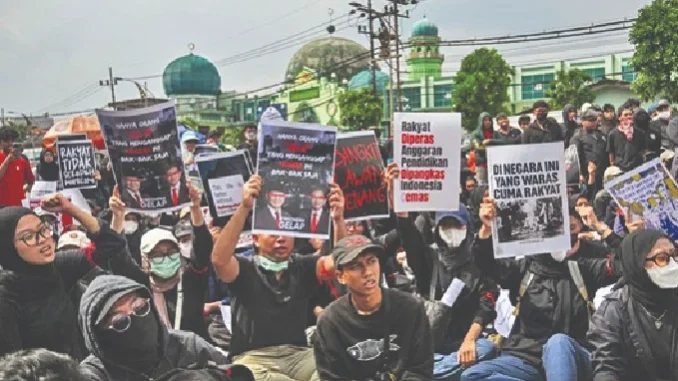
Just ten months into Prabowo Subianto’s tenure as President, social unrest is reaching a peak in Indonesia. On Friday, August 29th, a gig economy food delivery worker was killed after being run over by a Brimob (Mobile Brigade) truck driven by tactical police. The 21-year-old worker, named Affan Kurniawan, who was trapped in the middle of a demonstration, had to stop his vehicle because his mobile phone fell onto the road. One issue this demo was protesting was the decision to give MPs an extra $3,000 a month housing allowance. During the incident, he was hit and run over by the truck. Affan’s death was mourned by thousands of Indonesians and gig workers (Ojek), who accompanied his funeral procession to the cemetery. The tragedy sparked larger protests across the country, intensifying public anger toward the security forces. In the days that followed, police crackdowns resulted in the death of a student who was beaten by authorities. Meanwhile, in Makassar, three civil servants died after becoming trapped in a burning Regional People’s Representative Council (DPRD) building — the fire believed to have been started by unidentified protesters amid the unrest.
Social Unrest and the Brutality of Indonesia’s Ruling Class
Since the student protests dubbed ‘Dark Indonesia’ began last February, mass outbreaks have continued to occur in major cities and industrial areas across different regions involving hundreds of thousands of people. The series of protests that have erupted are generally peaceful but are often met with repressive and violent actions by the police. For example, on last May’s Labour Day (May 1st), a peaceful rally organized by a coalition of trade unions, students, and activists, GEBRAK (Workers’ Movement with the People), was reportedly proceeding peacefully when police acted by spraying tear gas, beating demonstrators causing serious injuries, and arresting demonstrators by accusing them of being anarchists. Observers described the arrests as indiscriminate, as not only protesters but also volunteer paramedics on duty were detained. Some of these arrests were reportedly carried out by unidentified individuals dressed to resemble demonstrators, raising further concerns about infiltration and the blurring of lawful and unlawful authority during crowd control.
Demonstrators who required medical treatment were pressured by police to undergo investigative procedures, despite healthcare personnel instructing them to rest. This even extended to urine tests administered by narcotics officers. Such measures were widely perceived as deliberate attempts to criminalize protestors and weaken the mass movement. The brutality and inhumanity of the authorities came under intense public scrutiny following the death of Affan Kurniawan, which spread rapidly across social media and dominated headline news. His death ignited an even larger wave of protests, ultimately forcing Prabowo to promise the revocation of increased housing allowances and several privileges previously granted to government ministers. In response to public outrage, he also demanded a thorough investigation, pledged firm action, and offered a house to Affan’s family. Yet these symbolic gestures raise difficult questions: will they truly satisfy Indonesian society? Can the public forget the systematic brutality of the authorities—who, between February and August, detained more than 1,000 activists, subjected them to violence, and left 20 still missing without a trace?
The authorities’ narrative of branding protesters as “anarchists” and “terrorists” formed the backdrop to National Police Chief Listyo Sigit’s speech—captured on video—where he instructed police to shoot demonstrators deemed anarchistic or terrorist. He later sought to justify his statement by clarifying that the bullets to be used would be rubber bullets, supposedly ensuring they would not cause death. Yet this does not make the authorities’ stance “more ethical.” Instead, it reveals the ruling elite’s willingness to rely on violence to preserve the status quo. Rubber bullets themselves remain deeply controversial, as they can inflict severe internal injuries and even cause death when fired at close range. Moreover, what assurance is there that live ammunition will not be used against demonstrators? The events in Papua in 2019 stand as a grim reminder: during peaceful protests against racism, the authorities opened fire with live rounds, leaving more than 40 people dead.
What Prabowo labels as anarchism and terrorism—such as the burning of the DPR building and the targeting of the homes of “big-mouthed” ministers and celebrities— reflects Indonesians’ refusal to continue tolerating the worsening economic conditions and the arrogance of the political elite of Indonesian capitalism, who show open disregard for the masses. The combination of widespread poverty, broken promises, and the cruelty of the authorities, set against the backdrop of elites flaunting their wealth, has only deepened public anger and resentment.
Before the new minimum wage was announced on January 1st, the Indonesian trade union confederation, Konfederasi Serikat Pekerja Seluruh Indonesia (KSPSI), had demanded a 10% wage increase across all regions. Yet the government only granted 6.5%—a figure that falls far short of the rising cost of living. The contrast is stark when compared to the obscene privileges of the ruling class: housing allowances for ministers were raised to a level equivalent to ten times the minimum wage in Jakarta alone. This exposes the true priorities of the regime—lavishing wealth on the elite while consigning workers and the poor to continued hardship. The unstable economic situation, the ever-widening gulf between rich and poor, the brutal repression of those who dare to resist, and the rot of a corrupt political system leave Indonesians with no meaningful channels to express their grievances. For the masses, it becomes increasingly clear that appeals within the system bring only betrayal, while the ruling elite deepen their luxury at the expense of the people.
The mass outbreak and rising people’s movement in Indonesia bear strong similarities to the revolutionary wave of 1998, when protests and demonstrations toppled the dictator Suharto. This assessment is also shared by Perserikatan Sosialis, a left-wing organisation in Indonesia, which points to the large-scale involvement of unions and workers as a decisive factor in the current struggle. While the economic, political, and democratic conditions are not identical, the people’s response to today’s crisis strongly echoes the revolutionary spirit that dismantled the New Order regime. What Prabowo cynically brands as “anarchic” or “terrorist” actions are expressions of a mass discontent that reflects the deep crisis of the Indonesian capitalist state. The ruling class uses such narratives deliberately, seeking to belittle and delegitimize mass protests that are in fact charged with systemic demands.
At the same time, as comrade Mahe of Perserikatan Sosialis—who is actively intervening in the movement—warns, acts such as vandalism or intimidating police, even if born from justified anger, can ultimately harm the struggle. The ruling class exploits such actions as a pretext for intensified repression, indirectly weakening the broader movement. Instead of destruction, public institutions like the DPR building should be seized and transformed into centres for organizing a wider and more progressive political struggle. To achieve this, the movement must be built on the foundations of collective struggle, solidarity, and conscious organization, capable of turning mass anger into a disciplined force for genuine change.
Return to Militarism
The reform project that shaped Indonesia’s democracy after the overthrow of Suharto in 1998 has now fully collapsed, turning into the greatest impediment to any meaningful democratic movement. Prabowo’s ascent to the presidency epitomizes this decay. He is not just the commander who ruthlessly suppressed the Reformasi movement in 1998; he now openly champions economic development through military “discipline,” a move dressed up as modernization but intended to slash public spending to benefit a small elite.
Prabowo is reviving Suharto-style military dominance in politics. Under his administration, amendments to the 2004 TNI law now allow active-duty military personnel to serve in up to fourteen civilian institutions—including the Attorney General’s Office, the State Secretariat, counterterrorism, narcotics, and others—a clear regression toward the New Order-era doctrine of “dwifungsi” (dual function). This rollback of military restrictions—combined with extended retirement ages for officers—signals a dangerous erosion of democracy.
Prabowo justifies this creeping militarization through geopolitical rhetoric—citing instability abroad and the need to protect strategic resources like food, agriculture, and water. In practice, however, it paves the way for the armed forces bureaucracies to administer social programs—such as free school meals and pharmaceuticals—while weakening democratic oversight.
History reminds us that the military is a pillar of the capitalist state, not a neutral guardian of society. Just as the U.S. military advances corporate interests in Gaza, Indonesia’s armed forces have long been used to subjugate West Papuans and suppress political dissent. Strategic national projects accompanied by military law amendments are not reforms—they are mechanisms to turn public services into profit-generating sectors. The military becomes the enforcer of capitalist extraction, not the defender of democracy.
Therefore, the military under Prabowo is no democratic institution—it is an instrument of authoritarian capital. Like the juntas in Myanmar, Sudan, and Burkina Faso, armed elites cannot lead society—they enforce violence to maintain the capitalist system that is the root of working-class suffering.
Prabowo’s Sovereign Wealth Scam
The Danantara project, launched last February, is an Indonesian sovereign wealth fund that pools the assets of major banks, state-owned enterprises, and national utilities like Perusahaan Listrik Negara, Pertamina, Telkom Indonesia, and Mining Industry Indonesia. With nearly $900 billion in assets under management, Danantara has been advertised as one of the largest sovereign wealth funds in the world — bigger than Singapore’s, and said to rival even Saudi Arabia’s. The government boasts this will push growth up to 8% in the coming years.
But behind the flashy announcements lies deep risk and speculation. Danantara’s first financing move has been to issue “Patriot Bonds” and shares — a gamble that depends entirely on volatile global markets. These debts will have to be repaid, with the burden inevitably falling on the masses. At the same time, Indonesia is pouring billions into building a new capital in East Kalimantan, officially projected to cost $33 billion. The state claims it will only cover a fraction of the cost, but in reality the money will be squeezed from debt, speculation, and austerity.
Indonesia is also being tied even tighter into the global capitalist market, especially through raw materials like nickel, where it controls around 60–70% of global supply. But the main buyer — China — is facing a crisis of overproduction in electric vehicles and semiconductors. This means less demand, factory slowdowns, and closures. With over a thousand Chinese companies operating in Indonesia, especially in mining and construction, the real price will be paid by workers: layoffs, wage cuts, and harsher conditions, all to shield investors from losses.
Prabowo’s government calls this “efficiency,” but it is nothing more than austerity. Cuts are hitting education, with 35% slashed from higher and basic education budgets, hurting students and pushing contract teachers into precarity. Public health services and disaster relief have also seen cuts of up to 50%. Infrastructure projects like roads and drainage — vital for everyday people — are abandoned, while billions are poured into prestige projects for the ruling elite.
The working class is already resisting albeit sporadically. Teachers, students, and trade unions are mobilizing with protests, pickets, and threats of strike action. The message is clear: the wealth of this country is being gambled away to serve global capital, while the people are asked to tighten their belts. Under Prabowo, Indonesia is not moving toward “modernization,” but back to Suharto-style military rule combined with brutal capitalist exploitation.
Build a Unified Struggle Against Capitalism
Prabowo, now appointed as president, carries a bloody record that remains unpunished. He was directly involved in the kidnapping and torture of pro-democracy activists in the turbulent months leading to the fall of Suharto in 1998. Twenty-three activists were abducted under his command; thirteen are still missing to this day. His crimes extend further back — including his role in the Krasas Massacre in Timor-Leste in 1983, where more than two-hundred people were slaughtered. These are not allegations from the margins; Prabowo himself has admitted to parts of these crimes, yet no genuine investigation or trial has ever taken place.
Despite this criminal past, Prabowo climbed to the highest office through manipulation, the machinery of mass media, and above all, through political deals that preserved elite interests. Central to this manoeuvre was his alliance with outgoing president Jokowi, sealed by the appointment of Jokowi’s eldest son, Gibran Rakabuming Raka, as Vice President. This dynastic handover was no coincidence — it was the product of constitutional amendments and backroom agreements designed to ensure the continuation of Jokowi’s political and capitalist agenda under Prabowo’s militaristic leadership (see here).
A recent campaign carried out by the Perserikatan Sosialis (see here) has rightly exposed this oligarchic-style militarism. Prabowo is not an exception but a symptom of a political system that places the power of a handful of capitalist elites above the democratic and social needs of the masses. His presidency represents the tightening grip of oligarchy, where the faces may change but the dictatorship of capital remains intact.
At present, the Indonesian masses are volatile and restless. While the movement is still fragmented and sporadic, its anger is unmistakably directed at systemic oppression rooted in capitalism. Across regions and layers of society — from workers demanding higher minimum wages, to youth and students fighting for free education, to communities demanding fair housing rights, democratic reforms, and the repeal of the Omnibus Law (see here) — the demands are surfacing as clear expressions of class struggle. They expose the growing divide between the capitalist ruling elite and the exploited majority.
The urgent task on the ground is to unify these diverse mass actions into a single fighting program rooted in class struggle. Only a program that boldly calls for the abolition of capitalism itself can channel the current anger into a movement powerful enough to overthrow the oligarchic system and replace it with one based on genuine democracy.
International Working Class Solidarity
The global capitalist system is entering a new era of crisis. No continent today is truly stable: each is witnessing mass outbreaks, political turmoil, and waves of resistance fuelled by a deteriorating world economy. The working class is paying the price everywhere. Governments delay or block minimum wage increases, slash spending through austerity, cut subsidies, and privatise key public services and national industries like electricity, oil, and transport. Millions are forced into precarious and unprotected jobs in the gig economy, a growing global trend that strips workers of the most basic legal and social protections.
Yet alongside this deepening exploitation, the world is also seeing a resurgence of class struggle. Workers everywhere are rising in defence of their rights and livelihoods. In South Korea, millions joined strike action that defied a military emergency declared by President Yoon and demanded his resignation. In India, a historic 250 million workers mobilised in a general strike in 2020 against privatisation, contract labour, and anti-democratic laws. In Britain, the strike wave in recent years has been the largest in decades — including the unprecedented five-day strike of NHS healthcare workers. In Northern Ireland, the public sector union NIPSA launched its biggest strike in history to resist austerity and demand higher wages. Across South Asia, mass uprisings toppled corrupt regimes in Bangladesh and Sri Lanka.
These struggles are not isolated. They are proof that the capitalist system has reached its limits. From one country to another, the same conditions appear: falling living standards, authoritarian governments, and economies run for the profit of a handful of billionaires and corporations. And in every corner of the globe, workers are showing their power. When they strike, profits stop. When they rise, consciousness spreads, inspiring workers elsewhere to fight back. We saw this dynamic in 1998, when the Indonesian uprising shook the region and helped spark political developments in Malaysia.
For this reason, Socialist Alternative Malaysia stands in full solidarity with Indonesian workers rising against systemic oppression. Their struggle is our struggle. The demand to dissolve the current Indonesian government — an oligarchic tool of the capitalist class — is not utopian, but a necessary step in the fight for the political and economic liberation of the masses. But dissolving a government alone is not enough if its replacement is also based on capitalism. If capitalism remains intact, the ruling class will regroup and reclaim the political vacuum. That is why the struggle must be directed towards building working class politics — a mass revolutionary party rooted in the labour movement, uniting workers, youth, and the oppressed around a socialist program.
Such a program must aim not just to resist, but to replace. A workers’ and poor peoples’ government to abolish capitalism itself — a system based on exploitation and profit — and establish a socialist democracy founded on collective ownership and workers’ democratic control. Only through this transformation can society be rebuilt on the basis of human need, and against capitalist greed.
Solidarity with the Indonesian working class and the oppressed masses! Forward to a socialist democratic revolution in Indonesia, in Southeast Asia, and across the world!