
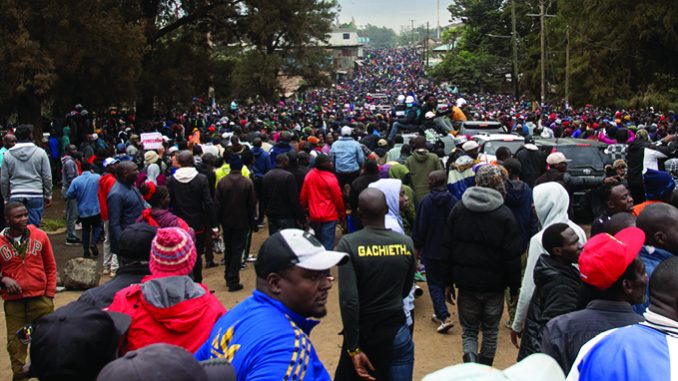
Economic protests turned into a struggle against oppression and for security
What many young Kenyans saw as the third political revolution in Kenya against a ruling class whose trail of blood and corruption has been witnessed for decades is unfortunately fading before their eyes. The economic situation in a country suffering from a crushing debt burden, still as high as last year, when Kenyan youth took to the streets to protest against the 2024 Finance Bill, is unfortunately no longer on Kenyans’ priority list. It now seems that the question on the lips of all citizens, namely “How will I survive this, economy?”, has been replaced by the question “If I speak out against this government or take to the streets to protest, will I come home alive?”
After a new series of protests began this year Reuben Wambui, an economist and sustainable finance consultant, was quoted in mid-July in the Daily Nation newspaper, “while the 2024 finance bill sparked the protests, what followed was a broader, deeper rejection of a broken system. In view of rising youth unemployment and 31 deaths on July 1 alone, the government’s violent crackdown signals a crisis of legitimacy. This is no longer just about bad politics, but about a cross-generational revolt against exclusion, corruption and impunity.”
Traditions of Struggle
Revolutions and especially protests against excessive taxes are nothing new in Kenya. One hundred years ago, the Young Kavirondo Association led a major protest against the punitive taxes imposed by the British colonialists, such as the smelter and poll tax, and demanded the abolition of forced labour.
The Mau Mau movement, which developed into a highly developed armed movement with a military wing, the Land and Freedom Army, and its own anti-imperialist ideology, was well organized among workers and peasants and found support in all parts of the country. In fact, the colonial authorities had to declare a state of emergency in the country in 1952 in order to bring the growing forces of the liberation movement under control.
Similarly, during the colonial era, the trade union movement in Kenya organized national strikes and campaigns that changed the country’s history.
These lessons from colonial history have not been lost on the liberation movements after independence, as some members of the Kenyan ruling class seem to believe when they claim that Kenyans are discussing taxes and budgets “for the first time”.
The movements in 2024 and 2025
The new face of the Kenyan mass movement are young Kenyans who have rewritten the rules of political engagement in real time. Armed with nothing but smartphones and Wi-Fi, they translated the controversial 2024 Finance Bill into local languages, used ChatGPT to decipher complex tax policies, and published politicians’ phone numbers for mass SMS campaigns. When President William Ruto’s administration tried to punish the population by raising taxes, Gen Z didn’t just complain – they organized.
The hashtag #RejectFinanceBill2024 exploded across TikTok, Instagram, and X, with protesters broadcasting their confrontations with police live. Unlike the elite-led demonstrations in Kenya’s past, these protests had no traditional leaders, no party affiliation, and no mercy for political sacred cows.
Repression
Unfortunately, a national survey conducted by Odipo Dev among 1,038 Kenyans in twenty districts where protests took place on June 25, 2025 to gauge the sentiment of the nation shows that while the economy remains a significant source of anxiety for 42 percent of respondents, state repression and violence have become a more immediate problem, with many citizens fearing injustice (52 percent), kidnapping (44 percent) and the police (38 percent). These are not theoretical considerations in Kenya today. Between June and July 2025, at least 47 Kenyans died in anti-government protests, hundreds were injured and billions of dollars in economic damage were caused. In April and May 2025, there were numerous reports of kidnappings and arbitrary arrests of filmmakers, techies, and online activists.
Kenya is a country where economic hardship has long been the predominant criterion for assessing governance, as it is measurable, commonplace, and pervasive. But society’s priorities change when peaceful citizens are shot in the street, kidnapped for tweeting, or silenced by surveillance. Fear has become more immediate than inflation, security more valuable than tax breaks. “Political theory shows that what worries citizens the most is not always what concerns them the most, but what seems most urgent to them at the moment,” says Darius Okolla, political scientist and author.
Crisis
Meanwhile, the crisis has not disappeared. It was merely pushed out of the national limelight. Kenya’s debt situation is particularly worrying and unsustainable, according to Kwame Owino, chairman of the Institute of Economic Affairs. “The government needs enormous relief from its high debt obligations. Total liabilities are still as high as last year. So nothing has really improved, especially after a year. We have drafted a paper calling on the Kenyan government to apply for debt relief. The country cannot bear these debts indefinitely. It cannot bear the debt service obligations indefinitely, especially since the shilling is, in our opinion, much stronger than it should be.”
Interest payments on the national debt currently devour about a third of total tax revenues, while over forty percent of young people are unemployed and about a million more enter the labour market every year. Investor confidence has been shaken by ongoing political instability, and experts warn that domestic borrowing and high borrowing costs are crowding out private investment. We all see that both political and economic solutions are needed – and not separately. The mass protests and the huge participation in the public debate on financial laws and the government budget in general show us that Kenyans believe that there is a political and economic limit to how much tax the government can levy.
Something has to change, there needs to be a government that can regulate public affairs more efficiently with less money. However, before this discussion can be held, we must not ignore the fact that a citizen who is faced with police violence does not think about interest rates. A parent trying to find a missing child does not calculate the cost of living inflation. A government that has declared demonstrators terrorists is a government that cannot be trusted.
State repression can intimidate and stifle a mass movement… temporarily. But mass protests in various countries in recent years show that there can also be tipping points where repression only increases activists’ determination to sweep away a regime. But then comes the danger that the political vacuum will be filled by forces that maintain the power of the old elites with new faces. To prevent this, Kenya’s workers and poor urgently need a party of their own, ready to challenge both Kenyan capitalists and the international institutions of capitalism such as the International Monetary Fund (IMF).
Also see: KENYA | Anger Erupts Again in New Wave of Anti-Government Protests