
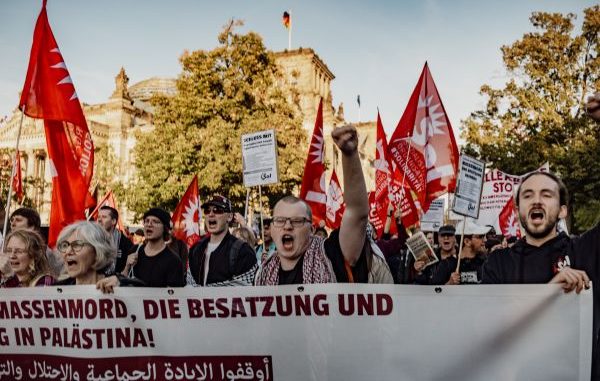
A big step forward for the solidarity movement in Germany
On 27 September, around 100,000 people took to the streets in Berlin in solidarity with the people of Gaza. This is the largest protest to date against the Israeli government’s genocidal war and could mark a positive turning point in the solidarity movement in Germany. As Sol, we supported this protest and participated in it.
After major demonstrations in the summer of 2025, with over 50,000 people in Berlin in June and in Frankfurt in August, the Palestine solidarity movement reached a new peak last weekend. According to the organisers’ estimates, up to 100,000 people took to the streets for the ‘Together for Gaza’ demonstration and the ‘All eyes on Gaza’ rally that followed. They came not only from Berlin, but many travelled by bus from all over Germany. As Sol, we were at the demonstration with almost 60 comrades from nine cities. We sold over 320 newspapers, had many conversations and met dozens of people from all over Germany who are interested in our organisation.
A big step forward
The background to this mass mobilisation is that it was organised nationwide, that this date was considered a key date (rather than many scattered small protests), but also that more and more people see the need to demonstrate against the actions of the Israeli government and the suffering of the Palestinians. Another reason is that fewer and fewer people are falling for the false claim that criticism of the Israeli state is automatically anti-Semitic. At the same time, it was very important that Die Linke (the Left Party) called for the protest and mobilised nationwide. This should have been done much earlier, that it happened now is an expression of external and internal pressure to take solidarity with the people of Gaza to the streets.
Equally significant was the fact that the GEW teachers’ union Berlin region and the Berlin hospital movement also called for the protest. Trade unionists should take this as an opportunity to demand that their workplaces and trade union branches also take a stand in solidarity with the Palestinians.
This demonstration was therefore a major step forward for the movement. Even the media smear campaign and police repression of the last two years did not deter people from demonstrating en-masse. Many were on the streets for the first time, and the task now is to mobilise them again and build a perspective for collective resistance. At the same time, in addition to many activists from Die Linke and its Linksjugend youth movement, there were also many activists from the Palestinian community as well as international groups, diaspora groups, trade unionists and young people on the streets. This made it possible to achieve a broad mobilisation and, due to the mass character of the demonstration, to make police repression more difficult. There were probably a few dozen arrests, but compared to the police violence at most Palestine solidarity protests over the last two years and in relation to the number of participants, these were few. This shows that mass protest can make repression and intimidation difficult or even impossible.
On a positive note, the two parallel protests in Düsseldorf (12,000 participants) and Berlin’s Moritzplatz (1,500 participants) did not detract from the large mobilisation, and the calls for a boycott apparently had little effect (for background to the boycott call, read ‘Together for Gaza’: As protesters take to the streets of Berlin, what is the way forward for the movement?). A division within the movement will not advance the liberation of the Palestinians, on the contrary. Some of the accusations made by the initiators of the alternative demonstrations, such as that the mass demonstration would mean a ‘normalisation of genocide’, are incomprehensible. Other criticisms were partly justified, but it is wrong to divide the movement over them. Instead, it would make more sense to discuss the issues with the tens of thousands of people on the ground rather than organising a separate, isolated boycott event. The police took advantage of the relatively small size of the protest at Moritzplatz, and terrible police violence ensued until the event was finally broken up. We stand in solidarity with all those affected by police repression, regardless of our criticism of the alternative call to action.
In future, the danger of police repression can be prevented above all through mass mobilisations. This will allow people who are concerned about violence and repression, for example due to an uncertain residence status, to feel safer participating in solidarity protests. Only in this way can the movement grow and further increase the pressure on union leaders to participate. Such a broad, large movement, in turn, is the necessary lever to put further pressure on the federal government.
Continue to build the movement
We must now build on Saturday’s success. Die Linke and the trade unions have a responsibility to ensure that this does not remain a one-off large protest. As we chanted at the demonstration: ‘If we strike like in Italy, Palestine will be free’. Of course, this alone is not enough, but it points in the right direction: only through massive protests, collective resistance and, above all, strikes can the German government’s support for the genocidal war through arms deliveries be ended.
It is clear that only the Palestinian masses themselves can fight for their liberation, but we can support and advance this through broad international workers’ solidarity (see https://www.socialistworld.net/2025/09/23/lets-block-everything-italian-solidarity-strike-for-gaza/).
If strikes like those in Italy were to take place simultaneously across Europe, such a movement could emerge, supported by the working class internationally, to end the suffering in Gaza and achieve real liberation and self-determination for the poor and working masses in the Middle East.
The DGB trade unions must now continue the discussion on what role they can play in ending the war and arms deliveries. Looking to Italy can be a decisive inspiration in this regard.