
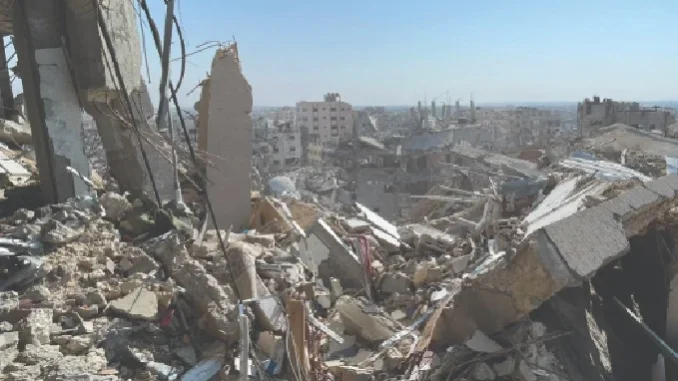
On the second anniversary of the 7 October 2023 attack on Israel and the subsequent prolonged genocidal slaughter in Gaza, the fate of Trump’s latest proposals for an end to the war is still in the balance. The US plans to impose a transitional government of technocrats on the Palestinians in Gaza, backed up by outside armed forces – a form of naked colonialism.
Israeli military forces will be allowed to remain inside the perimeter of the Gaza strip, maintaining control of its borders – a continued blockade, imprisoning the Palestinians and deciding what goods can enter and leave the strip. Israeli prime minister Netanyahu has made clear that Israel has no intention of entirely withdrawing from Gaza and stressed that there will be no possibility of a Palestinian state.
Trump has been caught between US support for Israel and the increasing pressure from Arab states and from domestic opinion in the US, Europe and elsewhere for an end to the war. US representatives initially claimed that the plan had the support of the leaders of a number of Arab and Muslim countries. But when the final outline was released, those leaders could only express conditional support, as the dominating interests of US imperialism and the Israeli regime in it became clear.
Incredibly, Tony Blair is to be part of the imposed authority’s governance, the same Blair whose hands were drenched in blood in the invasions he led the UK into in Afghanistan and Iraq. As Sky News commented: “Palestinians in general don’t see Blair as anything else than a war criminal and a mercenary, and do not expect anything positive coming out from his involvement in a region he has already damaged” (30 September).
The first stages of the plan could possibly go ahead, but with a high chance of collapse at any time and a resumption of full-blown war by Netanyahu’s government, with Trump’s backing. In particular, Hamas considers it essential to keep its arms, whereas the plan demands they be given up. However, the negotiations taking place might find ways around significant issues like that, preparing the way for a long-term ceasefire or an end to this particular war.
So devastating and horrific have been the two years of war, that a ceasefire in much or all of the strip, whether now or later, will inevitably be a massive relief to its starving, traumatised and displaced population. The prolonged slaughter and destruction inflicted by the Israeli regime has gone way beyond previous levels in the entire history of its conflict with the Palestinians. Most buildings have been reduced to rubble – homes, hospitals, schools, universities – with massacres and serious injuries being reported almost daily.
Among the officially recorded 67,000 deaths are over 20,000 children, an average of more than one killed each hour during the two years of war. More media workers have been killed than in both world wars, the Vietnam war, the Yugoslavia wars and the US war in Afghanistan combined (FT, 19.9.25). A vast number of seriously injured people lack medical care – even access to painkillers to relieve their agony.
Civilians who have been deliberately targeted by the Israeli forces include families who have refused to cooperate with Israeli intelligence against Hamas. Earlier in the war Israel armed certain gangs in Gaza, in an attempt to counter Hamas from within and foster even greater social disintegration in the strip, and those designs have continued (Middle East Eye, 29.9.25).
The preposterous denials by Netanyahu’s government that it has stopped essential goods from entering the strip have been negated by Trump’s ceasefire proposals, as they included that “full aid will be immediately sent into the Gaza Strip”.
Recognising the relief that a ceasefire will bring, or even more so, an end to the war, doesn’t mean in any way supporting a deal imposed from above – over the heads of the Palestinians – by the imperialist and capitalist powers. Their intent is just a change in the form of occupation and rule, because the length and intensity of the war has collided more and more with their interests, due to the anger from below that is rebounding on them domestically. Also, the Western powers view their closest capitalist ally in the Middle East, the State of Israel, as damaging its own interests by continuing the war and therefore see it as in their mutual interests to intervene.
No element of their interventions has the interests of ordinary Palestinians at heart. A flow of countries has formally recognised a Palestinian state, including recently three Israel allies in the G7 group of capitalist powers, but the Israeli ruling class has no intention whatsoever of conceding a genuine Palestinian state and neither do the capitalist powers worldwide intend to try to force it to.
Israeli Expansionism
As is well known, Netanyahu and the rest of the political right in Israel have been pursuing an agenda of ethnic cleansing across all the Palestinian territories, to undermine Palestinian nationalism and expand Israel across that land. They use both ideological and security justifications. Ideologically they invoke a biblical right to the land, which for an ultra-right religious minority of Jewish settlers is paramount and overrides other factors. Security considerations on the other hand are invoked across the spectrum of Israeli pro-capitalist politics – the argument that Palestinian militias will pose a threat to Israelis regardless of what concessions Israel makes.
However, whichever pretexts are highlighted, underlying them is the fact that the Israeli capitalist class can’t solve the national conflict, no matter what its political representatives do. The Zionist state they have built over the last 77 years – based on Jewish nationalism as the national and social basis for their rule and capital accumulation – was built on land that had an indigenous Palestinian population, creating an intractable conflict in which there is no solution on a capitalist basis.
Leon Trotsky, co-leader of the 1917 Russian revolution, warned Jews in 1940 that “the future development of military events may well transform Palestine into a bloody trap for several hundred thousand Jews.”
David Ben-Gurion, Israel’s first prime minister, recognised the oppression of the Palestinians many times, including saying in 1938:
“Let us not ignore the truth among ourselves … politically we are the aggressors and they defend themselves … The country is theirs, because they inhabit it, whereas we want to come here and settle down, and in their view we want to take away from them their country.”
And in 1956: “If I were an Arab leader, I would never sign an agreement with Israel. It is normal; we have taken their country. It is true God promised it to us, but how could that interest them? Our God is not theirs. There has been antisemitism, the Nazis, Hitler, Auschwitz, but was that their fault? They see but one thing: we have come and we have stolen their country. Why would they accept that?”
Netanyahu’s prosecution of the most terrible war on Gaza to date fundamentally stems from the position of the Israeli ruling class as expressed by Ben-Gurion when he wrote in July 1948: “We must do everything to ensure they [the Palestinians] never do return” and the decades of repeated capitalist failures to impose resolutions to the conflict ever since.
And Netanyahu’s time in power at the head of the most right-wing government in Israel’s history is linked to the crisis in capitalism worldwide and in Israel – which like all countries is dependent on the world economy. The decline in the rate of economic growth in the 1970s underlay the election of governments in Israel led by the right-wing Likud party, which has its support base in the Mizrahi Jewish working class population – Jews who immigrated to Israel from the Middle East and North Africa and who were, for some time, culturally oppressed. In that respect, Likud was a precursor to right populist governments that have come to power internationally in recent times.
Meanwhile, traditional capitalist political parties across the board, from former social democratic ‘left’ to the conservative right, have lost electoral support amongst Israelis due to their policies in the interests of the super-rich and big business, with the result that votes have been cast more widely, testing out other parties in a search for alternatives.
In Israel this has meant coalition governments which struggle to put together a majority to deliver stable rule. It led to Netanyahu’s reliance on a combination of far right and ultra-orthodox parties in order to govern, and a major stepping up of war and aggression in the occupied territories. But none of the pro-capitalist parties in Israel offer any alternative to repression of the Palestinians and the cycles of bloodshed.
Netanyahu’s claimed aims of destroying Hamas and liberating the remaining Israeli hostages from Gaza have always been thin smokescreens for the underlying motive – to attempt to decisively crush Palestinian aspirations and force all or part of the Gaza population out of the strip if he can push the war that far, whether through imperialist-sponsored displacement or possibly a mass breakout from Gaza into Egypt to escape the unliveable conditions.
The first part of Likud’s founding statement stated: “Between the Sea and the Jordan there will only be Israeli sovereignty”. Netanyahu and co exploited the massive Israeli shock, horror and fear after the October 2023 Hamas-led attack to take further decisive steps towards achieving that historic goal of right-wing Zionism. Hence his deliberate placing of obstacles into ceasefire negotiations throughout the war and his March 2025 breaking of a two-month US-brokered ceasefire.
Hamas has clearly been massively weakened militarily and regarding its ability to be a ruling authority in Gaza, which in any case has no functioning infrastructure after two years of massive bombardment. But wiping Hamas out will never be possible through Israeli offensives, as it replaces killed fighters by recruiting from among youth who are enraged by the mass slaughter. Neither can the Palestinians’ national aspirations be destroyed by the military might of their oppressor, no matter how much brutal force is used against them.
Along with the war on Gaza has been the Israeli regime’s ongoing annexation of the West Bank, including through expanding Jewish settlements and forcing degradation of the Palestinian Authority – today in deep crisis after having much of its normal funding and banking operations blocked by Israel. “Maximum land with minimum Arabs” was far-right Israeli finance minister Bezalel Smotrich’s declared goal for the West Bank, when asked in early September. Smotrich announced an aim of fully annexing 82% of the West Bank, not least to “remove once and for all” any prospect of a Palestinian state.
Linked to the repercussions of the war on Gaza and in order to assert dominance across the region and reduce the perceived threat from Iran, also came aggressive Israeli military action on targets in six other countries: Iraq, Lebanon, Syria, Iran, Yemen and Qatar, and expanded territorial occupations in Lebanon and Syria. The resulting weakening of the Iran-linked Shia militia axis across the region, particularly Hezbollah in Lebanon, boosted the hubris of the Israeli regime, which has further regional interventions in its sights.
On the one hand, a Gaza ceasefire could de-escalate tensions across the region, but on the other hand, shifting relations, aggression from Netanyahu’s regime and interference from the world powers – including in Syria – continue to contribute to great instability and the ongoing potential for a wider scale regional conflict.
Arab and Muslim Regimes
The Israeli bombing of a Hamas office in Doha, Qatar, on 9 September, sent shockwaves across the Gulf elites and added to their concern over whether they can rely on having US protection against attacks from Israel or Iran. For decades the Gulf leaders – in line with US interests – had some common cause with Israel against Iran, viewing it as their main military and economic rival in the region. These dynamics are shifting, partly due to their worries about how reliable Trump will be for their security interests.
Qatar has been a close US ally and is the location of the largest US military base in the Middle East. The US had in 2011 asked Qatar to host Hamas in the first place, was happy for Qatar to mediate talks with Hamas, and Qatar had funded Hamas with Israeli complicity. Yet none of this meant that the US prevented the Israeli attack.
Following that bombing, an emergency Arab-Muslim summit of around 50 countries reflected their elites’ mood of anger and insecurity. They also showed their rottenness and impotence, as divisions between them and reticence to risk angering Trump prevented them from agreeing any measures. The six of those countries that have normalisation deals with Israel haven’t withdrawn from them, but their relations with Israel have worsened considerably during the Gaza war and since the Israeli attacks on Syria and Qatar.
At the summit, Egypt’s president el-Sisi called Israel an “enemy”, which the head of Egypt’s state media agency thought was the first time an Egyptian president had used that word since the peace process with Israel began in the late 1970s (New York Times, 22.9.25).
The Saudi Arabian regime – which has more trade with China than with the US – has expressed relief that it didn’t conclude the normalisation deal being negotiated before the Gaza war. It’s no accident that the Saudi government has entered into a mutual defence pact with nuclear-armed Pakistan, and has some communication with its counterparts in Iran.
Overall, for the region’s rulers, the relative weakening influence of the US and their concern about regional aggression from Israel, together with pressure from the huge anger among the region’s masses against the Gaza war, has shifted them closer to Iran – with China’s encouragement – and further from cooperation with Israel.
Yet at the same time they are flailing around geopolitically, squeezed between fear of revolts from below and their need to try to maintain good relations with the US – they don’t want to jeopardise US trade, or aid – which is substantial to Egypt and Jordan – and security backup, all less predictable under the second Trump presidency.
They complain about the Israeli regime’s wars and expansionism, and its bypassing of the Palestinian Authority, but in reality have tolerated all of it. Trump, with his multi-billion dollar contracts with certain Arab states – for his family as well as the US – tried to assist them by saying he “won’t allow” annexation of the West Bank, but no one trusts such assurances considering his longstanding acceptance of the Israeli occupation, settlement expansion and ethnic cleansing.
Struggle and Protests
Just as the Arab ruling classes haven’t aided the Palestinians, neither have the Western capitalist ‘democracies’. They have mainly carried out ‘business as usual’ with Israel and have only taken token measures against the war, along with ineffectual legal threats.
The Palestinians can only rely on their mass struggle, backed up with solidarity from workers across Arab and other countries in the region and workers internationally. The Palestinians erupted in mass struggle in 1987 – the start of the ‘first intifada’ – the scale of struggle that is needed again, but this time on a fully democratic basis, with the formation of workers’ and grassroots community committees that can discuss action and political programme, and elect representatives to higher bodies. Workers’ organisations, independent of capitalist interests, and with socialists organising and arguing within them for socialist ideas, are the only way forward against the occupation and towards achieving a socialist Palestinian state that can eliminate insecurity and poverty.
Their present leading parties, Hamas and Fatah – both pro-capitalist – have only presided over a worsening situation. The programme of Hamas, based on right-wing political Islam, is rejected by a majority of Palestinians. Hamas’ support has been partly based on disgust at Fatah’s corruption but neither its programme or military methods can lead to Palestinian liberation and decent living standards for all. The Fatah president in the West Bank rules repressively and dictatorially, tolerates corruption, and collaborates with the Israeli occupying forces.
How far the Israeli regime can go with its aims is certainly not divorced from pressure that can be built up and applied by the Palestinians; and by workers internationally in support of their struggle. Worldwide, the war has had a major effect on consciousness, giving rise to a new wave of radicalisation in many countries, with a great many protests and demonstrations. The anti-war action reached a new level in the recent strike movement in Italy, where ports, trains, roads and schools were blocked on 22 September, expressing outrage at the new round of massacres in Gaza following Netanyahu’s decision to flatten Gaza City, and supporting the Global Sumud flotilla, loaded with aid for Gaza. That action led to a wider general strike on 3 October following the Israeli seizure of the Global Sumud boats, with over 2 million people protesting, according to the Italian General Confederation of Labour. That sweeping action marked a major shift in attitude to the Meloni government and was a turning point in the anti-war movement internationally, as it was a stepping up in influence, due to the large-scale entry of organised workers into the movement. They demanded that the government of Giorgia Meloni breaks commercial, military and diplomatic ties with Israel, calls and action that can have a galvanising effect on workers’ movements in other countries.
The Global Sumud fleet consisted of over 40 boats and was also a new step in scale compared to previous aid fleets. Meloni felt compelled by mass pressure to send two warships to accompany it, joined by two Spanish warships. As the flotilla participants acknowledged, expeditions like theirs can’t in themselves deliver sufficient aid or stop the war, but they can play an auxiliary role to workers’ actions – which governments are far more alarmed about – in drawing more attention to the hellacious situation in Gaza.
Also playing a significant contributory role has been increased protest action in the fields of sport, the arts and education. In education, protests have included waves of campus actions in various countries, strike action by hundreds of thousands of students in 40 cities across Spain on 2 October, and suspension of collaboration with Israeli institutions by a number of European universities, including in Ireland, Spain, Italy and the Netherlands. In the arts, 4,500 Hollywood actors, filmmakers and others pledged “not to screen films, appear at or otherwise work with Israeli film institutions . . . that are implicated in genocide and apartheid against the Palestinian people”, among many other protests.
CWI members have been involved in the anti-war movements from the start of the war, participating in the many demonstrations and protests in countries where we’re present, and moving anti-war motions in trade unions. We’ve put forward steps for building and strengthening the movements, in particular through greater and more direct involvement of workers’ organised in trade unions. Workers have the greatest potential power in society through their ability to halt production, transport, and all else, which when done, raises the question of why governments representing capitalist interests should be left in control. Rather they need to be replaced with workers’ socialist governments that could take meaningful action against the oppression of the Palestinians and other oppressed nationalities.
We have also put forward arguments to challenge accusations of antisemitism that have been thrown at protesters opposing the Gaza war and we have opposed state repression and state-sponsored intimidation against protesters.
We have called for democracy in the anti-war movements, instead of decision-making being in the hands of small minorities. For instance, CWI members in Germany have called for the formation of local Palestine solidarity committees in Germany and a national conference to establish a common platform and elect a representative committee.
A number of governments have slightly shifted their positions on Gaza as anger over the war has increased among working people in many countries. In Britain, polls show that over half the population now favours financial sanctions against Israeli leaders, or suspending arms sales (FT 19.9.25). London has had the largest national Gaza demonstrations in Europe, and across Britain opposition to the war has been reflected in election results, especially in votes cast by Muslim communities. CWI members in the Socialist Party have argued for more trade unionist candidates to stand in elections on an anti-war, anti-austerity platform.
There has been a particularly marked shift in opinion in the US. A YouGov/Economist poll found that 43% of Americans now believe that Israel has committed genocide in Gaza (Economist 19.9.25). Criticism of the Israeli regime is significantly higher among US Democrats than Republicans, but it has increased in both parties, especially among youth. A poll from the New York Times and Siena University reported that “a majority of American voters now oppose sending additional economic and military aid to Israel, a stunning reversal in public opinion since the October 7 attacks. About six out of 10 voters said that Israel should end its military campaign, even if the remaining Israeli hostages were not released or Hamas was not eliminated” (1.10.25).
These opinion shifts have impacted on leading politicians of both main parties, including some in the MAGA Republican right. For example, the Economist reported that Congress member Marjorie Taylor Greene wrote on social media: “I don’t want to pay for genocide in a foreign country against a foreign people for a foreign war that I had nothing to do with” and that since the US bombing of Iran in June, other MAGA “stalwarts” like “Steve Bannon, Tucker Carlson and Matt Gaetz, to name a few” have broken with the longstanding Republican position of staunch support for the US alliance with Israel.
Israel-US Relationship
So it isn’t just the Arab states that question how reliable the US will be; there is growing questioning in Israel on whether US support for the Israeli state will remain strong. Trump had initially held back from allowing US participation in Israel’s June missile attacks on Iran; he was reported as being irritated by Israeli military assaults in Syria; and declared himself “very unhappy” about the strike on Qatar – belatedly giving Qatar US security guarantees. “If pressed, he might choose his rich Gulf friends over an unmanageable Netanyahu”, hypothesised the Financial Times (25.9.25)
Before the Gaza war, US imperialism had been trying to move its military focus away from the Middle East in order to counter China in the Pacific arena. The Gaza war with its regional repercussions forced more US resources and attention – initially under president Biden – back to the Middle East, but is now on the basis of a cruder ‘America first’ stance and Trump’s transactional approach – looking to only spend money viewed as directly aiding US interests. Israel, the biggest recipient of US foreign aid, was particularly useful to US imperialism in the post second world war ‘cold war’ period, in which the US needed to counter the influence of the Stalinist USSR in the Middle East. It was also an important ally, although less so, after the collapse of Stalinism, when the US regime had designs on using military means for greater exploitation of the resources of the Middle East – which led to its over-reach in the invasions of Afghanistan and Iraq.
Today, world relations have shifted yet again, under the impact of capitalist decline and the erosion of US economic power worldwide, not least due to China carving out a growing share of global GDP. In this more multipolar world, all relations have become more volatile and less certain; the more so as Trump has decisively rejected the old ‘rules based’ international order. Regarding the US-Israel alliance, the Economist stated that it is more “shaky”, but comments like that in the capitalist media are at this stage mainly of the nature of being warnings – US imperialism can still on balance find the alliance useful.
Netanyahu, on his part, has issued military orders during the Gaza war on the understanding that the US will tolerate them – and indeed it has done. But when Trump decides to apply greater pressure on the Israeli regime to take a different path – which he might decide to do with his present ‘peace’ plan – the result is more likely to be Israeli submission to that, than a severing of the alliance.
Israel has a substantial domestic arms industry so can pursue wars without US supplies, but it can’t presently itself produce, or source from elsewhere, certain weaponry it receives from the US, such as advanced fighter jets. It also benefits significantly from US intelligence and surveillance operations and from the backup provided by US military bases across the region.
Above all, more than the divisions between themselves, the capitalist powers fear discontent surfacing from below. The Economist reflected this when it wrote in an editorial: “Long-run shifts in public opinion are more dangerous than rows between governments. Although they are slow to gather momentum, they are hard to reverse. When voters change their minds, political taboos can suddenly crumble” (20.9.25)
Discord in Israel
In Israel, while the main opposition parties offer no alternative to the cycles of brutal repression against the Palestinians, there is at the same time unprecedented turmoil in ruling class circles, with former and present military generals, security chiefs and intelligence officers, among others, condemning Netanyahu’s policies. Regarding his drive to destroy Gaza City, military chief of staff, general Zamir, pointed to the exhaustion of reserve soldiers, the lack of a plan for control of Gaza and the danger the action has posed to the hostages held there (NYT, 18.9.25). The likes of Zamir don’t advocate an end to the onslaughts against the Palestinians in the occupied territories; rather their angle has been to try to mitigate the disastrous direction that Netanuahu’s coalition is taking Israeli capitalism in.
They are concerned about his trend to centralise power, the influence of the far right in his coalition, the elements of erosion taking place regarding willingness to serve in the armed forces, and the impact of the war on the economy, which has been suffering from domestic disruption and the growing effects of international criticism. This doesn’t mean that they, and a majority of the population, haven’t welcomed the aspects of government military policies that they consider a success, such as the degradation of the Iranian ‘axis of resistance’.
Trump’s ‘peace’ plan has given Netanyahu a problem regarding keeping his government afloat. Smotrich has strongly opposed a ceasefire and criticised the offensive on Gaza City for not going far enough. In the face of polls indicating that in the next general election his Religious Zionism party won’t be re-elected to parliament, he is no doubt trying to regain some support by moving his party in an even more aggressive direction than that of Netanyahu’s blind-alley military strategy.
However, the far right is at odds with a majority of Israelis, who while not seeing any alternative to the use of military force on Gaza (supposedly aimed at eliminating the forces that led the bloody attack into Israel on 7 October 2023) oppose Netanayahu’s government and want a ceasefire deal that can secure the release of the remaining hostages. At different times during the two years of war, there have been large protests along those lines, including a short general strike last September. Austerity measures blamed on the war have also met with opposition.
Regarding the idea of a future Palestinian state, only a minority of Israelis now express support for it, as most fear that it would be led by the likes of Hamas, but the UK Sunday Times reported a pollster as saying: “Ask Israelis about a two-state solution as part of a regional security framework presented by Trump, and approval ratings for the idea double” (28.9.25). However, in reality, no framework presented by Trump can lead to greater security for Israelis, because no solution to the national conflict will be on offer. Support for a socialist alternative will have to be built among workers in Israel, with a programme to challenge the whole edifice of Israeli capitalism, including its brutal repression of the Palestinians.
Today, with nationality-based distrust and division dominating the Israel-Palestine landscape, a solution can seem further away than ever. On a capitalist basis, it’s not just further away, but impossible. However, consciousness of workers and the poor in Israel and among Palestinians will not be disconnected from developments in other parts of the world, a world in which young people are increasingly questioning whether capitalist crisis is their only future.
Independent workers’ organisations to assert working class interests will need to be built in the Arab and Muslim countries of the Middle East, with the goal of removing the many autocratic, repressive capitalist regimes and building socialist societies in their place. Socialist transformation is also essential in Israel to remove the Israeli capitalist state. Through such revolutionary socialist developments, a democratic, socialist confederation of the region will be possible, on a voluntary and equal basis. A confederation in which the national and social aspirations of the Palestinians – including Palestinian refugees – can be justly satisfied, while guaranteeing the rights of all nations and minorities.