
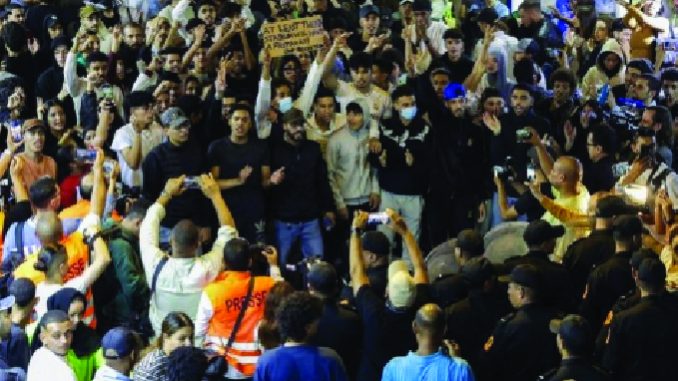
For several days, we have witnessed a massive mobilisation of young people, the youngest, especially 15-24 year olds, who have taken to the streets en masse. A tragic event triggered this social anger: in Agadir, eight women died at the Hassan II hospital, the city’s main health facility, in the space of ten days, following caesarean sections. This establishment, nicknamed “the hospital of death”. This tragedy is a symbol of the failures of the public health system.
What is the situation in Morocco?
The country has experienced a period of strong economic growth in recent years and an increase in tourism and some industrial activities.
But the fact remains that the country is marked by significant poverty, with an unemployment rate of around 13.3% in 2025. And above all, this rate is very high among young people, reaching about 36.7% among 15-24 year olds.
The movement is still growing. But since September 30 it has been subjected to violent repression, with the first clashes broking-out after four days of mobilization. Three people died in the crackdown on the protests.
The demonstrators denounce massive corruption at the head of state, collusion with the richest, the dramatic problems with education and health, as well as the lack of massive investment in public services.
It is precisely this generation, the 15-24 year olds, that are the most numerous within the movement, called “Gen Z 212” (after Morocco’s telephone code), and among the arrests on 30 September.
Wealth and power concentrated in the hands of the ultra-rich around the King
For several years, Aziz Akhannouch has been at the head of state. He is both the prime minister of King Mohamed VI and the richest man in Morocco. This man embodies Moroccan capitalism, strongly attached to political power and royal networks.
His Akwa Group is a major conglomerate, with a turnover of more than 2.7 billion euros per year. It is active in real estate, hydrocarbons, media and chemicals. In reality, what the demonstrators are denouncing is the gigantic collusion between political and economic power.
In recent years, he has placed his relatives at the head of power, or of a group linked to the government, which gives him a political and economic influence that is clearly contested by many young people, workers and the poor in Morocco. The population still has the appointment of two of his relatives to head the ministries of health and education in the back of its mind.
Akhannouch is the heir to a family group founded in the 1950s and linked to King Hassan II, father of Mohammed VI, who gave him increasing power. This group was linked to Elf Aquitaine, the French capitalist company. There was then an accumulation of wealth within this group and a diversification of activities that make Akhannouch the richest man in Morocco today.
In October 2021, Mohammed VI appointed Akhannouch as head of government, as his party, the RNI (centre-right), won a majority and they were able to come to power.
For more than four years, the conflict of interest has been obvious. He has accumulated a fortune estimated by Forbes at $1.6 billion by 2025, in oil, gas, chemicals, as well as in subsidiaries such as Afriquia Gaz and Maghreb Oxygen, of which he is the majority shareholder.
At the head of power, a minority around Akhannouch is getting richer and richer through privatizations. During this time, the population has suffered a spike in prices, especially the price of meat, which has been very, very high. Inflation has been such that there was a controversy on the occasion of the end of Ramadan in 2025. Indeed, the State has asked for a halt to the ritual slaughter of Eid because it would have an impact on the price of meat, which is quite unprecedented.
Regular Revolts for 15 Years
The GenZ 212 mobilization has arisen. The young men and women who are demonstrating are demanding the right to education and to real public health. One of the slogans that permeates the mobilization is: “We don’t want the World Cup in 2030, we want real health, real education”, which clearly reflects the aspirations of the population to live in dignified conditions. Given the role of football as an outlet for a whole section of young people, this slogan is very significant. The revolt does not come out of nowhere.
Movements regularly arise in the kingdom. In 2011, a massive protest movement, the M20F, was launched, in the wake of the revolutions in the Maghreb and the Middle East known as the “Arab Spring”. This forced Mohammed VI to announce democratic and social reform measures in the face of a particularly tense situation. The result: a little more parliamentary democracy in the country and a more liberal transformation of the economy, making Morocco the privileged partner of the United States and other imperialist countries.
But beyond that, no significant improvement in living and working conditions has been observed. Wages have risen slightly, but inflation is such that these increases have been offset by the cost of living.
In 2016-17, there were mobilizations in certain regions, particularly in the Rif, a region that is particularly less developed than the rest of Morocco, because it has a strong Amazigh majority. Massive mobilizations took place there following the death of a young man during a police check. There were regional demands such as the recruitment of the inhabitants of the region into the local civil service services and the adoption of Amazigh as the language of local administration. At the same time, underdevelopment was not specific to this region and demonstrations also took place at the time in several urban centres.
In 2024, unemployment had reached a record high of 13.7% in the first quarter, and rising prices, especially for fuel, have caused significant social discontent. The “#Dégage_Akhannouch” protest movement then developed, denouncing both the concentration of wealth and the mismanagement of social crises, especially after the earthquake of September 9, 2023, which killed thousands of people. Entire areas have remained abandoned.
During the cabinet reshuffle of October 23, 2024, the choice to appoint Mohamed Saâd Berrada and Amine Tahraoui as heads of Education and Health had already raised questions because they are close to Akhannouch.
A new generation is on the streets. What is particularly significant is his determination despite the repression. Interestingly, this mobilization was organized via social networks, in particular Discord.
Today, the Akhannouch and Co. government is in the hot seat. On October 10, Mohamed VI is due to speak at the opening of the parliamentary session. However, as in 2011, after the massive movement, the king should not be counted on to meet the demands of the young people and the majority of the inhabitants.
It is the entire corrupt regime that must get out!
Most of the demands of the young people in struggle are those that the whole country is facing. These demands could be taken up elsewhere and develop a powerful social movement capable of linking up with the rest of the population.
The majority of the population is suffering. Workers are increasingly numerous and exploited in Morocco in the automotive, aeronautics and energy industries. A large proportion of the peasants are very poor, excluded from the modernization of the country and do not benefit from the improvement of their living conditions.
The events took place in more than ten cities and demonstrate that the potential is there. To wrest a real public health and education system, it is necessary to put an end to the repressive power of the Akhannouch government and Mohamed VI and the capitalists.
We must organize together and create committees of struggle, capable of organizing a massive mobilization, a massive strike movement of workers alongside the youth in revolt. These committees would be the basis for organizing the struggle, deciding on its demands.
- Against the power of the capitalists and the rise in prices,
- for the freezing and lowering of prices,
- against privatizations,
- for the nationalisation of the major sectors of the economy (energy, banks, etc.).
It is up to the workers, together with the youth, to take control. Only the workers organising society themselves for the interests of the overwhelming majority of the population can truly improve the lives of the people of Morocco by overthrowing the power of the tiny minority of ultra-rich capitalists who rule today.