
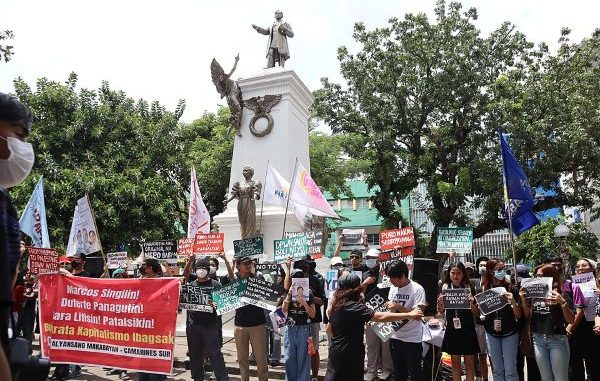
Protests erupted across the Philippines over billions of dollars’ worth of state corruption in fraudulent flood control projects. On the 21st September, the 53rd anniversary of the late dictator Ferdinand Marcos Sr.’s declaration of martial law, Filipinos across different classes and groups— the middle class, petty bourgeoisie, working class, peasantry, clergy, and the urban and rural poor — went out to the streets to denounce the corruption, called for the stolen funds to be returned, and for those involved to be persecuted. The funds that were supposed to go to climate adaptation projects went into the pockets of greedy politicians and their crony contractors, which enraged the entire Filipino masses.
The protests in the capital, from Luneta Park to Epifanio de los Santos Avenue (EDSA), were largely peaceful. Violent demonstrations emerged in some areas of Manila. Masked demonstrators set fire to vehicles, whilst some threw rocks and Molotovs at police officers. In response, the police beat up the demonstrators and arrested them. Authorities reported that more than 200 people were arrested, with some of them minors. However, according to videos and reports circulating online, the police killed two young people, and the detained violent demonstrators were allegedly tortured.
Corruption amidst the Climate Crisis
The Philippines is one of the most vulnerable countries to climate change. If risks continue to be ignored, the country will suffer more intense droughts, crop losses, and a decline in its reefs and fisheries, as well as increased flooding and water scarcity. The climate crisis would also lead to increased epidemics. With intense flooding becoming a norm, the cases of leptospirosis, a life-threatening bacterial infection, will continue to rise. Increasing temperatures are also contributing to the surge in diseases such as dengue, malaria, cholera, and typhoid. The presidency of the late dictator’s son, Ferdinand “Bongbong” Marcos Jr., in its declared effort to avert this, funded billions of dollars to climate adaptation projects. However, despite the substantial budget, the flooding problem remains unresolved.
Greenpeace Philippines, the local branch of the international environmental activist group Greenpeace, estimated that as much as PHP 1.089 trillion (approximately $750 million) was lost due to anomalous climate adaptation projects. The Department of Public Works and Highways (DPWH), the government branch responsible for building national infrastructure, received PHP800 billion, the bulk of the budget, with PHP560 billion potentially lost to corruption.
The government reported that 5,500 out of 9,855 flood control projects were completed in 2022. However, the media, both mainstream and alternative, revealed that most of these “completed” projects turned out to be of low quality and non-existent, or, as the Filipinos called it, “ghost”. The anomalous flood control fund is only a small fraction of the corruption pie. There are also high levels of corruption in other sectors of the government, such as the Philippine Health Insurance Corporation (PhilHealth) and the Department of Education (DepEd), among others.
The corruption scandal came to light on July 28, during Marcos Jr.’s 2025 State of the Nation Address (SONA 2025), in which he ordered an investigation into the corruption and told those involved, “Shame on you!” The statement from the president is nothing but a mere political cant from someone whose family plundered an estimated $10 billion of public money whilst in power, pushing millions of Filipinos into extreme levels of destitution, with its effects still felt up to this day.
The big names identified by the whistle-blowers included Lucas Bersamin, the president’s top aide; Martin Romualdez, the president’s beloved cousin, who recently resigned as House speaker; and Manuel Bonoan, a former secretary of DPWH appointed by the president in 2022. The whistle-blowers also named incumbent senators, including Francis Escudero, Jinggoy Estrada, and Joel Villanueva. Members of the House of Representatives who aligned with the Marcos-Duterte alliance in 2022 were also included, and the list continues to grow. Those above denied the allegations.
The biggest names in this issue are the Discaya couple, specifically Curlee Discaya, the husband, and his wife, Sarah Discaya, who have been dubbed the “Bonnie and Clyde” of flood control projects by Filipinos online. The Discayas bagged projects worth PHP31 billion from their owned and affiliate companies between July 2022 and May 2025 alone. Over the past decade, from 2016 to 2025, the couple secured PHP 207 billion worth of contracts from the DPWH. All of these were lost to corruption and were used to fund the couple’s luxurious life. How did they manage to do this in broad daylight? How did they evade the anticorruption watchdogs?
The Discayas, with the aid of high-ranking government officials, manipulated and rigged the bidding process for contracts. The Discayas have 13 affiliated companies; most of these were founded by them, while the rest are under joint ventures with the couple’s business firms. The bidding process exists to fool the people. The officials in charge have already blocked the bidding process, forcing contractors to submit to their own terms and conditions, i.e., to give a massive kickback in exchange for contracts. A negotiator will then conduct the proper bidding ceremony to make it appear legitimate to Filipinos, while also evading the scrutiny of anticorruption watchdogs. With the state-wide corruption scandal involving officials from all echelons of the government, the Philippine government has now become a syndicate — activists argue that it has always been one since its inception.
The people continue to suffer
Whilst corrupt politicians and their cronies continue to live in prosperity, most workers, youth and the poor continue to live in poverty. The stolen money is too massive to comprehend. To put it in perspective, stacking PHP1.089 trillion into PHP1000 bills vertically would measure around 15,000 km; that would be approximately 18,900 times taller than the Burj Khalifa. But the accurate measure of the corruption doesn’t lie in the height of the stacked bills; it is measured in lives.
The stolen money could have been used to tackle homelessness. There are around 4.5 million homeless people, and about two-thirds of this number are in the National Capital Region, which is a region hugely affected by flooding. If the stolen money were used to build socialised homes, then these people wouldn’t have been forced to sleep on the streets, under bridges, and in other nooks and crannies of society.
The stolen funds could have been used to improve the Philippine public healthcare system. The government-run Philippine Health Insurance Corporation (PhilHealth), the body responsible for managing the country’s public healthcare system, which is also grappling with its own corruption issues, has been impoverished by a series of budget cuts and rapid privatisation. If the stolen funds are to be returned and reallocated to the country’s dying health care system, assuming its own problem of corruption is solved, then there would be more public hospital beds available for the masses; there would be much better compensation for healthcare staff that would prevent them from working abroad; and more Barangay Health Station (BHS) built that would help communities far from urban regions.
There is a lot more that could be done with the stolen funds. The money could have been used to improve other sectors, such as education and agriculture, among others. However, merely returning the stolen funds is insufficient. The returned funds will then be used for another cycle of corruption within the government. There needs to be a solution to avoid this, that is, a workers-led government.
State violence
On September 21, over 100,000 people took to the streets in Manila alone. The protest was largely peaceful, but some areas were riddled with violence. The protestors who made violent demonstrations were met with brutal force by the state bourgeois cops. At least 219 protestors were arrested, 95 of them minors, with the youngest being 9 years old.
Most of the arrested children did not take part in the demonstrations. They were bystanders who, like all children, became curious about what was happening with the protests. With the usual moral bankruptcy of the state bourgeois cops, they beat up the children and arrested them violently. Children’s rights lawyers condemned the brutality of the police. The parents of these children were barred from visiting them.
The most brutal display of state violence was the shooting of Eric Saber, a bystander who took no part in the protest. Eric was hit by a stray bullet fired by a police officer dressed in civilian clothing. The police did a false flag attack whilst in civilian clothing to justify their barbarity and brutality. It was not surprising to the public when the Philippine National Police (PNP) stated that no one was hurt when Eric’s death was not yet revealed to the public, but once it was released, the police justified why they had to fire those bullets.
The state bourgeois cops called the violent demonstrations “baby” terrorism. Filipino activists from across the different political spectrum condemned this terror tagging of the protestors. They argued that there is no wrong in protesting against a system that continues to exploit the Filipino masses. There are other cruel things the state bourgeois cops did that the mainstream bourgeois media did not report to the public. Rumours of torture were spreading online a day or two after the protest. There are videos online showing a guy half-naked, beaten up mercilessly and dragged around by the police.
The Filipino bourgeois media’s reluctance to report the damage done by the corrupted state police shows us that the bourgeoisie will only look for itself. The bourgeois press, owned mainly through oligarchs, is only reporting about the damage done by the rightfully angered protestors to the cops, an effort to humanise the disciples of Satan. These media never mentioned the protestors’ side. Even before the protest, “progressive” bourgeois politicians pleaded with the enraged Filipinos not to resort to violence like the protests in Nepal and Indonesia. The “progressive” bourgeoisie called for renouncing physical struggle. And if they call to renounce physical struggle, then it’s better if they renounce all forms of struggle, for the spirit cannot live without the flesh.
Struggle for socialism
We must demand the end of the corrupt capitalist system. Merely returning the stolen funds is not enough. The recovered money will likely be used again for another cycle of corruption within the government.
We need a sustainable solution to prevent this cycle. The new generation of looters has inherited enormous wealth, and corrupt methods will only continue to increase poverty and suffering. The so-called “Nepo kids”, as the protestors called them, should not be allowed to perpetuate their rule.
We must come together to establish an independent organisation that unites workers, youth, environmental activists, farmers, the poor, and all oppressed and marginalised communities living under harsh conditions. It is now the time to create a united front of mass workers’ and community organizations and youth campaigns etc. against capitalism. The ongoing divide between the “rejectionists” and the “reaffirmists” should come to an end. Such an organisation can promote economic policies — specifically socialist policies — that prioritise the people’s benefits over profit.
(See the definition of “rejectionists” and “reaffirmists” here: Philippines: ‘Economic miracle’ – a neo-liberal nightmare for the masses https://www.socialistworld.net/2014/11/30/philippines-economic-miracle-a-neo-liberal-nightmare-for-the-masses/)
What we need is an alternative to the profit-driven, corrupt capitalist system. The establishment of a socialist, workers’ government is essential to reversing environmental damage and implementing measures to improve working and living conditions, for all.