
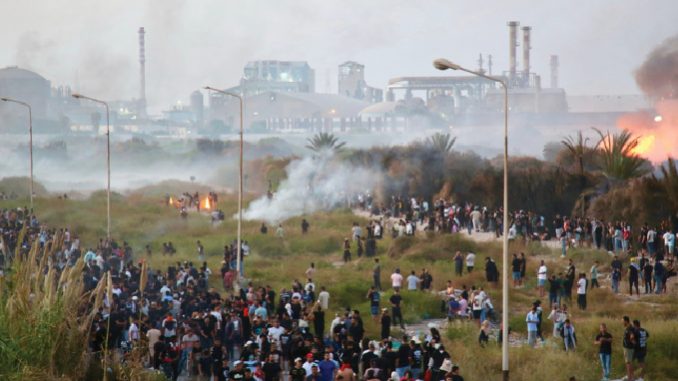
Thousands of residents of the southern Tunisian city of Gabès demonstrated on 15 October to demand the closure of a chemical complex of the Tunisian Chemical Group (TCG), which is responsible for serious environmental pollution. This industrial site uses sulphuric acid and ammonia to produce phosphate-based fertilisers, releasing toxic gases and radioactive waste. In one month, nearly two-hundred people have been treated for poisoning. Videos of suffocating, intoxicated children have made the rounds on social networks.
Faced with this popular mobilization, the Tunisian state responded with repression: more than one-hundred arrests, often at night, sometimes directly at the homes of activists. The authorities are trying to criminalise the legitimate anger of the inhabitants, by invoking “conspirators showered with foreign money”.
A Region in Crisis and Struggle
Kaïs Saïed, the president, promised in 2017 to dismantle the site. But in fact, he defends the polluting industry as a “fundamental pillar” of the economy, and plans to increase fertilizer production fivefold by 2030.
In 2021, the local population rose-up in Gafsa against corruption in two local public companies. The poverty rate in the governorate of Gafsa was around 19%, according to 2020 data from the World Bank. A few heads fell with twelve officials of the Gafsa Phosphate Company prosecuted for corruption. But Law 38 of 2020, which was supposed to promote the hiring of graduates who had been unemployed for more than ten years in the civil service, had been suspended. And the mobilization had resumed. The unemployment rate is 26% in the southwest of the country (the Gafsa region) and 30% in the category of higher education graduates, hence the dashed hopes raised by the abandonment of the law.
The popular uprising of 2025 is a cry against the impunity of those who pollute shamelessly. It is also a revolt against the abandonment of working class neighbourhoods which are those directly affected by this pollution.
The ecological struggle is increasingly a social and political struggle. This is all the more true in the neocolonial countries, ravaged by the damage of unbridled capitalism. And it is not Kaïs Saïed, the authoritarian and brutal leader, who is staying in power by coup de force, who will want to meet the demands of the population.
Gauche Révolutionnaire (Revolutionary Left), the French section of the Committee for a Workers’ International (CWI-CIO) affirms its total support for the inhabitants and demonstrators of Gabès. International solidarity! No to repression in Gabès! Enough of the corruption of the elites!
For a real public and collective ownership of the local public companies SPG and CPG through the direct control and management of the workers themselves and their organizations, in conjunction with the local population. This is the only way to take the necessary measures to stop pollution, maintain jobs, while moving towards a conversion based on the needs of the population and the protection of the environment.
Their fight is ours: For the right to live in liveable neighbourhoods and not sacrificed! Enough of profits at the expense of our lives! For a socialist society freed from the law of profit and at the service of human needs!