
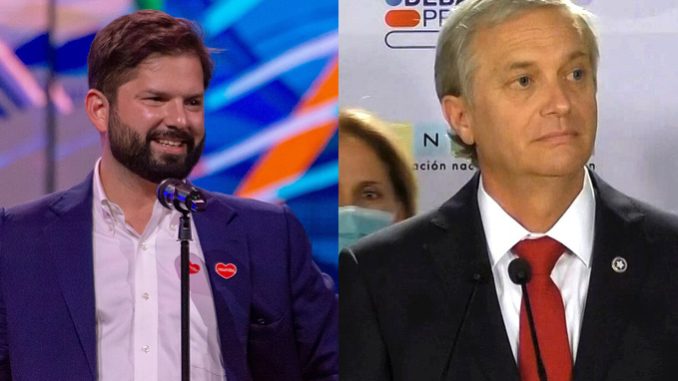
On Sunday, November 16, presidential, congressional, and senatorial elections will take place in Chile. In these elections there is a high probability that a candidate from the extreme right will be elected as president. In the last elections in November 2021 the winner of the first round was far-right candidate José Antonio Kast. It was only in the second round of December 2021 that Gabriel Boric ended up winning due to the fear of Kast that existed among the population. But after almost four disappointing years of the government of the “progressives” and the communists led by Boric and the Broad Front (Frente Amplio), everything indicates that this time a candidate from the far right could be imposed.
The first presidential round will have eight candidates on the ballot: Jeannette Jara of the Communist Party (PCCH), José Antonio Kast of the Republican Party (PRCH), Evelyn Mattei of the Independent Democratic Union (UDI), Johannes Kaiser of the National Libertarian Party (PNL), Francisco Parisi of the People’s Party (PDG), Marco Enriquez-Ominami (Independent), Harold Mayne-Nicholls (Independent) and Eduardo Artes (Independent). Of all these candidates, it is assumed that only three would have a real chance of going to the second round, Jara (PCCH), Kast (PRCH) and Mattei (UDI), although some say that Kaiser should not be ruled out. Some pollsters say that although the three candidates of the ultra-right – Mattei, Kast, Kaiser – will be practically tied, one of them could eventually go to the second round.
According to the polls, which in Chile have low credibility, in the first round Jara would come out first, followed by Kast, Mattei or Kaiser. According to those same polls Jara would lose to any of the three in a second round, this tells us that any of those three who go to the second round will be the future president of Chile.
If the trend of the October and November 2024 municipal elections is continued the right would have a very favourable scenario. In these elections the right managed to impose itself on practically everything – it got a greater number of votes, more candidates elected as mayors, imposing itself in several emblematic communes (counties) such as Santiago, Concepción and Ñuñoa. They also got more councillors and cores (regional councillors) and went from control of one to six regional authorities. For this reason, it is difficult to imagine that the results will be diametrically different from the last election, even more so if we add the poor performance of the Boric government.
You don’t have to be a fortune teller to understand that the presidential and parliamentary elections will be very complex for the “progressives” and “social democrats”, for the parties that are in the current government. Any projection made from the electoral results of the last municipal elections in 2024 anticipates a probable triumph of the most reactionary, the most Pinochetist right.
The projections for the parties that are part of the ruling coalition are not good (PS, PPD, PR, DC, PL, FA and PC), but it is unlikely that the right wing will be able to sweep the parliamentary elections and win the presidential elections in the first round, but in the second round it is most likely that they will elect the future president of Chile.
The “progressives” will surely blame the people for not knowing how to vote and for supporting the same forces who attacked their rights under the Pinochet-led military dictatorship. But when these “progressives” are in government they govern with the neoliberal policies of the right inherited from the dictatorship they supposedly opposed. This is precisely what explains the increase in support for the Chilean right and ultra-right – the supposedly leftist parties abandoning class positions or even putting aside reformist policies. People are tired of them, stopped trusting them and see them as responsible for the hardships that the working class has to go through under this system.
Practically all the candidates – from the candidate of the Communist Party to the most reactionary candidates of the ultra-right – defend neoliberal policies as the only route out of the current crisis in which capitalism is submerged. There is only one candidate who does not defend neoliberalism, that is Eduardo Artes, but unfortunately he is a totally marginal candidate who has no chance of being a real alternative to the candidates who defenders of the current system of injustices. It is clear that the working class does not feel represented by any of the candidates, which is equivalent to saying that workers do not have a candidate in these presidential elections and the idea of voting for a “lesser evil”, as in 2021, is unpalatable.
Later the parties in the Boric coalition will ask themselves: Why did this happen? They will offer excuses such as the correlation of forces not being favourable, or the right preventing them from making change. These will not be accepted. This is the discourse of a supposed “left” that does not even deserve to be considered “reformist”. All the forces who claim to represent the interests of the oppressed classes have progressively abandoned the idea of change, defending the interests of the dominant elite, something that the most recalcitrant right is supposed to do and not a supposed left.
In the first quarter of this twenty-first century, liberal democracy (bourgeois, employers) is in a deep crisis. The decomposition is already too evident, just as evident as the deep decomposition of the capitalist system. It is already difficult for the ruling elite to play “democracy”, given that they are now showing their true face, the harshest and most violent side of the neoliberal capitalist system, such as the brutal repression that we are seeing in several Latin American countries such as Argentina, Peru or Ecuador, which are a clear example of how liberal democracy has deteriorated on the continent.
Given that the current presidential candidates defend the same neoliberal capitalist economic policy, what can they debate? If everyone in the end defends the same thing, they are only left to argue about who is more and who is less corrupt, and which individual or which parties are the most parasitic within this system. They end up presenting programs and making promises that they never have the slightest intention of implementing.
Finally, the candidates end up fighting over who is the best administrator of the system, who is the most capable of making the biggest cuts to social spending such as health, education or pensions, and who has the greatest capacity to stop the struggles of the workers and popular sectors if they make a forceful response to those attacks. These are the politicians that end up being the most reliable for business, to achieve the long-awaited “social peace” it needs to continue increasing its enormous profits and filling its bank accounts even more.
It is all too clear that under capitalism there is no possibility of improving the living conditions of the working class and the popular sectors. It is not possible to achieve this with a simulacrum of democracy to which we are invited to participate every four years and where afterwards everything remains the same as before, but now with a new face administering the same system.
To put an end to the current system of injustices of capitalism it is necessary to build a political alternative of the working class, which is capable of leading the workers towards the seizure of power, to build a workers’ democracy, a democracy for the great majorities, diametrically opposed to the current democracy of the bosses that is only designed for a minority and that only serves to defend the interests of the ruling class.