
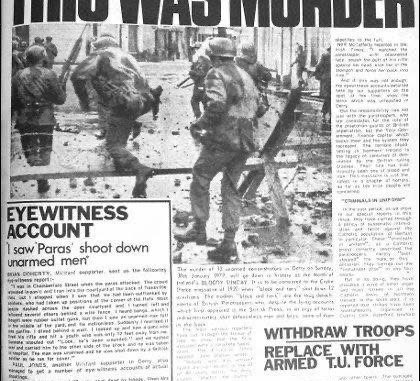
Yesterday a judge in Belfast gave a ‘not guilty’ verdict regarding ‘Soldier F’, a former parachute regiment solider who was accused of the murder of two civilians in Derry city, on January 30th 1972, in what became known as ‘Bloody Sunday’. The judge’s verdict was a huge disappointment to relatives of the victims. They had waited 53 years to see somebody held accountable for murdering 14 unarmed civilians in Derry. On that January day, the British army shot 28 peaceful civil rights demonstrators. Thirteen innocent people were killed and another victim died later. Seven of the victims were in their teens.
Bloody Sunday was one of the many horrific events that took place during the ‘Troubles’ period. ‘Bloody Friday’, the Monaghan and Dublin car bombings that killed many, sectarian massacres in Darkly and Kingsmill, the Enniskillen bombing, massacres at the Ormeau Road Bookies, in Belfast, and the Omagh bombing, and many other such atrocities, were all chilling low points in the three decades of violent conflict. However, what makes Bloody Sunday particularly important was that it was openly carried out by the British state forces against peaceful civilian protesters and it fuelled the conflict for many more years.
That charges were even brought against Soldier F’ were because the relatives of the victims campaigned ceaselessly. That campaign is a tribute to this group of working-class people from Derry.
‘Soldier F’ was found not guilty because the cover-up began immediately. Disgracefully, the dead were immediately smeared as being involved in shooting at soldiers. Military Police took statements. These were taken without a caution. That is because the army was investigating themselves.
Guns used were destroyed. These were vital forensic evidence.
The greatest disgrace is ‘Soldier F’ was the only person ever charged with murder regarding the massacre. Bloody Sunday was planned at the highest level of the British army and government Cabinet. Most attention has been paid to the Parachute Regiment’s rampage. However, forensic investigation has proved snipers from another regiment were firing from Derry’s walls. They were also murdered on the day.
Shortly beforehand, the army commander in Northern Ireland Robert Ford spat it out: “I am coming to the conclusion that the minimum force necessary to achieve a restoration of law and order is to shoot selected ringleaders among the (Derry Young Hooligans).”
Within minutes, the British army and government had a false version of events.
However, the key was that the families did not give up. The first Inquiry was a whitewash. The second ‘Saville’ Inquiry ruled all the dead were innocent. Conservative Prime Minister David Cameron publicly stated this was so.
That was a partial win for the families. However, the state still did not admit its own responsibility.
As years went by, the state slowly changed its narrative. The massacre was the fault of a bunch of out-of-control squaddies on the ground. This version does not hold up. Who sent them there? Who fired them up? If they were out of control, why were they not suspended from duty? Why were none charged for half a century? And why were other soldiers also stationed on the Walls, shooting down into Derry’s Bogside area?
The Bloody Sunday massacre also shows the arrogance of the state. They committed it with television cameras recording. They believed they could get away with anything.
Kate Nash’s brother was murdered on Bloody Sunday. In a statement, she has said: “Soldier F and his kill-crazy comrades in Rossville Street, Abbey Park and Glenfada Park didn’t decide on their own to spray bullets into unarmed marchers demonstrating for civil rights.
“If justice were to be done there would have been cabinet ministers, top civil servants and an array of generals standing shoulder-to-shoulder with F in court, just as they’d all willingly backed one and other up in 1972.
“The Bloody Sunday massacre was planned and authorised by men of far higher rank than the scruffs like Soldier F who pulled the triggers.”
Bloody Sunday was one of the turning points in Northern Ireland’s ‘Troubles’. It drove many young working-class Catholics to the (Provisional) Irish Republican Army (IRA). Anger at Bloody Sunday fed the violence for many years. Those who issued the orders for Bloody Sunday are responsible for fuelling the horrors of subsequent decades.
The ongoing ‘Troubles Legacy’ underscores the urgent need for genuinely independent investigations of atrocities, and the role of the state – involving trade unions, community organisations and relatives of victims. It also highlights the importance of building working-class unity and advancing socialist struggle as essential tools to confront and ultimately end all forms of atrocity and oppression.
For more Marxist analysis on the background to Bloody Sunday: https://www.socialistworld.net/2022/01/30/50th-anniversary-of-derrys-bloody-sunday-the-struggle-for-justice-continues/