
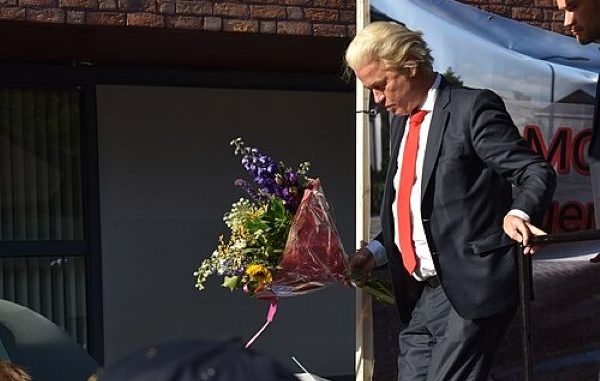
The anti-immigrant, Islamophobic and far-right party of Geert Wilders, the Party for Freedom (PVV), suffered a severe blow in Dutch parliamentary elections on the 29th of October, falling back from 37 to 26 seats.
Left parties failed utterly to campaign on a fighting alternative for capitalist policies.
The so-called ‘progressive liberals’ of the Democrats 66 (D66) bounced back up from 9 to a record 26 seats, gaining slightly more votes than Wilders. D66 campaigned on a ‘yes we can’-like positivism, but also shifted to the right on issues like patriotism and migration.
The results do not mean a return to political and social stability. On the contrary, whichever coalition is formed, it will continue anti-migration policies, feeding further polarization, and implement cuts to pay for militarization.
Coalition with far right exploded
New elections became necessary when Wilders broke with the right-wing coalition that he had helped form in 2024 after his big election victory in 2023. This coalition, with the right-wing liberal, People’s Party for Freedom and Democracy (VVD), new boy in town, New Social Contract (NSC), and the farmer-based protest party, BoerBurgerBeweging (BBB), or Farmer–Citizen Movement, apart from loud mouthed anti-migration talk, never got much done due to chaos and infighting, stimulated by Wilders himself, and was renowned for incompetence. The reason Wilders pulled the plug, however, calling for ever more repressive antimigration policies, even though his own minister was responsible for those, was that he hoped to restore his flagging poll results. This seemed to work for a bit but backfired in the last weeks of the campaign and on election day.
Far right poison their partners
The VVD, for years the main capitalist party, and responsible for allowing Wilders back into coalition after they excluded him in 2012, was for the first time in years forced to play second fiddle, to Wilders’ piping. They, and the new founded ‘party of decent government’ NSC and the BBB, underwrote Wilders’ rabid and often unconstitutional anti-migration demands. After the coalition blew up, the VVD narrowly escaped the disaster the polls predicted and lost only 2 seats (down from 24 to 22). The BBB however went from 7 to 4 seats. Most spectacularly the NSC turned out to be a one-day wonder and disappeared entirely, losing all its 20 seats in one fell swoop.
These developments show the inherent instability of political formations that base themselves on a capitalist system in crisis. But they also show that playing ball with the far right is dangerous for less rabid parties.
‘Left’ fails to provide an alternative
Left and center-left parties scored a record low, with 30 seats between them, showing that most workers and youth do not feel – correctly – that any of those parties fight for their interests. These 30 seats include a miserable 20 seats for the merged GreenLeft (GroenLinks) and Labour Party (PvdA), that lost 5 seats – a result that caused their leader to resign. Their program included very few concrete demands that working class people could identify with and basically promised that a better run capitalism under a coalition of the political ‘middle’ would lead to a more just society. It is no coincidence that D66, which is a little more to the right than GL-PvdA but with a younger and more dynamic leader, promising more or less the same, got 20% of its result from former GL-PvdA voters.
Socialist Party aimed for coalition with CDA
The Socialist Party (SP) made some promise when at the start of the election campaign they presented a more left programme, campaigning for raising wages, taxing the rich and a mass social housing plan, which had them slowly rising in the polls to a peak of 7 seats. However, their leader kept hammering on the need for the SP to participate in a ‘social coalition’ government, including the Christian-Democrat CDA. This traditional party of the Dutch bourgeois participated in most austerity coalitions over recent decades. Whatever support the SP gained with their left demands then evaporated. They went from 5 to 3 seats, their 6thconsecutive parliamentary election loss since their record result of 25 seats in 2006.
Will ‘Yes we can’ form a coalition?
The D66’s 26 seats are not significantly more than the 24 seats they won in the 1994 and 2021 elections. What is new is their lead among parties, which enables their leader, Rob Jetten, to be the first to try and form a coalition. He needs at least four parties for a majority. Since Wilders has for now been excluded by the major parties, to form an openly right wing coalition Jetten needs at least four other parties’ support. This last option is not excluded but would make D66 prisoner to its more right wing partners. Secondly, and more importantly, its majority would still be small, making the coalition vulnerable to its most right wing but smallest participants.
Stable government?
The employer’s federation, VNO NCW, lamented after the fall of the last government that they agreed with the main thrust of its policies but were bothered by the instability. The bosses want a stable government. That is also the wish of the main so-called center parties D66, CDA, GL-PvdA and VVD. Although the last claimed they loathe the idea of being partners with GL-PvdA, Jetten will first try to form a coalition of these four parties, which would have a likely majority.
Government of cuts and crisis expected
Whatever coalition is constructed, it will be far from stable. No party was untuned enough to campaign on the cuts they are planning but from the figures behind their programme serious austerity is looming. There will be cuts for the public sector, for health care, on insurance for unemployment and disability, and in education. All cuts are against a background of a still growing economy, a small budget deficit and a relatively low state debt. The money is needed however to pay for militarization, which will cost tens of billions of euros. If, or rather when, a recession sets in, austerity will become much more dramatic.
Dutch workers will not take coming attacks lying down. Over the past period we have seen successful strikes on wages and conditions, in traditional sectors like railroads, docks and the airport but also in new sectors like the pharmacies. There will be more to come. Unions in higher education have already announced a one day strike against cuts on the 9th of December.
Polarization rampant
Also, the next coalition will have to deal with hostility against immigrants. Having given in to scapegoating immigrants for the ills of the capitalist system, these parties are now finding out that it is easier to mount the tiger of racism than to try and get off. Although hailed in the press as a victory for positivism and sensible policies, the losses for Wilders’ PVV do not mean that the trend towards further polarization has been stopped. On the contrary.
On the one hand, almost all parties, in one way or another, now openly embrace anti-migration policies, echoing the PVV’s scapegoating of immigrants for many, if not all, of the social ills, like the housing crisis. Even the GL-PvdA, and the SP, agree that migration must be curbed.
On the other hand, Wilders’ loss has been the gain of the two other far-right parties, JA21 and FvD, so that the three of them have gone from 41 to 42 seats. The more rabid of those is FvD, grown from 4 to 7 seats, that claims 60,000 members, a vibrant youth organization with summer camps, and which includes semi-fascist tendencies.
Violent protests planned asylum centres
During the election campaign we have already seen a rise in often violent protests against plans for new or expanding centres for asylum seekers in a series of towns, infiltrated or instigated by extreme right and fascist groupings. A demonstration against migration at the Hague turned into a violent riot by over a thousand extreme right elements, shouting ‘Sieg Heil’ and waving right wing flags, that among others attacked the offices of D66. No doubt this led to sympathetic support for D66, among some voters. Remarkably, and scandalously, politicians of the right wing liberal VVD and other ‘decent’ right wing parties, refused to label this violence as extreme right, instead talking about hooliganism and the like.
Working class disenfranchised – an alternative is needed!
The traditional mass party of the working class, the PvdA, now merged with the Green Left, has been openly on the side of capitalism since the 90’s, participating in or leading governments of cuts and privatization. The sole focus of the SP on electoral results and joining capitalist coalitions has led to their ongoing demise. The resulting massive vacuum on the left has opened the doors for ever increasing polarization. The Dutch working class has been politically disenfranchised.
However, while it has been sidelined on the political arena, the working class will not stay quiet in the face of austerity – the recent growth in size and frequency of strikes shows that while workers do not see a political home in any party, they are willing to fight for themselves. Also, while the overall union membership has still been declining somewhat, the last two years have seen a significant 50% rise in new membership from younger workers and women.
A new mass fighting party of the working class will have to be built, one that will be able to provide a real alternative for working people, and that will be based on the broader workers’ movement.
In a coming article we will discuss the failure of Dutch capitalism to deliver and a more specific analysis of resulting socio-economic problems. We will also deal with the need for fighting unions, a mass fighting workers’ party and for a socialist programme.