
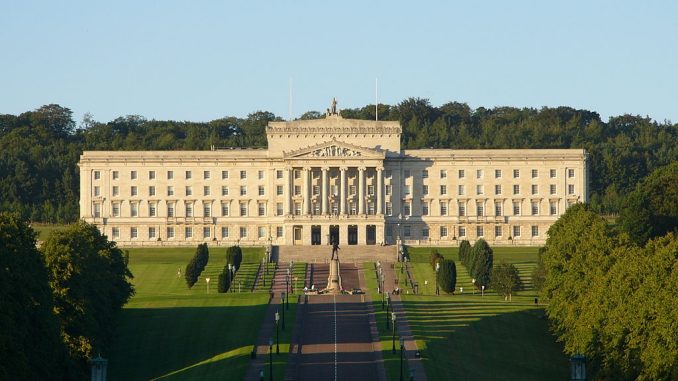
Last month marked 10,000 days since the re-establishment of local government at Stormont buildings, Belfast, following the Good Friday Agreement in 1998. Its failure to deliver social and economic improvements, let alone bridge the deep divisions in northern society, has rarely been more manifest.
The power-sharing institutions have experienced repeated crisis and extended periods of suspension. The Stormont Executive has only sat for 62 percent of the last 10,000 days and only three of the seven Assembly terms have been collapse free. Even when it has functioned, the structures of government have been marked by paralysis and stand-off rather than any form of progress.
Yet across the world, the Good Friday Agreement which cemented the ending of the ‘Troubles’ in Northern Ireland is promoted as the ‘go to’ success story of imperialist foreign policy. It is their template for resolving ‘community’ conflicts in cases as disparate as Sri Lanka, Colombia and Israel-Palestine.
Bourgeois commentators boast that the complex system of mutual vetoes at the heart of the Stormont executive offer a pragmatic solution for the advancement of a divided society. The truth is that they were established by the governments north and south, with the blessing of EU and US imperialism, as a means to put a cap over the peace process ending decades of conflict. As the leading Marxist thinker in the Irish section of the Committee for a Workers’ International, Peter Hadden, wrote at the time at its core the Agreement has a model that institutionalises division rather than offers a way to resolve it.
The mechanism could perhaps have been more stable if it had occurred against a backdrop of capitalist expansion and growth but with unending economic stagnation following the financial crisis of 2008 and with the dominance of neo-liberalism, and concomitant austerity, in Westminster – the experiment has largely failed.
Stormont – a model of cultural autonomy?
The model is not new, however. It closely resembles the theory of cultural autonomy advanced by the reformist Austro-Marxist school at the beginning of the 1900s. Cultural autonomy proposes a form of shared sovereignty as a solution of sectarian conflict in multinational states – avoiding the need for national self-determination. The model was advanced then in the pre-First World War multi-national Habsburg empire to allow them to enter parliament while avoiding a sharp conflict with imperialism. Under the model the central state handles the issues of vital importance to capitalism like economics and defence, while distinct ‘cultural’ parliaments, representing national groups, manage education, language and heritage. The parallels with Stormont could not be clearer.
The goal is to defuse conflict and paper over unresolved national questions by assigning to each group control over its own cultural destiny.
With minor adjustments Stormont mirrors this model with a system of governance based on power-sharing between self-designated unionist and nationalist blocs. Given the fear of a return to ‘majority rule’ all ministers are fundamentally unaccountable within their own fiefdoms meaning the Assembly lacks any real power over policy-making. Add to that the petitions of concern and mechanisms requiring cross-community ministerial agreement for controversial or cross-cutting policies and the fact that cultural matters, including language rights, symbols or funding decisions for segregated education require dual consent and it is clear why government alternates from ‘go-slow’ to ‘stop’.
Set against a backdrop of budgetary austerity by the United Kingdom government in Westminster it is a system guaranteed to perpetuate community division by facilitating competition in scarcity.
Indeed the only real benefits go to the political ‘champion’ on each side as the system of mutual veto encourages a system of horse-trading. The interests of both main parties – currently Sinn Féin and the DUP – is to be seen to ‘deliver the goods’ on their sides’ priorities to reinforce political support. The lesser representatives from both sides play the role of opportunistically snapping at the crumbs which fall off the table. That dynamic also explains why, in a such a sectarian set up, voters will tend to prefer voting for the perceived ‘strongest’ champion to defend their interests.
Divide and conquer set in stone
The system sets in stone the centuries-old policy of ‘divide and conquer’ used by British imperialism in Ireland. Rather than allowing a true reconciliation process, it incentivises the political entrenchment of division and cultural difference. The protracted and bitter struggle over the Irish language act is a prime example. It was never just about bilingual services or even hopes to revive the language; it was a symbolic battle for recognition and authority between two conflicting identities.
Imperialism’s impact on the Irish language has been devastating. Despite the recent blossoming of interest in the language and rapid expansion of Irish language schooling, the Irish-speaking (Gaeltacht) communities face an unprecedented struggle to survive. 100 years of bilingual signage and the ‘cupla focail’ has covered over abject neglect of Gaeltacht communities by consecutive right-wing governments in Dublin. The mass emigration of young generations of Irish speakers continues anew with a new cohort unable to afford a home in the Gaeltacht amidst the crushing impact of the housing crisis and a total absence of new public housing.
That said the Irish language still has huge, and increasing, cultural significance for Irish people and there is a rising militancy among language activists. As evidenced by recent demonstrations in Dublin and Belfast, there is a strong, youthful and vocal lobby demanding language rights and equality.
However under the Stormont system, the rights sought by Irish language speakers can only be obtained through a grand bargain that simultaneously addresses unionist cultural and identity concerns (expressed partially through Ulster-Scots); reinforcing the very transactional, group-versus-group dynamic that defines the system. The recent and long-delayed joint confirmation of Irish and Ulster-Scots language commissioners (having very little direct powers) also confirms that reality.
The result is that questions of language and symbolism unfortunately remain central to the sectarian politics which dominates Stormont.
Stability under reaction
In the north, the sectarian carve-up acts to sustain an unstable constitutional arrangement where a part of Ireland remains within the UK – but all crucially subject to the domination of capital in the final instance.
This model is designed to exclude the agency of the working-class – whose interests are internationalist by necessity and therefore have no interest in the divide and conquer game. It also excludes those young people who reject the sectarian labels.
Under the carve-up those who do not identify exclusively as unionist or nationalist are marginalised. For its part the Alliance party has succeeded by carving out a position of championing economic advancement albeit on the most thoroughly reactionary neo-liberal basis.
Workers’ voices are heard in Stormont only through the distorted amplification offered by the sectarian parties. Campaigns to reduce poverty, improve healthcare or education appear only as proxies and are sacrificed as necessary for the wider constitutional battle – a battle which cannot be resolved due to the reinforced sectarian division.
A socialist alternative
Issues affecting the working class as a whole or class politics presents a fundamental challenge to the system. The usual response are attempts to divide them by painting community campaigns into either green or orange corners – and if that fails – the agenda is to seek to ignore or sideline them.
The political system is designed to make it difficult to build a cohesive, cross-community alternative based on working class or socialist politics. But the realities of class struggle and the broader failure of capitalism are not going away. The objective conditions remain ripe for a cross-community and working-class politics to emerge challenging the neo-liberal consensus as well as positing an internationalist socialist alternative to both imperialism and bourgeois nationalism.
Stormont was not set up to deliver for working class people. It was established to stitch up a peace process so that British and Irish capitalism could get back to business as usual. The opposition to Stormont is not to be found inside the corridors of power but outside them. Increasingly the trade union movement – in workplaces, on picket lines or protests on the streets – is viewed as the only real opposition.
It is vital for socialists, trade unionists and those involved in grassroots and cross community campaigns to get involved in efforts led by Militant Left and others to establish a cross community socialist alternative – focused on advancing our interests as a class. Capitalism and imperialism are incapable of achieving genuine reconciliation or a resolution to the national question – that requires a politics built on class struggle to overcome sectarian division and reaction.