
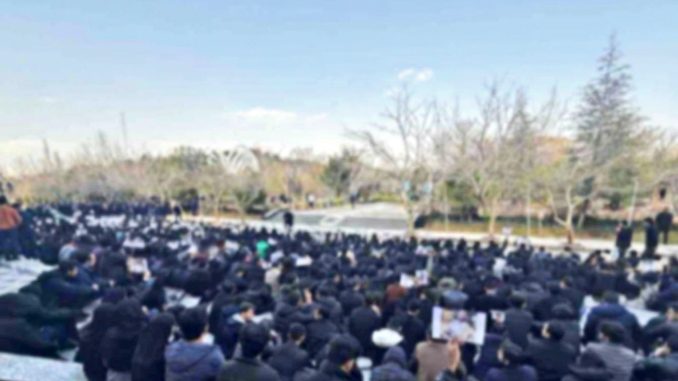
Amid the unrest following the recent mass protests in Iran, that were marked by brutal violence, a weeks’ long internet blackout, and ongoing arrest of those who spoke up, sections of the population have refused to retreat into silence. Among those who have continued to resist are university campuses.
Forced Normality and Collective Refusal
Universities have long been spaces of critical thought and political debate. Yet an institution which remains silent in face of injustice is stripped of its very essence. Nearly one month after mass killings and arrests, the Iranian state is attempting to reassert control through routine. Universities reopened online after being closed due to “cold weather”, exams rescheduled, and administrative calendars resume. Official state language insists on stability and calm.
Students across Iran have responded with collective refusal, through boycotts of exams, public statements, and organized sit-ins. The students of Gonābād University of Medical Sciences, for instance, announced that should the authorities attempt to compel attendance by threats or pressure, they would show up in the exam halls wearing black, in a silent but clear protest.
Instead of complying with the illusion of normalcy, through collective statements students have expressed solidarity with a grieving nation, condemning the mass killings and state violence, defending freedom of speech and justice for those murdered by the regime. The loudest demand is for the unconditional and immediate release of detained students and healthcare workers who provided emergency care for wounded protesters. Medical students who refuse participation in exams are not only protesting university policies but responding to criminalisation of their future professions. At least one surgeon, Dr. Alireza Golchini from Qazvin, now faces charges of “waging war against God”. This charge can carry the death penalty. In this context, defiance is not symbolic dissent but a rejection of being conscripted into a system that punishes care itself.
Facing mounting pressure, the Ministry of Health announced that absence from final exams could be considered justified, without the need for documentation, citing students’ psychological well-being. While presented as a measure of accommodation, this move reflects the scale of student resistance rather than institutional empathy.
Boundaries and Solidarity
What is unfolding across Iranian universities does not point toward a unified movement immediately with a shared programme. Its political significance lies instead in the boundaries it sets. Under conditions of mass repression, academic routine cannot be treated as neutral, but it functions as a mechanism through which violence is pushed out of sight. The refusals articulated by students mark a limit: what cannot be normalised, administered, or resumed as if nothing has happened.
These actions also pose expectations beyond Iran’s borders. International universities, academic associations, medical bodies, and student organisations cannot claim neutrality while cooperating with institutions that enforce silence under repression. Solidarity, in this context, is not symbolic alignment but refusal to legitimise normalisation. At a minimum, solidarity with these refusals requires public recognition of student boycotts and statements as political acts, opposition to the criminalization of medical workers, and demands for the immediate release of detained students and healthcare professionals.
Such solidarity cannot come from imperialist powers that posture as defenders of freedom while sustaining mass violence elsewhere. Claims of support from governments like those of Trump — which backed Israel’s assault on Gaza (an assault the Israeli military itself now admits killed ‘around 70,000’ people) — do not represent solidarity with struggles against oppression. In Iran, these same powers seek not liberation but the replacement of one repressive order with another, aligned to their own interests.
The protest action by students are not proposals for a future strategy. They are defensive boundaries drawn in the present against the danger that silence be mistaken for stability.