
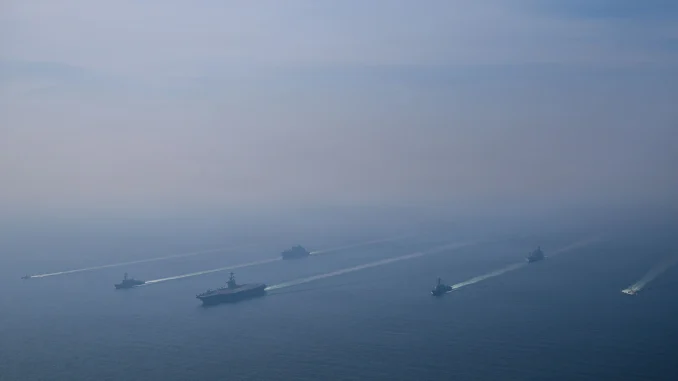
Once again peoples in the Middle East face the horrors of another war with its human casualties and physical destruction. Already there are reports of 85 people, mainly school students, being killed in a strike on a school in Minab.
This joint US‑Israeli attack is different from their previous attack on Iran in June last year; now they are clearly aiming for “regime change.” Israel/US are now claiming that Ali Khamenei has been killed. The war is escalating; SocialistWorld will provide further analysis and updates on developments in this, the heaviest attack so far on Iran.
But this has nothing to do with freedom and democratic rights. How could it be when some of the US’s closest allies, like Saudi Arabia, do not even pretend to be democratic, holding only fake elections.
Trump claimed in his address to the US people justifying starting this war by saying that “the Iranian regime has … waged an unending campaign of bloodshed and mass murder.” But the Israeli military, the US’s ally in this new war, has itself been waging a “campaign of bloodshed and mass murder” that has killed over 70,000 in Gaza in revenge for the deaths of over 1,200 in the October 7, 2023 raid on Israel. However, US governments under both Biden and Trump have not condemned these Gaza deaths and have continued, like other western powers, to arm Israel.
Trump’s aim is both personal — he wants to claim victory over the Islamic Republic and boost his falling approval ratings — and strategic in the sense of consolidating US imperialism’s influence and power in the Middle East. Trump is probably betting that overwhelming military attacks can be enough to split the state’s leadership and, alongside mass protests, lead to the regime’s fall or the granting of significant compromises by elements within the Tehran regime. However, faced with this existential threat, many in the Iranian regime are likely to do all they can to stay in power.
Even before this war started some nations and capitalist strategists feared that it would simply destabilise Iran, the Middle East and possibly further afield. That’s why some neighbouring regimes like Saudi Arabia fear the wider impact of the war, including in their own countries. The collapse of the Iranian regime could lead to a vacuum in a large country of over 91 million with a multi‑national and ethnic makeup and the possibility of new Iraq‑style civil wars and wider regional destabilisation.
In an attempt to limit the fallout, Israel, on the first day of this new war, bombed southern Lebanon clearly as a warning not to get involved in the current fighting. Only a few days before today’s bombing the Lebanese foreign minister complained that “Lebanon has received signs that the Israelis could strike civilian infrastructure and maybe the airport” in Beirut.
This unilateral attack on Iran can also ratchet up western powers’ tensions with Iran’s allies, Russia and China, meaning that a rapid truce in the Ukraine war seems less likely now, while increasing the possibility of future military clashes involving China and Taiwan.
Right now it is not clear how widely this conflict will develop. Despite the heavy damage to Iran’s military resources in last year’s war and the severe impact of Israel’s recent offensives against Iran’s allies and proxies in the region, there are fears of the war having a potentially large effect on oil and shipping. Already Iran has declared the Strait of Hormuz closed, through which about a fifth of the world’s oil and gas passes — something that can lead to a hike in worldwide inflation and a wider economic jolt.
Of course Trump and the US will talk about democracy. But this is hypocritical, not just in relation to today but to Iran’s history. In 1953 the US and Britain both collaborated to bring about a coup in Iran that ousted the democratically elected Mossadeq government, which had nationalised the oil industry. That coup restored Mohammad Reza Pahlavi, who had gone into exile in 1951, to the throne; his father had seized power in 1925 after leading a military coup in 1921.
The same applies to Trump’s talk of Iran’s “malicious pursuit of nuclear weapons.” The US and other western powers never comment about Israel’s undeclared nuclear weapons and the harsh punishment of any Israelis who leak information about them. In a world dominated by capitalist competition and rivalry, capitalist classes have one rule for their allies and another for their opponents.
Among Iranians there will inevitably be fear of who will suffer, how many civilians will be killed or injured as was the case in last year’s Israeli‑US bombing campaign.
It is possible that there will be some Iranians who would welcome the US “surgically” removing the regime’s top leadership. But what sort of regime would Trump try to impose? Look at how the Trump administration runs the US: it refused to even question the January killing of two US citizens in Minneapolis who opposed ICE’s anti‑migrant offensive.
While the war continues the Islamic Republic leaders are likely to use some elements of ‘revolutionary’ rhetoric to defend their regime, something they have done from the very beginning of their rule in describing all opposition as either ‘unislamic’ or ‘counter‑revolutionary’ or both. But opposition to intervention by imperialist powers like the US does not mean supporting the existing Iranian regime, which is dictatorial, repressive, exploitative and pro‑capitalist.
The Iranian regime claims that it is defending the 1979 revolution when, in fact, the establishment of the Islamic Republic represented a counter‑revolution that suppressed the original widespread idea of overthrowing corrupt rule, ending repression and winning democratic rights. Initially it was not clear to most Iranians what the would‑be rulers around Khomeini meant by an Islamic Republic. But among the youth, workers and poor an “Islamic Republic” was often simply seen as a “republic of the poor.” This is not what it turned out to be, as a new elite rules; just this week the Guardian reported on how many children of the elite live in western countries.
In preparation for a possible collapse of the regime there is an effort to promote Mohammad Reza Pahlavi’s son, Reza Pahlavi, as a future ruler. Certainly his core supporters think he has the ‘right’ to the throne even though his grandfather only became king by ousting the Qajar Dynasty’s Ahmad Shah. Already before protests began at the end of last year the monarchists modestly proclaimed Reza Pahlavi as “Leader of the National Uprising.”
However, they are not democratic. In the recent movement in Iran one of the monarchists’ slogans was “Death to the three corrupt — the mullahs, the leftists, the mujahideen,” lumping together the regime’s leaders, socialists and the MEK anti‑regime fighters who now receive support from within the US. Internationally, Iranian monarchists in Frankfurt, Germany attacked Iranian leftists at a recent protest against the regime. In Vienna, Austria, Iranian monarchists have demanded that all Persian restaurants fly the monarchist flag and put up pictures of Reza Pahlavi.
These are warnings of how they could behave, not just towards the left and workers’ movements, but also if they faced opposition from any of the national minorities who make up just under 40% of the Iranian population. Because of this, and the bitter legacy of the dictatorial monarchist rule finally overthrown in 1979, it is questionable whether the monarchy could be restored. Trump himself has been sceptical of its support and it is possible that a combination of dissident elements within the regime and some oppositionists will form a coalition government if the regime collapses.
But such a government would clearly rest upon the continuation of capitalism and, for this reason, workers’ organisations should not participate in it. In nearly all revolutions such multi‑class coalition governments have acted to hold back the movement to prevent a challenge to capitalism. The key to a real transformation of Iran that ends dictatorship and repression, defends democratic rights, ends oppression of women and national minorities, and at the same time breaks with capitalism and begins the socialist reconstruction of the country.
The CWI’s orientation is towards helping to build independent workers’ organisations that will oppose both oppression and capitalism.
We stand and argue for a revolutionary socialist opposition to imperialist intervention, the Islamic Republic and the simple replacement of the Islamic Republic by another capitalist regime. This standpoint, essentially for a workers’ government, is our foundation as we argue for both campaigns on immediate issues (like democratic rights, an end to repression, economic and social demands) and to win support for the idea of socialist revolution.
On this basis we argue against those forces which simply oppose the renewed US‑led attacks on Iran and say nothing, or next to nothing, about the Iranian regime’s dictatorial character. Such an approach actually helps both the imperialists and Iranian capitalists in their desire to maintain capitalism in Iran.
Immediately there needs to be a drive for youth and the working class to build a mass anti‑war movement against militarism and nuclear proliferation, and to build real solidarity and links with the Iranian working class and youth and especially its genuine organisations like the semi‑legal bus drivers’ union in Tehran.
This war, especially as it is led by the US and Israel, will strengthen anti‑imperialist consciousness and, depending on how the war unfolds, could lead to a further weakening of both Trump and Netanyahu in the US and Israel. At the same time this attack can be perceived as another assault on the Muslim world and thereby feed a certain resurgence of Islamic fundamentalism and more terror attacks.
Opposition to the war can include different political forces and the CWI strives for the workers’ movement to be clear on both its programme and on alliances with different forces. For example, Marxists would oppose, with others, any attempt to restore the Iranian monarchy, and at the same time argue for a workers’ government and not a capitalist one.
Now faced with an imperialist attack we would argue that a real defence would mean overthrowing the Islamic Republic and establishing a workers’ government prepared to fight a revolutionary war if necessary, while at the same time starting a socialist transformation within Iran. Such a government could expose the real intentions of the foreign capitalist powers, campaign against imperialist wars and call for an international movement by workers and the poor in their own countries against repression, the rule of the rich and capitalism itself.
This may seem a long way off, but experience and struggle can build movements that understand that the only way out of this seemingly endless series of crises, upheavals, oppression, environmental decay and wars is socialist change.