
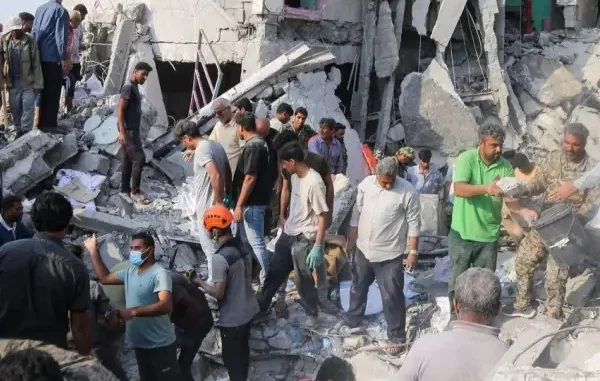
There is no horizon for security or liberation in an imperialist show of force that deepens a regional bloodbath.
Written by Shahar Ben-Horin & Yasha Marmar – a guest article from the Socialist Struggle Movement (SSM) in Israel/Palestine originally published on March 5th. ( Stop the War in Iran and the Region || There is no horizon for security and liberation in an imperialist show of power that deepens a regional bloodbath • Socialist struggle)
Stop the war on Iran and regionally
There is no horizon for security or liberation in an imperialist show of force that deepens a regional bloodbath
The regional war ignited by Trump and Netanyahu, accompanied by declarations of an aspiration to promote regime change in Tehran, is expanding and exacting a heavy price from ordinary people
Guest article by Shahar Ben Horin and Yasha Marmer, SSM in Israel/Palestine (originally published on 5 March)
Through a cynical exploitation of the liberation aspirations of the masses in Iran, and by manipulating the security fears of the masses in Israel, Trump and Netanyahu have launched a war that now directly involves most Middle Eastern states — and has spilled beyond that. This is yet another catastrophic turning point for the masses across the region within the ongoing blood-soaked crisis since 7 October 2023. It is the most extensive military action initiated so far by the Trump administration, and the first time the State of Israel has openly assassinated a head of state.
Preparations for the imperialist offensive continued for months and began almost immediately after the previous attack in June, which concluded with the bombing of Iran using the most powerful non‑nuclear weapon in the world, and with Trump’s declaration of “CONGRATULATIONS WORLD, IT’S TIME FOR PEACE”, as well as Netanyahu’s boasting of the removal of “two existential threats” — nuclear and ballistic — and of a victory that “will stand for generations”. Within days it became clear that the military hits had not been at a strategic level, that the regime in Tehran was not crawling towards a surrender agreement with Trump, and it soon became evident that Netanyahu was failing to reap political gains and decided to avoid snap elections and continue the genocidal offensive in Gaza. Now, the assassination of Iran’s ruler Ali Khamenei and other senior regime figures on the first day of the offensive symbolised an escalation in aims, firepower, and the scope of the campaign. Trump and Netanyahu openly turned to a more aggressive promotion of the idea of intervention for regime change, even though they currently have no clear horizon for achieving it, and they threaten that the offensive will continue for weeks.
Accordingly, the counter‑offensive launched by the regime in Tehran has also developed on an unprecedented scale, including strikes on a series of US military targets and on civilian targets in territories under most Arab states in the region. UAVs reached as far as the skies of Cyprus and Azerbaijan, and a ballistic missile launched from Iran was intercepted on its way towards Turkish airspace, a NATO member. The Iranian regime at least partially closed the Strait of Hormuz, through which around 20% of global oil output passes, and caused disruptions to liquefied gas (LNG) production in Qatar. Global energy prices have surged and stock markets across Asia have recorded declines. Tens of thousands of flights have been cancelled so far. The longer the crisis continues, the more it may both fuel price hikes and also push the global economy towards recession.
The war is spreading
The US military has sunk Iranian vessels, including a warship in the Indian Ocean, off the coast of Sri Lanka, thousands of kilometres from Iran. In Lebanon, Israeli military attacks had already escalated even before the offensive in Iran, and now the operations of the occupying ground forces have been expanded, accompanied by a call for all residents of Lebanon south of the Litani River to move northwards. According to reports, there are hundreds of thousands of displaced people. Hezbollah joined the counter‑offensive in a limited capacity by launching missiles towards the State of Israel following the assassination of Khamenei — this coming a year and a half after the Israeli assassination of the organisation’s secretary‑general, Nasrallah. It is also possible that the Houthi regime in Yemen will intervene.
The entire Israeli ruling class has once again rallied to strengthen Netanyahu’s government and its military actions through security demagogy, identifying an opportunity for what they see as geo‑strategic gains in the form of weakening up to potentially toppling the regime in Tehran, the central link in the weakened “Axis of Resistance” alliance in the region. The Israeli right‑wing regime continues with the logic of a bloody campaign which, through an unprecedented display of military force, seeks to reshape the balance of power in the region by expanding the operational range of the war machine, extending the territorial scope of military occupation, and deepening the oppression and dispossession of the Palestinian people through acts of ethnic cleansing, centred on the annihilation offensive in the Gaza Strip — which continues, albeit at lower intensity, during the partial ceasefire.
As of 5 March, over a thousand civilians have been killed so far in Iran, including around 150 schoolgirls. More than 120 have been killed in Lebanon. In Israel, around 12 people have been killed in the counter‑offensive, including children and adults in a poor working‑class neighbourhood in Beit Shemesh, and a care worker from the Philippines in Tel Aviv — the chief responsibility for the killing of civilians in Israel lies with the Israeli government, which chose to launch the war. In the Arab Gulf states, around 10 civilians have been killed.
Demonstrations around the world
Across the world, demonstrations against the new offensive were organised from the very first day, both by opponents of the regime in Tehran and by its supporters, including Shia communities for whom Iran’s ruler was a religious symbol. In Pakistan and Iraq, protesters stormed US diplomatic buildings — and dozens of demonstrators in Pakistan were shot dead. In Bahrain, which has a Shia majority, protests were organised against the offensive. Conversely, demonstrations in support of the offensive are also being organised, led by Iranian exiles and migrants, apparently including monarchist elements hoping for the restoration of the Shah’s dictatorship, as well as others tempted by the false “liberation” propaganda.
The fireworks in Tehran in response to the killing of the tyrant, and expressions of joy among some Iranian communities around the world, reflect understandable feelings among parts of the Iranian population, given the murderous repression used by the regime to crush the heroic struggles of the masses for freedom and welfare — including workers fighting for wages and living conditions, and struggles against gender oppression and the policing of women’s bodies. Yet the offensive, carried out by nuclear powers responsible for sanctions that intensify the plight of the masses, is likely also enabling the regime, to some extent, to re‑cohere its support base across Iran around “anti‑imperialist” propaganda, particularly among the ‘Revolutionary Guards’, the Basij militia, and sections of the army. Only the masses in Iran, under the leadership of the working class in society and in collaboration and solidarity with the masses across the region and the world, will be able to liberate themselves. This as a part of a struggle against all the oppressive regimes in the region — including the occupation and domination imposed on millions of Palestinians — and for democratic and socialist states that will operate within a framework of confederative coordination, on a democratic and socialist basis, to secure the future of the region.
The semi‑mass movement in Iran at the beginning of the year, which was crushed by murderous persecution, exposed a deep crisis within the regime. Western imperialist leaders sensed this weakness and returned with renewed vigour to “liberation” propaganda. This is aimed at manipulating the aspirations and struggles of the masses in order to harness them to an agenda of regime change in favour of one willing to dance to Trump’s tune. Speeches by Netanyahu and Trump were broadcast by hacking into Iranian television before the bombing of the broadcasting authority. This represents a further strengthening of the vector of destabilising the regime in pursuit of its replacement, even though the architects of the US–Israeli offensive have no certainty as to how far they can go in the current round. The longer the offensive continues, the more likely it is to lead to scenarios of the central regime collapsing in parts of Iran, and the possible development of a prolonged sectarian civil war similar to Libya after the fall of Gaddafi’s regime. One potential trend in this direction emerges, for example, from reports that the CIA and Mossad are actively working to rely on the infiltration of Kurdish militias into Iranian Kurdistan as part of a plan to destabilise the regime.
Potential for entanglement
The US Secretary of War, Hegseth, declared that the offensive “isn’t a war for regime change — but the regime is changing”, meaning as a result of the assassinations within the regime’s upper echelon. The power structure of the regime is undergoing an upheaval that has not yet concluded, but it remains an open question to what extent, for example, Ali Larijani, head of the Supreme National Security Council — who, according to reports, was appointed by Khamenei to ensure the regime’s survival in the event of an assassination, is now the de facto strongman of the regime, and is described as “pragmatic” — will be open to a ceasefire deal on terms of capitulation to the White House. For the masses in Iran, in any case, he is known as one of those responsible for the massacre of protesters at the beginning of the year. If reports are accurate regarding the formal appointment of Khamenei’s son, Mojtaba, to the position of “Supreme Leader”, this too symbolises continuity.
In Venezuela, US imperialism abducted a sitting president in order to engineer a “regime adjustment”, that is, to subordinate the regime to Washington’s dictates. Regarding Iran, the Trump administration claims that senior regime officials are now open to returning to negotiations, but that in Washington — which blew up the negotiations when it launched the offensive — the possibility is being rejected. Counter‑claims have been voiced, and it is clear that at least key figures within the Tehran regime, which is in a survival crisis, view signing a surrender agreement under fire — with the same Trump who collapsed the previous agreement — as political suicide. Even after the previous round in June, the regime defiantly refused to accept Trump’s dictates. Thus, a capitulation deal does not appear to be on the immediate agenda, although the possibility of a tactical attempt to reach a new ceasefire arrangement cannot be ruled out.
It is still unclear how far the military offensive will go in destabilising Iran and the region, given that the Trump administration has an interest in containing the event. Trump is under public pressure in the US. An initial poll estimated 41% support and 42% opposition to the offensive among registered voters, and later a general poll showed only around 27% support among the wider public. At least 6 US soldiers have been killed so far, and there is concern about deterioration in the US economic situation. A day before the offensive, a Gallup poll was published showing a changeover in US public opinion, with general public sympathy for Israel falling below the level of sympathy for the Palestinians — a sentiment that may also manifest in the context of the offensive on Iran.
In his remarks on Monday, Trump did not include regime change in the list of the offensive’s supposed objectives, which he defined as further degrading naval and ballistic capabilities, preventing a military nuclear option, and weakening the regime’s capacity to support its proxies in the region. An air‑strike campaign alone cannot impose regime change, particularly given the size of Iran’s territory and population. The scale of air power concentrated in the region potentially allows for a military offensive lasting several weeks, but it is significantly smaller than the equivalent force assembled on the eve of the 2003 invasion of Iraq.
Trump’s boast that he does not rule out sending ground forces was also made previously regarding Venezuela, but aside from a potential intervention by commando units, a large‑scale deployment of forces to Iran is unlikely in the coming weeks, as it would exact a heavy price from the interests of US imperialism and provoke significant public anger in the US — including among the Trumpist MAGA movement, elements of which have already clashed with Trump in recent months, mainly over foreign policy. Thus, the ultra‑right politician Marjorie Taylor Greene is now exclaiming: “We promised no more foreign wars, no more regime change”.
The fact that French President Macron, who heads the strongest military power in the European Union, was pushed to publicly oppose the offensive highlights concerns among sections of Europe’s ruling classes about the potentially far‑reaching destabilising consequences in the region, and even for the global economy, and for public anger. This is echoed in the opposition expressed by the Spanish state government.
Meanwhile, the offensive enjoys the support of the governments of Britain and Germany, and of the Arab regimes in the region, although the latter made sure to publicly distance themselves from the idea before it began, in light of Arab public opinion.
The regimes in the region on a collision course
A broad survey across the Arab world published at the beginning of January showed majorities of 84% and 77%, respectively, who view the policies of the Israeli regime and the US regime as threats to regional security — 44% saw the State of Israel as the primary threat to security in the region, 21% identified the US in that role, while 6%, in third place, defined Iran as such. Therefore, in the previous round, the Arab Gulf states even publicly condemned the attack on Iran. Yet now they find themselves in open confrontation with the regime in Tehran, as does Erdoğan’s regime in Turkey, which is manoeuvring between the pressures. The longer the regional war continues, the higher the price it will exact from the Gulf states — including damage to tourism and trade, the erosion of personal security not only under Iranian missiles but also in the face of a growing danger of individual revenge attacks, and destabilising consequences in general.
The détente between Saudi Arabia and Iran under Beijing’s auspices since 2023 survived until the current offensive despite constant tension. For the Saudi monarchy, it was important to publicly present a position demanding a diplomatic solution and to declare at the end of January that Saudi airspace would not be used for military action against Iran. Yet according to the Washington Post, behind the scenes bin Salman acted in parallel with Netanyahu to persuade Trump to carry out the offensive, despite assessments by US intelligence agencies that the regime in Tehran is not expected to pose any significant military threat to the US in the coming decade.
A week and a half before the offensive began, Russia, China, and Iran held a military exercise in Hormuz, and a spokesperson for Putin, Nikolai Patrushev, expressed an aspiration to build a “multipolar world order on the oceans” in the face of Western hegemony, and ostensibly in an attempt to enlist the BRICS bloc in this direction. Yet once again, Beijing and Moscow — which invested in strengthening the regime in Tehran and did not join the snapback of UN‑backed sanctions in September — are forced to watch from the sidelines, unable to mount any real response to the blows dealt by US imperialism to their geo‑strategic interests, given the regional balance of forces. The surge in oil prices may benefit Russian exports in the short term, but it pales in comparison to the overall consequences of the war. For China, the difficulty is far greater due to its heavy dependence on oil and LNG imports through Hormuz. So far, the Chinese regime has limited itself to condemnations while attempting to extract propaganda gains from its opposition to the US offensive in the “Global South”, but it is not impossible that it will also turn to breaking the relative lull in the trade war with the US as a lever of pressure.
The hubris of Netanyahu’s “government of death”
Netanyahu’s government of death is once again at the height of its hubris. Unlike Trump, it faces no domestic public pressure to stop the war. All establishment parties and the establishment press, speaking with one voice, have lined up to praise Netanyahu and Trump for the offensive, and even beforehand assisted the government for weeks in mobilising support for it, supposedly once again to remove existential threats from millions of Israelis.
Naturally, the orchestrated campaign, together with the fear effect of the missiles, has a significant impact. According to a survey by the Institute for National Security Studies (INSS), among the Jewish population, around 92% support the offensive (73% “strongly”), around 5% oppose it (0.5% “strongly”), and 4% do not know. Among the Arab‑Palestinian population in Israel, the corresponding figures differ drastically, yet still show a notable influence of the security demagogy (even assuming that fear of persecution may have somewhat skewed the results): 38% support (11% “strongly”), 49% oppose (27% “strongly”), 13% do not know.
Socialists, of course, belong to the minority that categorically opposes all the military actions of Netanyahu’s government of death, which are neither intended nor will provide any fundamental solution to the security concerns of millions of Israelis. There is no basis for such a solution without a struggle for regional peace founded on an end to the occupation, the oppression, and the dispossession of the Palestinian people, and for equality in rights and a decent standard of living for all peoples in the region — there is no solution without a struggle for socialist change, to be able to guarantee genuinely and sustainably personal security, welfare, democracy, and freedom from oppressive regimes, from imperialist subjugation, and from weapons of mass destruction.
The military actions of the “ultra-right” Israeli government, while inflicting the gravest harm on the security and wellbeing of millions of Palestinians, Iranians, and Lebanese, also exact a heavy price from millions of Israelis, and as time passes, critical voices will grow.
The overall catastrophe of the blood‑soaked crisis that has continued for nearly two and a half years has deteriorated the security and economic situation of millions in Israel. By government decision, millions of Jews, Palestinians, and others in Israel are left to try their luck dodging missiles, often without access to a shelter or reinforced security room, especially in impoverished working‑class communities, in Arab municipalities, and in “unrecognised” villages. The partial reopening of the economy under pressure from employers will only worsen daily risks. Economically, around a quarter of wage‑earners in Israel have reported a loss of income since 7 October 2023, and many have no income or have seen it reduced — 54% among the Arab‑Palestinian population inside the Green Line, 23% among non‑Haredi Jews, and 18% among Haredim.
Contrary to the false security promises of Zionist nationalism, which time and again lead to even bloodier crises, the war machine is fundamentally operated not to promote a safer or more peaceful regional reality, but to entrench and fortify a capitalist order of occupation, settlements, rule of capital, inequality, poverty, and anti‑democratic attacks.
A test for all political forces
Every war puts all political forces in society to the test. This war too has exposed how political forces — worldwide — that support the offensive, and in particular the policy of assassinations, integrate themselves into the imperialist deception propaganda of Trump and Netanyahu. Trailing behind them are supposedly “left‑wing” political forces that evade taking a clear, categorical stance against military intervention for regime change and against the assassinations. Those who do so while echoing “achievement” propaganda over the death of Iran’s tyrant Khamenei contribute to throwing sand in the public’s eyes.
In most cases, these are forces that would certainly not be celebrating, for example, in the reverse scenario in which the regime in Tehran assassinated the US president and senior members of his administration, or an Israeli prime minister and senior members of his government. Why? Their support for strikes against Khamenei and co. is not truly about the amount of blood on the hands of those leaders or of the next assassination targets who would replace them — it is enough to point out that even the most conservative death toll in Gaza, at the hands of the Israeli military, has already crossed the threshold of 75,000. Rather, the support of those supposedly “left‑wing” political voices for the assassinations fundamentally echoes a chauvinist propaganda campaign seeking to present the current war falsely as serving the interests of the masses in Iran, Israel, and the region.
But the role of left‑wing forces, committed to the interests of working‑class communities and the masses in the region, is to help expose this deception and to show that this is an imperialist campaign by capitalist right‑wing governments, unpopular governments, defending the geo‑political interests of ruling elites who continue to drag the region’s future further into decline. It is necessary to explain that bombings and assassinations will not provide any real answer to the aspirations for freedom, personal security, and welfare of millions of Iranians, Palestinians, Israelis, and others, and that the struggle to stop the war and achieve fundamental solutions requires a left‑wing, indeed socialist, alternative.
For the sake of the future, it is essential to stand clearly and firmly against the campaign led by Trump and Netanyahu, with the assistance of their servants in the Israeli establishment parties of the “opposition”. In the coming months elections will take place, and Netanyahu is even considering bringing them forward to the end of June — advancing steps to build protest and resistance to the war and to the government of death in all arenas, including within organised labour, must be connected to the idea of a genuine alternative of class‑based socialist left politics against the parties of war, occupation, and rule of capital.