
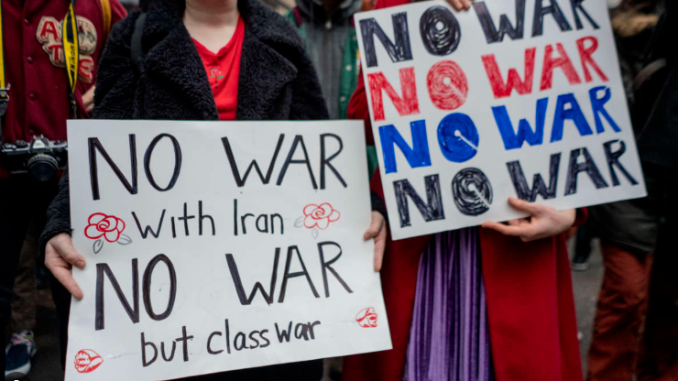
The impunity with which US-Israel waged war on Iran, killed its supreme leader, preceded by the genocide in Gaza, has led to shock, disbelief and anger among the masses in the region and around the world. At the same time, the Iranian regime has shown the resilient defence in the face of such aggression and has earned some admiration among the masses. While acknowledging such sentiments, the struggle for emancipation cannot rely upon any capitalist regime but demands the sustained struggle for socialism in Iran and the Middle East. This assertion is not based upon any abstract formulation but on the concrete analysis of the regimes in the region and the prevailing socio-economic contradictions.
The regime in Iran has not only survived but out-maneuvered the US and Israel with its military strategy. Fully exploiting its strategic location in the Persian Gulf and the vulnerabilities of US assets in the vicinity, it has at least partially turned the tide. The delusions of the US to rapidly topple the regime have fallen flat. On the contrary, the current crisis ends up further galvanizing the support of the regime. Iran is often characterized as a theocratic state, giving the impression that it is fundamentally grounded in religious ideology, clerical authority, and Islamic principles. While the regime does make extensive use of Islamist ideology and revolutionary rhetoric, these do not constitute its core foundation. Rather, they function as instruments of legitimacy and political mobilization. As the response of the Tehran to the US-Israel aggression demonstrated, the regime has a deep institutional basis enabling it to withstand the loss of its supreme leader around whom the whole regime was supposed to have centered around.
The IRGC (Islamic Revolutionary Guard Corps) is a striking example of such an institutional basis. Incorporated in 1979 as an ideological armed force to defend the revolution, it has evolved into an economic, political mammoth that runs and controls vast business empire across sectors. As per few certain estimates, it controls anything from one third to one half of the domestic economy. Bonyads, officially designated as charitable or religious foundations, are large semi-state conglomerates with extensive business interests spanning agriculture, industry, and services. Although originated under the Pahlavi era, they expanded significantly after the revolution, when confiscated assets were transferred to their control. Today, they are estimated to account for a substantial share of the Iranian economy (around 20% according to some sources). Commanding vast resources, they operate numerous social welfare programmes while also forming a key component of the regime’s patronage network. In addition, it has myriads of entities like Basij that acts as a mass volunteer militia, the Supreme Council of the Cultural Revolution that controls the education system and state media with monopoly over broadcasting and thus controlling the narrative. The regime is thus deeply entrenched in socio-economic and cultural realities of the Iranian society.
The deep entrenchment of the regime also implies its susceptibility to the deep contradictions that run in society. Far from being a monolith, the social and economic spectrum of the country is a playground of disparate interests though political framework generally suppresses its open manifestation. Iran has been under economic sanctions for most of the last 47 years, with a respite between 1981 until 1987 when the US reimposed them. Later these were strengthened by Clinton’s executive orders in 1995. Over the period, they only grew tighter and tighter. The Comprehensive Iran Sanctions Act, 2010 introduced stringent measures aimed at constraining the Iranian economy. It expanded sanctions on investment, technology, and services related to Iran’s petroleum industry—its principal source of revenue. Alongside these measures, multilateral actions—most notably the 2012 disconnection of major Iranian banks from the SWIFT (Global financial messaging) system—proved highly consequential, as they severely restricted Iran’s ability to conduct international financial transactions. While restrictions on oil exports curtailed Iran’s access to global energy markets, exclusion from SWIFT effectively isolated it from the global financial system, compounding the economic pressure.
The extraterritoriality of these US sanctions deters any other foreign companies from trading or investing in the country. It, however, did not cripple the economy nor make the regime collapse. On the contrary, the regime has further centralized its control over economy. Sanction evasion networks have been built. A parallel trading system has enabled it to find purchasers for its oil. China has been extensively relying upon Iran oil. More importantly, projecting it as ‘resistance economy’ it gave it an aura of ideological defiance. Nonetheless, while not crippling, these measures have adversely impacted Iran’s economy. Its GDP has imploded and the Rial currency has registered a steep fall. Inflation surged periodically at times, scaling to three digits and thus deteriorating the purchasing power of the masses.
Although the political system in Iran suppresses such expressions, the demand for opening up the economy has remained persistent among certain sections. It includes a section of the ruling elite that senses the “missed opportunity” created by prolonged sanctions. And in a way it is hard not to sense it. The country has world’s 4th largest proven oil reserves and 2nd largest natural gas reserves. But with access to global markets and financial systems truncated, it has not been able to fully monetize on its precious resources. Foreign investment in oil infrastructure could upgrade it, expanding output, while access to global markets could significantly boost the revenue.
For this section of the ruling elite, the comparison with the surrounding Gulf States is too conspicuous to miss. Qatar, for example in partnership with US oil giants like ExxonMobil, gained critical capital and advanced technology to revamp its gas infrastructure to claim global leadership in LNG production. ExxonMobil, with its investments exceeding $30 bn holds 25% interest in a joint venture for the North Field East project, the major site of gas production. So, the comparison is quite stark from capitalist point of view. The reformist faction in Iran has been vocal about the demand for opening of the economy. Last year in August, The Iran Reform Front, a coalition of 27 reformist organizations, called for suspension of its uranium enrichment program and strike a deal with US. The Front said the deals would pave the way for “comprehensive, direct negotiations with the United States and normalization of relations” that would ensure lasting peace and a much-needed economic boost for the nation.
Reformists in the Iranian regime
While the reformists do not carry the substantial political weightage, another faction of pragmatist conservatives does. These pragmatists, while being fully loyal to the regime, are not averse to market-oriented reforms and tend to favour foreign investment. Of course, their approach is driven much by pragmatism and survival than by ideological commitment. This faction has long lineage, dating back to Akbar Hashemi Rafsanjani whose presidency in the 1990s marked the steps towards economic liberalization, promotion of private enterprise and a cautious outreach to West.
Bazaar merchants, adversely affected by currency devaluation, persistent inflation, and restricted access to global finance, have a strong incentive to support any economic reorientation that alleviates these pressures. Thus, the class discontent among a section of ruling elites as well as among working class has been a key driver of periodic political unrest. The January 2026 agitations reportedly saw bazaar merchants participating in large numbers—an especially consequential development, given their historically pivotal role in Iran’s political mobilizations. Anyone even broadly familiar with modern Iranian history would recognize the potential significance of such a shift. Thus, while the regime may have consolidated its support base in the short term, the underlying class contradictions remain sharp. Over time, these tensions could facilitate the emergence of economic pragmatism, ultimately leading to an accommodation with U.S. imperial interests—driven less by ideology than by the imperatives of capital and economic survival. This may come from within or may happen through external manoeuvres.
It is against this backdrop that the present conjuncture must be situated within a broader framework of the struggle to build a force that can implement a socialist alternative. The realization of the original the 1978/9 Iranian revolution’s democratic, anti-corruption and anti-imperialist agenda would ultimately require a transition towards socialism. While Iranian masses have shown extra-ordinary vigor in repeated struggles over living standards, against repression and also to defend 1979’s anti-imperialist legacy, the continued economic hardships and state repression shows how the regime betrays the masses. Islamist ideology no longer occupies the same central place in everyday life, particularly among younger Iranians, many of whom display limited engagement with it. The regime itself despite uttering Islamist principles favors survival and pragmatism. The selection of Mojtaba Khameini, mid-ranking cleric and not a high ranking Ayatollah as the supreme leader itself points to the fact that its theocratic claims remain primarily instrumental than doctrinal. Nonetheless, notwithstanding the decadence of the current regime, Iran represents the persistent resistance to imperialism in the region ravaged by imperialist violence. It has a wider appeal among countries across the Global South that continue to grapple both with the legacy of imperialism and the impact of capitalism today. Any capitulation—whether through the gradual erosion of the regime’s internal coherence or via the rise of opportunistic, externally backed figures such as Reza Pahlavi—would be a major setback.
The surest way to avoid such capitulation, however, does not lie in being apologist for the existing regime, as some tend to assume, but in the emergence of a genuinely socialist alternative—one that combines winning democratic rights, like the right to freely organise, with a workers’ government placing the means of production under the democratic control of the working class. Only such a transformation can provide a durable basis for resisting imperial domination. Workers in Iran have been protesting the unpaid wages, abysmal working conditions and the policies of privatization. 2017 was a watershed year that opened a period that saw strikes of workers across many workplaces. The Haft Tappeh Sugar factories, the steel workers in Ahvaz, HEPCO represented few of the major struggles. The slogans at the strikes were explicitly class slogans declaring, “Workers will die but not accept humiliation,” and, “Iranian workers, unite.” While, on some occasions, the regime repressed these struggles with iron fist, the struggle against privatization and capitalist interests would continue.
The struggle for socialism is relevant not just for Iran but for the Middle East as a whole. Much of the modern Middle East (with partial exception of Iran and Turkey) was shaped by imperial powers in the early twentieth century. The Skyes-Picot agreement, a secret pact between Britain and France in 1916, aimed to divide Western Asia between these powers following the anticipated fall of Ottoman Empire during World War One. It was akin to dividing the booty after the loot. But that’s what imperialism is. Based on the agreement, the region was divided into British and French mandate without any regard to aspirations of the Arab, Kurdish or other peoples or any socio-ethnic realities. As part of the indirect colonial rule, a section of local elites aligned with imperial interests were installed from above. Iraq was thus carved out and Hashemite monarchy of the Arabian Peninsula that had backed British against Ottoman was imposed by Britain from outside the country. Similar had been the fate of other territories in the region. The formation of Israel in the land of Palestine and the subsequent bloodshed is the making of nothing but imperialism and the exploitation of the fears of the Jewish people who migrated there.
Along with Africa, perhaps it is the Middle East that continues to pay for the crimes of the imperialism with its blood and flesh. The hypocritical claims of democracy by these powers fall flat in the face of the fact that all those non-democratic and repressive regimes in the region including the absolute monarchies of Saudi Arabia or Qatar are propped up and are protected by them. Whenever masses of these countries attempted any democratic reforms, US and its local allies chose their own capitalist interests over democracy. In 1949, US actively sponsored the military commander Husni al-Za’im to topple the democratically elected Syrian government to ensure Trans-Arabian Pipeline project gets nod. Much of the region continues to be under monarchical or some form of authoritarian control denying the working masses of any basic democratic or civil rights. Arab spring in 2011 witnessed the mass uprisings in states like Bahrain, Kuwait, Jordan. Bahrain, in particular, saw the sustained and massive protests, rallies numbering more than 100,000 participants demanding the end to the Monarchy of Hamad bin Isa al Khalifa. It was only after thousands of soldiers from Saudi Arabia and Kuwait along with naval ships arrived and unleashed brutal suppression that the massive protests could be put down.
It is in this larger geopolitical context that the issue of socialist transformation in Iran acquires much larger significance. The working class of Iran with its own rich legacy of heroic struggles alone could lead the way forward for the Middle East. It must be emphasized that the regimes in the Gulf States are deeply embedded within the U.S.-led global capitalist order. Their role extends well beyond oil, gas exports and has undergone significant transformation over the past few decades. Saudi Arabia, UAE, Qatar lead the way. The sovereign wealth funds of these countries have evolved into major global investors. Saudi Arabia’s public investment fund emerged as the most active of these funds and has invested around $55 bn in Electronic Arts, the premium video game publisher in US. Gulf sovereign funds invested $66 bn in AI and Digital Tech in 2025 with Abu Dhabi’s Mubadala Investments alone accounting for $12.9 bn. These funds have ploughed in the whooping amount of $131.8 bn in US real estate alone. In sports, now Manchester City is owned by UAE while Paris Saint-Germain club belongs to Qatar. Gulf Sovereign funds control more than $6 trillion in assets. Thus, these are not just oil economies but play a much larger role as major exporters of capital in the global capitalist framework. And at the same time, these are among the most undemocratic regimes in the world exploiting millions of immigrant laborers, repressing own populations and coercing women into middle-aged patriarchal customs.
Marxist traditions in the region
Challenging these entrenched Arab elite regimes is crucial not only from a broader anti-capitalist perspective but also for the Palestinian struggle for statehood. We fully support the right of Palestinians in defending themselves in the face of aggression. But the struggle cannot be won in isolation. The role of the Arab working class is central in this context. Widespread anger among Arab masses over the genocide of Palestinians by the Israeli regime persists, even as monarchial regimes suppress its public expression. The transformation of this sentiment into organized mass movements in support of Palestinian statehood is therefore critical. Without it, there cannot be any solution.
The Arab elites have completely betrayed the cause of Palestinians. The 2020 ‘Abraham Accords’ through which UAE and Bahrain established diplomatic relations with Israel without linking it to Palestine statehood only made this betrayal formal. The Saudi monarchy with its long stand alliance with US is equally responsible. So, while Israeli regime has been carrying out gruesome genocide, the hands of Arab elites too are stained with the blood of thousands of Palestinians. It is only Arab working class who can hold them responsible for their crimes. And this cannot happen without Iranian working class leading the struggle. The women in Iran have been bravely fighting against the clerical regime. With relatively higher access to education and workforce participation, women in Iran built a strong resistance movement, the 2022-23 “Women, Life, Freedom” protests against oppression. Their ongoing struggles could serve as a source of inspiration for women across the Arab world in challenging patriarchal, religious institutions in their own countries.
What is often forgotten is the rich legacy of progressive thought, socialism and Marxism that once prevailed in this region of the world. In 1950s and 1960s, Gamal Abdel Nasser mobilized the generation of Arabs around what was seen as a mixture of progressive nationalism and ‘socialism’, his party was called the Arab Socialist Union. The formation of United Arab Republic, the short-lived political union of Egypt of Syria in 1958, was celebrated as a major victory against western imperialism. Baathism was another variant of this current emphasizing anti-imperialism and secular pan-Arabism. Marxist thought exerted significant influence in countries like Lebanon, Palestine shaping up the political processes and struggles. However, while in some countries inroads were made into both imperialist and local capitalist power, there was not a complete break with capitalism. But one must not forget the decisive role of the Iranian working class in carrying through 1979 revolution, a fact that mainstream narratives bury under the story of rise of Islamism. These movements — Nasserism, Baathism, and the broader left — had their own contradictions and limitations, to be sure. But they represented something real: a concrete expression of anti-imperialist struggle at the stage of national liberation refusing accommodation with imperialist capital and looking towards socialism to take their countries forward. This history is, by any measure, recent and its influence on the political imagination, consciousness of the region has not entirely faded despite the rise of religious based movements.
It is the working class of Iran, Turkey, and the Middle East that represents the only social force capable of decisively confronting imperialism and the local capitalists in the region. Genuine Marxists have the historical obligation of organizing the working class to lead the struggle for emancipation. That task has never been more urgent.