
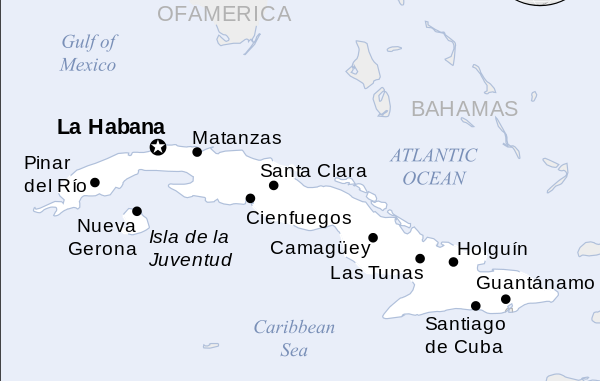
“I do believe I’ll be having the honour of taking Cuba, I think I can do anything I want with it” proclaimed the autocratic Donald Trump in another of his imperial declarations. This followed his kidnapping of Venezuelan President, Nicolás Maduro, in January, followed by Trump’s aerial blitzkrieg on Iran, and his threat to destroy its entire “civilisation”.
Cuba is next on his list of targeted colonial conquests. Venezuela’s new President, Delcy Ridriíguez, who is happily heading what has become Trump’ s puppet regime, complied with Trump’s demand to stop the crucial supply of Venezuelan oil to Cuba. Combined with US imperialism’s murderous intensified embargo, this is an effective blockade of the island’s crippled economy. The strengthening of the embargo is having devastating consequences on the already crisis ridden Cuban economy. The price is paid, like in Iran, by the Cuban masses. Pharmacies are empty. The once prized Cuban health system is on the point of collapse, as life saving treatments are shut down due to lack of fuel. Chemotherapy for cancer patients, dialysis for kidney patients and other crucial treatments and vaccines are delayed or cancelled. Malnutrition and a breakdown in public health services have led to an increase in viral diseases. Since last autumn, tens of thousands have been afflicted with chikungunya, dengue and oropouche.
Food shortages are reported and the threat of malnutrition is now facing thousands. Trump’s embargo is literally killing and starving Cuba’s population. Petrol is now selling in Havana at US$40 per gallon! Power cuts are longer. Tourism, a crucial ingredient in the economy in recent years, has ceased due to the embargo and the inability of planes to refuel if they make it to Cuba. The regime has used solar power, much of it supplied by China, to try and mitigate the loss of oil based power supplies.
Prior to the revolution in 1959, and the overthrow of capitalism which followed in 1961, when Fidel Castro proclaimed “socialist” Cuba, the island was the playground and brothel for the US rich and powerful including the Mafia gangs. Following the revolution, prostitution disappeared. Now, it has returned illustrating the counter revolution and capitalist restoration which was unfolding and is now more rapidly taking place.
One of the gains of the Cuban revolution, which resulted from the overthrow of capitalism, was the building of the once celebrated health system. The Cuban regime was spending 20% of the state budget on health care; twice the global average. As a result, until COVID, life expectancy and infant mortality was more than comparable with western capitalist states. In 2018 infant mortality was four per thousand – lower than the US.
This was despite the devastating effects of the collapse of the former USSR in 1992 and the loss of subsidies that flowed from it to Cuba. Despite what Fidel Castro dubbed the “special period” that followed, incredibly the Cuban regime and its nationalised, planned economy managed to hang on against all the odds. But now things are very different. By 2025, infant mortality had more than doubled to ten per thousand – twice that of the US.
Vindictive Trump has now threatened countries with sanctions if they continue to allow thousands of Cuban doctors to help care for their populations; the aim is to cut further the foreign income going to the Cuban government.
Three hurricanes have ravaged the island in the last 18 months resulting in one million people being displaced. Limited aid from the US was only distributed through the Catholic Church, hampering the state efforts to organise some relief. The vindictiveness of Trump and his reactionary regime seemingly has no limits.
The healthcare and other gains of the revolution have been systematically destroyed. This was happening before Trump’s recent assault on Cuba. Yet it has dramatically accelerated since Trump’s sanctions were hardened. Market and capitalist measures were increasingly introduced by the regime as the bureaucracy desperately attempted to find a way out of the economic and social crisis. This process is now rapidly accelerating as the counter revolution and capitalist restoration gathers pace.
Cuban revolution
The Cuban revolution in 1959/61 resulted in the overthrow of capitalism and landlordism. It enjoyed the mass support of the Cuban population and enthusiastic support internationally amongst the working class and the socialist left. It resulted in massive gains for the Cuban masses. Yet the character of the revolution, led by a relatively small guerrilla army rather than the collective action of the working class, resulted in the establishment of a bureaucratic regime, not one of workers’ democracy as was initially the case following the Russian revolution in October 1917
Although initially some elements of workers’ control did exist at the local level in Cuba, overall it was a bureaucratic regime modelled largely on what existed by then in the former USSR. It was however enormously popular with deep social roots, which was a crucial reason the regime managed to endure so long after the collapse of the former USSR.
Fidel Castro, and the other leaders of the July 25th Movement, in distinction from Che Guevarra, did not regard themselves as socialist. Raúl Castro was not in the leadership of the July 25th movement but had joined the Young Communists at an early age. Following the revolution he was incorporated into the leadership and was the maintain liaison with the Stalinist bureaucracy in the USSR. The leadership of the July 25th Movement was driven to overthrow landlordism and capitalism, and became drawn into the orbit of the USSR, by the pressure of the masses and the intransient opposition of US imperialism. (for more background analysis see Tony Saunois’s Che Guevara: Symbol of Struggle – Left Books and Cuba, Socialism & Democracy, Peter Taaffe – Socialist World Media- shop). The “socialist” regime of Cuba accrued the bitter hostility and opposition of US imperialism which resulted in hundreds of assassination plots against Castro and failed attempts to overthrow the regime.
In a desperate attempt to survive and overcome the isolation and impasse the Cuban government found itself in by the late 1990s, some capitalist measures were introduced. These are now assuming a qualitative change. Trump and US imperialism are now capitalising on this, and aim to secure in Cuba a client regime that will do its bidding. Rather than launching a full blown military intervention Trump, Rubio and his entourage are looking to repeat what they secured in Venezuela, without a kidnapping.
Bolivarian Revolution
In Venezuela, the ‘Bolivarian Revolution’ led by Hugo Chávez constituted a political but not social revolution. It overthrew the ruling powers, purging the state machine, including the army. It made serious incursions against capitalist interests and, based on income from oil, introduced important reforms. However, capitalism was not overthrown despite Chávez eventually proclaiming a “socialist” revolution. The top down, bureaucratic methods were similar to those employed by the Cuban regime. Corruption and mismanagement developed and a new ruling class, dubbed the “Bolibourgeoisie”, emerged.
Following the death of Chávez in 2013, and the fall in oil revenues, the corruption, repression and economic crisis rapidly accelerated, made worse by the sanctions imposed by US imperialism. The initial assive support for the “revolution” eroded as the economic and social crisis dramatically worsened. Millions fled the country as a result (for more background information, see Venezuela’s Bolivarian Revolution – Lessons for the New Global Era of Populism – Socialist World Media- shop). Trump intervened with the objective of regime change to get access to Venezuela’s vast oil reserve, and also to send a warning to China, which has economically penetrated US imperialism’s “backyard”.
Collaborating with Delcy Rodríguez, Maduro and his wife are left languishing in a US jail awaiting trial. Rodríguez had since acted as a puppet for Trump and initiated a purge of the former regime. She has replaced military commanders, changed 17 ministers, appointed new diplomats and overseen the detention of at least three major businessmen linked to Maduro. She has also fired several of Maduro’s relatives from positions, and cut off most of his family from oil contracts. In effect, a client regime of US imperialism has been installed and the right-wing capitalist opposition has been cast to one side.
A similar effort is underway in Cuba. Blockades alone rarely cause an immediate regime change. They impact slowly, in general, and accumulate pressure over time. In the American civil war Lincoln ordered the blockade of ports across the confederacy. They were effective but yet the fighting continued for four more years. Britain blockaded Germany in 1914 yet the war endured until 1918. Venezuela was blockaded in 2025 but further action was needed. Nor is the blockade of Iran bringing an immediate end to the conflict. Thus in Cuba, Trump is also reaching out to sections of the Cuban regime to try and negotiate a change. Raúl Castro’s grandson met with Marco Rubio, US Secretary of State, at a Caribbean summit in St. Kitts. Following this, Rubio commented, “Cuba needs to change. It doesn’t have to change all at once”.
The Cuban regime is now in dire straits. Since 2021 an estimated 20% of the population have left the island, mainly younger people. There has also been a generational change in the regime, apart from Raúl Castro, who despite being 94 years old, and having retired as President, still wields power from behind the scenes.
Others like the existing President Díaz-Canel were not active participants in the revolution and have accumulated wealth and business interests. This layer, following events in Venezuela, are hoping to “hang on” by reaching a deal with US imperialism. Others like Oscar Pérez-Oliva Fraga, was recently made deputy Prime Minister and given a seat in the National Assembly, a prerequisite to become President or the Prime Minister. Manuel Marrero Cruz, former head of tourism, is also being speculated on to play the role of Rodrígez. The regime has already taken the previously unacceptable decision to allow Cuban Miami businesses to invest and own property in Cuba. Others involved in negotiations with the US include Raúl Guillermo Rodríguez Castro, Raúl Castro’s grandson (known as “the crab” as he was born with six fingers).
Whereas Fidel Castro in public maintained an austere lifestyle, “the crab” has been viewed travelling in private jets and living a lavish lifestyle. He is also understood to be involved in looking after family interests in GAESA – Business Administration Group, which is an opaque organisation and one of the most powerful institutions. It was formed as a way of financing the military in the “special period”. It has since grown into a business conglomerate involved in dozens of businesses, construction, hotels, tourism, fishing, retail stores and financial services. It is thought to own businesses in Panama. These sections of the regime are involved in a variety of business and money making companies and schemes and are detached from the revolution of 1959/61.
Capitalist transitional arrangement?
US imperialism is likely to tolerate some transitional arrangement involving sections of the existing regime. There are obstacles to this process. Not least the continued claims for compensation of the companies taken over by the state following the revolution. ExxonMobil is claiming US$1 billion and another for four hundred million dollars from Florida based cruise ships for using ports facilities expropriated by the revolution.
Should this process be carried through, as is probable, Cuba will de facto revert back to being governed by a regime serving US and capitalist interests, as is currently the situation in Venezuela. It signifies a counter revolution and a defeat and will be a disappointment to many workers and socialists. It will be used by the ruling classes internationally to attempt to discredit socialism especially in the US and Latin America. However, it will not have the same effect as the collapse of the former USSR did in 1992. The world situation today is entirely different. Global capitalism is in a deep protracted crisis and death agony. But capitalism will not simply collapse, the ruling classes will fight to maintain their power and need to be overthrown. The movement and the struggle for socialism will overcome this set back. Yet from this setback important lessons must be drawn.
This development was not inevitable. The Cuba revolution could have been developed internationally, especially in Latin America. The attempt to replicate the Cuban revolution through a guerrilla struggle elsewhere in Latin America, in very different conditions and a powerful working class existed, was a decisive mistake. This mistake involved Che Guevarra – a socialist and internationalist, repulsed by the bureaucracy in the former USSR and Eastern Europe, who wanted to develop the international revolution but with the wrong methods.
Opportunities were also lost later in other countries like Chile during the revolutionary process which developed between 1970-73. More recently, if Chávez had completed the revolution and overthrown capitalism and established a government of the workers’ and poor in Venezuela, along with Evo Morales in Bolivia and Rafael Correa in Ecuador, with an appeal to the Cuban masses to establish a genuine workers’ democracy, a socialist confederation of those countries could have been established. This would have acted as a massive pole of attraction to the working class throughout the Americas and beyond, including Greece and Spain, where explosive struggles were unfolding.
A defeat of the Cuban revolution, historically therefore, was not inevitable. If it comes to pass, it will however have significant international repercussions. The Chinese regime is likely to tolerate Cuba being turned into a client, but unstable capitalist state (which will not lead to a new “golden era” of rebirth of Cuban society). The Chinese regime can take this development as an example to justify its own aspirations and future interventions, in its own sphere of influence.
Socialists and revolutionaries need to draw the lessons from these developments, to prepare for the revolutionary movements that will erupt in the coming years.