
The results of the elections for the Scottish and Welsh parliaments and 5,000 English local council seats produced, as predicted, a slaughtering of the despised Labour Party. Reduced to just 17 MSPs out of 129 in Scotland and 9 MSs in Wales from a parliament of 96, along with a loss of almost 1,500 councillors in England – almost 60% of their total – the outcome means it’s a matter of when, not if, Prime Minister Starmer is forced out as UK Labour leader.
However, the elections also underlined the already advanced process of hollowing out of support for the hated capitalist political establishment as a whole, primarily Labour and the Tories. Their combined support in Scotland is now just 31%. The Tories lost half of their 2021 vote and 19 MSPs, falling from second place to fifth.
In Wales the Labour-Tory vote fell even further, from 61% at the last Senedd (parliament) election to just 21.8%. In the English local council elections Labour and the Tories polled just 34% between them, as opposed to around 44% for Reform and the Greens.
A more detailed analysis of the results in England and Wales can be read here.
In Scotland, despite being the winners on 58 MSPs, the SNP were also the biggest losers in terms of vote share, which fell by 9.5% across the 73 constituencies. A loss of over 400,000 votes compared to the last election in 2021. The SNP regional list vote fell further still, by more than 13%, a reduction of 468,000 votes.
The significant drop in SNP support reflects the enormous disillusionment in a government that has inflicted cut after cut to the NHS and council services. As well as declaring a housing emergency and failing to take any measures to solve it.
As we pointed out in our pre-election article, the scunnered factor was on high throughout the campaign. This was reflected in the overall turnout which fell by over 10% to 53%. For those who did vote, it was a very often a choice of the least worst option available.
Reform UK won 17 MSPs on a vote share of 16% that meant they tied with Scottish Labour who also lost further ground. Both Labour and the Tories had their worst-ever performance in a Holyrood election. While the Scottish Greens gained six seats to finish on 15 MSPs, finishing fourth overall behind the SNP, Labour and Reform.
Threat of Reform
As expected, Reform entered the parliament in an election for the first time. Reform’s gains were largely a redistribution of the anti-independence, pro-union vote, with the Tory vote falling by over 10% in Scotland. However, there was also a shift in working class areas by some Labour and even SNP voters to Reform.
This election underlined the dangers of a Reform campaign that in part based itself on appealing to working class anger at both the SNP and Labour with anti-immigrant rhetoric. At the same time their performance also showed its limits of its appeal as a party that is anti-working class to its core. The Scottish Reform leader, Lord Malcolm Offord, exposed himself as a creature of the big business class when he boasted at a recent televised election debate that, “I own six houses, five cars and six boats.”
The threat of Reform UK poses the urgent need to offer a fighting socialist alternative to racism and division, and the cuts implemented by all the main parties in power, including Reform itself in the councils it now controls in England.
What is urgently required to defeat the threat of Reform is the building of a mass party that can unite the working class. Such a party would undercut support for Reform and weaken the appeal of racism and division. The cuts and continued austerity being implemented by the SNP, Labour and even the Greens in the areas where they run or influence councils can only continue to build the bridges that allows Reform to cross into working class communities.
And that is also why the call by some on the left to simply say Don’t Vote Reform is completely insufficient. Yes, Reform need to be beaten – but to avoid the question of the building of a mass working class political alternative in order to do that is a significant political error.
The three main pro-union within the UK parties – Labour, Tories and Lib Dems – polled 46.5% of the vote in 2021 on the regional lists, but this time around, with Reform added into that mix, that vote increased to 52%. Votes for the two main pro-independence parties – the SNP and the Greens – went from 48.4% in 2021 to 41.2% last week.
Independence
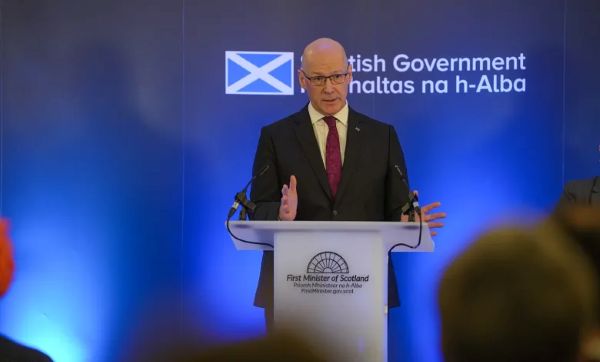
Nevertheless, the pro-independence parties won 73 of the 129 seats overall, the largest number ever. SNP leader John Swinney ran his campaign asking voters to elect a majority SNP government as a mandate for a second independence referendum.
The 58 seats won by the SNP means they are seven short of a that majority, giving the Labour government at Westminster further reason to undemocratically refuse to give the powers to Holyrood for indyref 2. Since the election the SNP have changed tack, arguing that the pro-independence majority at Holyrood is sufficient.
Indeed with the pro-independence Plaid Cymru emerging as the largest party in Wales, the threats to the union are becoming even more concerning for the capitalist class in Britain, particularly with no stable or authoritative political base for its rule. Nevertheless, they will fight tooth and nail to avoid conceding another referendum to Scotland. A mass working class campaign – separate from the leadership of the SNP – is necessary to deliver democratic rights alongside a struggle for socialist change.
The SNP will most likely seek to govern as a minority for now, seeking support from the Lib Dems and the Scottish Greens for its legislation and budgets. One thing for certain is their campaign of cuts to public services will continue. Indeed, the Scottish Government before the election announced their intention to axe 11,000 public sector jobs as part of a £1.5 billion “efficiency savings” plan. The claim by the SNP finance secretary before the election that the public sector “needs to be smaller” is a warning to the trade unions about what is to come.
The Scottish Greens benefited from the anger towards the SNP government, including winning SNP seats in Glasgow Southside and Edinburgh Central. Yet, they were part of the cuts coalition with the SNP between 2021 and 2024 at Holyrood and have no record at all of opposing cuts either at council level. Indeed, some of the new Green MSPs have played a role in supporting cuts as councillors.
The Scottish Green candidate who defeated the SNP in Edinburgh was in fact a minister in the previous SNP-Scottish Green coalition. Unless the new intake of Scottish Green MSPs change that approach those voting Green hoping for a struggle against austerity will be badly let down.
Socialist campaign
The election campaign was dominated by the cost of living crisis, with food, energy and rising prices across the board. A recent government survey from February 2026 found a large majority didn’t trust the SNP on the cost of living, or to improve the NHS, or on climate change.
63% believed the costs of living crisis would have a long term impact on their family. 72% disagreed that the cost of living crisis was easing. And that was before the impact of the US-Israeli war in Iran had begun to be felt. And it was those issues that the socialist campaign of the Scottish Trade Unionist and Socialist Coalition sought to address.
We stood six candidates for Holyrood, all of whom were members of Socialist Party Scotland, (see results at end of article) and won a creditable 2,740 votes across the six seats, an average of 457 votes per constituency. Our votes were up significantly on those achieved in 2021.
We achieved some very positive results, including winning the highest left votes in any constituency in Scotland for our candidates Jim McFarlane in Dundee City West and Jim Halfpenny in Renfrewshire North and Cardonald. Our candidates included the branch leaders of Dundee City Unison and Glasgow City Unison.
Standing a range of trade union and socialist fighters, we stood on a policy of demanding pay and benefit increases to match the costs of living. For a massive programme of council house building to end the housing emergency. For an end to cuts to the NHS, councils and social care and to take the wealth off the super-rich and fight for an independent Scotland.
By explaining that neither Labour, SNP or Reform fight for us, Scottish TUSC was able to appeal to a layer who were looking for an alternative. Our call for the trade unions to build a mass party of the working class was especially popular.
With the failures of the Your Party leadership to capitalise on the massive enthusiasm for its creation last summer, indeed Your Party did not stand a single candidate in Scotland, nor did they endorse any candidates either – it was incumbent on Scottish TUSC to stand.
Indeed we received the active support of a number of Your Party and former Your Party Scotland members who campaigned for our candidates.
As it did in the run up to the Holyrood election, Scottish TUSC will appeal to all those who want to see a widespread a socialist election challenge as possible to meet to discuss preparing for the council elections which take place in May 2027.
The Holyrood elections underlined both the accelerating erosion in support for the capitalist parties, including the SNP, and the crushing need for the workers’ movement to build its own political vehicle to fight for its interets.
Socialist Party Scotland will continue to fight in the trade unions for that mass workers’ party to be built. The recent advances for the left in Unison, PCS and Unite means there are new opportunities to make the case for those unions to build a campaign for working class political representation.
In the meantime, we will take every opportunity to stand candidates as part of Scottish TUSC to advance that case, as well as making the case for the necessity for socialist change.
2026 Scottish TUSC Holyrood votes
Dundee City West – Jim McFarlane 649 (2.5%)
2021 Scottish TUSC vote Dundee City West – 432 (1.3%)
Dundee City East – Donald MacLeod 361 (1.4%)
2021 Scottish TUSC vote Dundee City East – 287 (0.9%)
Rutherglen and Cambuslang – Chris Sermanni 467 (1.4%)
2023 Scottish TUSC vote in the Rutherglen and Hamilton West Westminster by-election Chris Sermanni 178 (0.6%).
Dumbarton – Lynda McEwan – 356 (1.1%)
Renfrewshire North and Cardonald – Jim Halfpenny 610 (1.7%)
2016 Scottish TUSC result Renfrewshire North and West – Jim Halfpenny 414 (1.4%)
Paisley – Sinead Daly – 297 (1%)
Total Scottish TUSC vote was 2740, an average 457 votes per constituency candidate
Other left/socialist votes
- The Scottish Socialist Party (SSP) stood on the eight regional lists across Scotland polling 8,326 votes (0.4% of the total) with an average of 114 votes per regional list constituency
- The Workers Party of Britain stood in four constituencies and four of the eight regional lists, receiving an average of 330 votes per constituency candidate (1,321 votes in all) and an average of 95 votes per regional list constituency (3,402 in total)
- The Socialist Labour Party stood on one regional list, polling 2,270 votes, an average of 227 votes per regional list constituency
- The Communist Party of Britain stood on one regional list winning 672 votes, an average of 75 votes per regional list constituency