
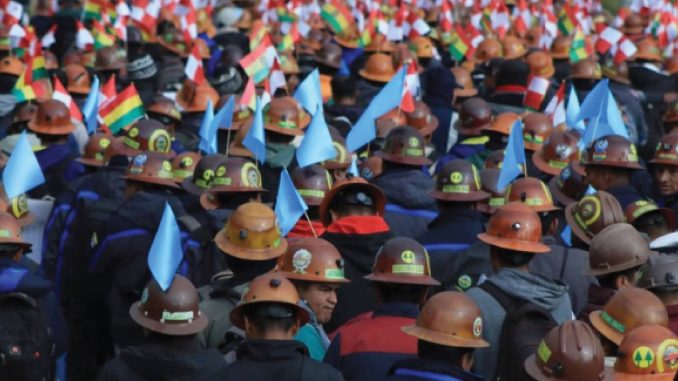
In Bolivia there is an ongoing revolution of workers and peasants, which will have an impact throughout the continent. The revolt began at the start of May 2026 and, so far, three deaths have been reported as a result of the repression, hundreds have been injured and arrested, but the government has not acknowledged any fatalities caused by the clashes and blames the demonstrators for stopping ambulance workers from doing their job.
The popular uprising which erupted in Bolivia at the beginning of May 2026 is the result of a combination of a deep economic crisis and a struggle for political power involving broad social and indigenous groups who had been brought in to manage the Bolivian state and are now excluded and marginalised from positions of power. The mass protests were sparked by the announcement of a series of austerity measures but they quickly escalated and are now demanding the resignation of the President Rodrigo Paz.
Causes of the Uprising
The current unrest is the result of the confluence of several critical factors:
Economic crisis: Bolivia is going through its worst economic crisis in four decades, with depleted dollar reserves, a year-on-year inflation of 14% and a generalized shortage of foreign currency.
Austerity measures: The elimination of fuel subsidies last December and the subsequent shortage of the product created widespread discomfort, everything was exacerbated when the government imported adulterated gasoline that damaged vehicles and agricultural machinery. The government of Rodrigo Paz promised that it would take care of the costs of repairing the vehicles, which it has not fulfilled.
Conflict over land: A land law (Law 1720), harmful to the indigenous and peasant sectors they considered because it opened the possibility of seizure of their lands, was the initial trigger for the protests, although it was later repealed when the demands had already escalated to the resignation of neoliberal president Rodrigo Paz.
Legitimacy and representation: President Rodrigo Paz took office with promises of improvement, “capitalism for all” that he has not fulfilled, and his austerity policies generate a strong rejection in the sectors that feel excluded from the political system.
Actors and Demands
The protests are led by a mosaic of traditional organizations, supported by the structure of Evo Morales’ followers, who face a government locked in its bastion and with less and less capacity to respond.
Confederation of Bolivian Workers (COB), the main trade union organization in the country (its main leader: Mario Argollo now in hiding). He called for strikes and marches. He demands the resignation of President Paz and a solution to the economic crisis. His rank-and-file rejected previous negotiations of leaders and stressed the need for Rodrigo Paz to leave.
Social Sectors. Peasants, indigenous, cooperative miners, teachers and transport workers. They block roads. Paz’s resignation, salary increase, repeal of laws and improvements in fuel.
Followers of Evo Morales fraction of the MAS. They mobilize against the government and justice. They demand Paz’s resignation, stop the judicial “persecution” against Evo Morales.
Government of Rodrigo Paz Executive Branch. He refuses to resign and offers dialogue only if the blockades cease. He claims to maintain constitutional order and governability.
The extreme right, the Civic Groups, with their Committees for Santa Cruz and Cochabamba, for their part, call for the defence of democracy and an end to the blockades that suffocate the country, and call for marches for democracy. They were at the spearhead of the 2019 military coup against Evo’s government, which only managed to stay in power for years and were unable to contain the widespread protests.
The popular uprising in Bolivia is led by the COB, which has managed to weave a broad, albeit fragile and with questioning from the rank-and-file, alliance to coordinate the protests at the national level.
Organizations leading the uprising
The COB is the main instigator of the “Alliance for Bolivia”, supported by a bloc of key groups that share the central demand for the resignation of President Rodrigo Paz.
Bolivian Workers’ Central (COB): The country’s main trade union organization, led by Mario Argollo (who went underground due to an arrest warrant). He called for strikes, marches and is the main voice of the protest.
Allied sectors (formal alliance): They formed an “Alliance for Bolivia” that includes:
- Peasants (CSUTCB): Crucial social base that provides critical mass to the mobilizations.
- Carriers: Their adhesion is key, since road blockades are their main pressure measure.
- Indigenous (CONAMAQ): They provide the legitimacy of the original movements.
- Factory Groups, Neighborhood and Intercultural Councils: Complete the social front that demands the resignation of the president.
- Followers of Evo Morales (“Evismo”): Although they converge in the streets, they act for their own political reasons. They seek to stop the “judicial persecution” against the former president and take advantage of the crisis to regain power.
Is there coordination between them?
Yes, there is a formal alliance: The COB has managed to establish explicit coordination by announcing an “Alliance for Bolivia”. This makes it possible to articulate joint marches (such as the one on May 18) and block roads simultaneously.
Internal tensions and discontent: Coordination is not total. Important sectors of the teachers of La Paz have distanced themselves, denouncing that they are “betrayed.” They affirm that the COB has diverted its union demands (salaries) towards a political objective (the resignation of Paz) responding to the interests of “evismo”, and have announced that they will fight autonomously, other sectors of the teachers continue to be allied with the COB.
The COB has forged this formal alliance to amplify the pressure, but this union has cracks. While the miners and peasants remain loyal to the COB line, sectors of the teachers feel used for political purposes and threaten to break the unity. Along with the traditional leadership of Evo’s MAS in the popular world, a new political-social leadership has emerged headed by the COB.
The Coat of Arms of the Americas
All the extreme right-wing governments of the continent that made up the so-called “Shield of the Americas”, headed by the US, plus Israel have expressed solidarity with the government of Rodrigo Paz. Argentina and Chile have sent air aid.
In Summary
The popular uprising, workers and peasants, in Bolivia is not an isolated event, but the most acute manifestation of a structural crisis where the discontent over the economic situation has merged with the struggle for power, leaving the country paralyzed and plunged into deep uncertainty.
In Bolivia there is a social revolution underway. Its outcome will define a continental relaunch of revolutionary processes or, on the contrary, the deepening of a reactionary course inaugurated by the turn towards extreme right-wing neoliberal governments.