
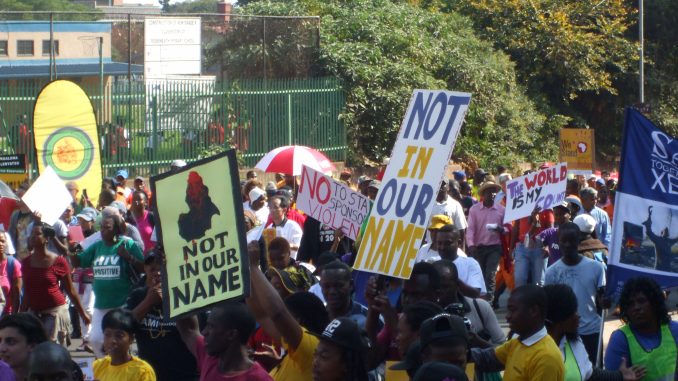
For a National Day of Action against xenophobia!
Saftu must set a date for the reconvening of the Working Class Summit
The xenophobia sweeping across the front pages of the media in South Africa and internationally is causing shock waves worldwide especially in Africa. There is understandable disbelief that a country whose black majority against apartheid attracted Pan Africanist and global working class solidarity has now come to be associated with xenophobia directed primarily, though not exclusively, against Africans. The overwhelming majority of these foreign nationals are in SA seeking refuge from devastating poverty, mass unemployment and war. There is righteous indignation especially within the generation that fought and defeated apartheid that there is a campaign to mobilise the black working class against fellow African working class people in a repudiation of the very solidarity that played such an important role in defeating the racist white minority apartheid regime.
The poisonous winds of xenophobia blowing across the country are bringing with them in tow, its blood relatives: racism and tribalism. Anti-immigration organisation March on March has set a 30th June deadline for mass deportations. Fears are rising of new pogroms as in 2008 and further attacks subsequently. That of the 63 lives lost in 2008, 21 were South African (10 out of 12 in 2019) shows that this orchestrated barbarism that criminal elements use as a cover as well, can morph into racial clashes amongst South African themselves. This has raised fears of a repeat of not only the 2008 pogroms but of the violence of the July 2021 riots that claimed 354 lives in Gauteng and Kwa Zulu Natal. This could make the barbaric invasion of maternity hospitals to deny medical treatment to pregnant foreign national women in Gauteng and the witch-hunting of school children in KwaZulu Natal pale by comparison.
The mobilisation by a range of organisations, mostly NGOs has correctly focussed on exposing the lies in the propaganda peddled by the orchestrators of xenophobia. They have provided facts countering claims that foreigners are taking jobs, overwhelming public services and responsible for crime, especially drug dealing. For attempting to defend foreign nationals against abuse, organisations such as the SA Human Rights Commission and the Socio Economic Rights Institute, have been campaigned against by the xenophobes. Necessary as all these efforts to counter xenophobia are, Marxists, however, have a duty to explain how this reactionary barbaric phenomenon has risen and to develop a programme to fight it.
There is consensus in the anti-xenophobia mobilisations that it is not a spontaneous development with mass support in the working class and the poor in which its instigators are attempting to sink roots, but politically orchestrated. This is an important step forward. The orchestrators are the sections of the black capitalist class frustrated that their aspirations to become the dominant demographic at the summit of the post-apartheid economy, have not been fulfilled. Only one fully black-owned company is in the top 100 of the Johannesburg Stock Exchange – owned by Ramaphosa’s brother-in-law, Patrice Motsepe. They are spearheading political formations that are a combination of the political debris of the capitalist ANC’s factional wars, like the uMkhonto weSizwe Party (MPK) and opportunists figures from outside the ANC bent on getting into government by securing an electoral base by pandering to backward sentiments.
Capitalist class finance xenophobe political parties
The most significant force orchestrating the xenophobia is the capitalist class which funds these formations and their main political parties, the ANC and DA that give it official cover. After resorting in desperation to the construction of the capitalist coalition they dubbed the Government of National Unity, following the resounding defeat of their main parties in the 2024 elections, they are actively inciting working class division. They are funding parties like ActionSA and the Patriotic Alliance that stand for the promotion of racial resentment and antagonism amongst working class people and hatred of poor foreigners from Africa especially. In gratitude for amnesty for its role as a murderous apartheid armed and sponsored militia, the Inkatha Freedom Party has now thrown its political weight behind the anti-foreigner campaign. It is the post-apartheid incarnation of the same policies of ‘black-on-black’ divide-and rule they aided the apartheid regime in carrying out that claimed 20,000 lives in the 1980s and early 1990s.
The capitalist class fears that the electoral revolt of 2024 against the disastrous consequences of their neoliberal policies throughout the entire three decades plus since the end of apartheid, may find expression on the streets, in communities amongst students and youth and in the workplace.
Xenophobia in SA is thus the resurrection of apartheid’s “swart gevaar,” (black danger) slogan – a political weapon deployed to incite fear in the white population in the face of the liberation struggle for majority rule. Its aim is to fracture working class solidarity and divert attention from the systemic post-apartheid capitalist crisis. This explains the rise of organisations such as Operation Dudula and March on March, legitimised by politicians, funded through sinister, likely criminal sources and shielded by security services. Far from being spontaneous grassroots movements, these formations are auxiliaries of the ruling elite, serving to obscure the failures of governance, looting of resources, corruption of their own leaders, and the deepening inequality that defines post‑apartheid SA.
Historical Roots: Apartheid’s Laboratory of Division
The apartheid regime perfected the social and political architecture created by British colonialism out of which xenophobia has sprouted. As a tool of control, they turned African tribes against each other in the wars of conquest and dispossession. When it came to power in 1948, the apartheid regime turned the labour reserves created by British imperialism in the countryside into the Bantustan system institutionalising ethnic fragmentation. At the same time, they preserved the migrant labour system for migration of workers from the SA hinterland and neighbouring countries to supply especially the mining industry with cheap labour under strict segregation as ‘temporary sojourners’ in the cities. Today it is from these single sex hostels that MKP and March on March recruit their rent-a crowds. This “laboratory” of division has been repurposed by the ANC‑led GNU, which now deploys similar tactics to deflect blame for poverty, unemployment, and collapsing services. The continuity between apartheid’s racial engineering and contemporary xenophobia underscores its systemic function: to protect capital by dividing labour.
Political Complicity: The GNU’s Xenophobic Consensus
The ANC and its GNU partners have reignited xenophobia with a common purpose. Limpopo MEC (provincial assembly cabinet member) Phophi Ramathuba’s berating of a Zimbabwean patient, Minister Aaron Motsoaledi’s opposition to refugee protections, and Gauteng Premier Panyaza Lesufi’s threats of mass evictions all exemplify how xenophobia cascades from the top. Even the EFF, despite its socialist claims, has indulged in populist stunts that scapegoat migrants. It embarked on a foreigner witch-hunt at restaurants to demand compliance with self-created SA/foreigner quotas demanding “prioritisation” for locals. It echoes the artificial self-created distinction between legal and undocumented migrants, ignoring the government’s policy to close refuge centres and austerity driven staff cuts is deliberate and cynical, making becoming “legal” as onerous as possible. The GNU’s coalition with openly xenophobic parties such as the Patriotic Alliance further entrenches exclusionary policies. This bipartisan complicity demonstrates that xenophobia is not marginal but central to the political project of the ruling class.
Militarisation of Xenophobia: The SANDF Cadre Group
The most alarming institutionalisation of xenophobia emerged in 2020 with the SANDF Cadre Group’s “Turnaround Strategy 2025.” This document, presented to the ANC National Working Committee, amounts to a far‑right manifesto. It proposes:
- Mass expulsion of foreign nationals within 90 days.
- Criminalisation of harbouring foreigners.
- Forced labour for unemployed citizens and prisoners.
- Abolition of bail and social grants (except pensions).
- Racial reclassification recognising only African, Asian and European
This programme fuses authoritarianism with xenophobia, embedding reactionary ideas within the state itself. Its populist rhetoric mixes left‑wing phraseology (condemnation of neoliberalism) with far‑right ideas, illustrating how xenophobia serves as a bridge between authoritarian nationalism and a capitalist offensive on the working class. The ANC may have distanced itself from the Cadre Group’s coup‑like proposals, but its 2024 election campaign manifesto and rhetoric before and after the elections have clearly influenced GNU policy and legitimised xenophobic discourse.
In the extensive, uncritical and even sympathetic coverage of xenophobic actions, the media is playing a cynical role as a propaganda machine no different from the role the SA Broadcasting Corporation played as a public broadcaster for the apartheid regime. It portrays xenophobia as a legitimate outlet for the grievances of the poor and dispossessed suffering the consequences of the government and the capitalists’ neo-liberal policies. It is calculated to deflect the attention of the masses from the economic and political elite’s culpability for the social crisis and to turn them towards African and Asian foreigners nationals instead.
Capitalist Cover‑Up: Xenophobia as Diversion
Since 1994, the ANC has faithfully preserved capitalism, adopting its neoliberal model, GEAR (Growth Employment and Redistribution) policy. Its corporate tax reduction, exchange control relaxation, privatisation and outsourcing is financed through savage social spending cuts. The result is staggering inequality The World Bank has now classified SA as the most unequal society globally.
The exploitation of exchange control relaxations has led to capital flight and illicit capital flows that have drained trillions from the economy. Between 1995 and 2018, cumulative capital flight amounted to $185.5 billion (R3.1 trillion), with at least R938 billion lost since 2018. Illicit flows add another R400 billion annually, largely driven by the top ten percent of the 2 000 multinationals in SA. Whilst demonising poor foreigners, the ANC-led government facilitates the looting and plundering of the country by wealthy foreigners. The R1.1 billion per day spent to service government debt is the direct result of the budget deficit created by the billions donated to big business in corporate tax cuts that have declined from 52% in 1992 to 27% today. The working class pays for this in social spending cuts that have led to service delivery collapse today. Capital flight and illicit capital flows are critical factors in the bloodbath of job losses today. These figures show that poor foreign migrants are being scapegoated for the real “burden” on services and loss of jobs the foreign capitalists and their local collaborators in SA have placed on the economy.
The leaders of Operation Dudula and similar groups are using the poor as “useful idiots” in pursuit of their ambitions for self-enrichment and political power, registering as political parties to access tenders for corrupt purposes. They are exploiting the alienation of the black working class majority whose experience of post-apartheid democracy is poverty and destitution. A tiny parasitic black elite has been elevated into the social stratosphere above them, making up just under half of the top 10% who own 84% of the country’s wealth whilst the bottom half own negative wealth.
The xenophobes use this reality to mount a right wing campaign against “white monopoly capital” as well as ‘democracy’ and the constitution. Marxists recognise that SA’s constitution is the cornerstone of the post-apartheid economic dictatorship of the capitalist class, previously defended by white minority rule. It was put together in a protracted process of negotiations between the apartheid government and the ANC leadership, who used the time to demobilise the mass working class movement that forced the apartheid regime to the table. However, we recognise at the same time, that under the pressure of the working class movement, the drafters of the constitution were forced to enshrines many working class rights, won in the struggle against apartheid. These would be crushed along with bourgeois parliamentary democracy under the tribal dispensation MKP leader Zuma openly stands for. The socialist reconstruction of society by the working class can only be fulfilled under a workers’ democracy the preparation for which must be a democratically elected constituent assembly and a workers democracy.
The tactics of the xenophobes serve the interests of the bosses and the government by turning the working‑class in SA and those on the African continent and beyond, against each other. Yet the SA government facilitates the plunder of the resources e.g. of the DRC by mining companies and the exploitation of workers by propping up corrupt regimes politically for that purpose. In the DRC this war between different armed groups has displaced millions, threatening the break-up of the country whilst multinationals including from SA loot and plunder the country and exploit the working class. The same applies to the ANC-led GNU’s foreign policy towards eg Mozambique, Lesotho and eSwatini through the Southern African Development Community – a political protection racket of the post-colonial and apartheid elite supervising neo-liberal policies on behalf of imperialism.
The xenophobia campaign orchestrators are superimposing the economic exploitation of the working class of SA, southern Africa and beyond, upon their political exploitation. The media’s amplification of their rhetoric also helps obscure the systemic corruption revealed by especially, but not exclusively the Zondo and Madlanga commissions of inquiry. It is a useful distraction for MKP leader Zuma, who is still facing charges for the arms deal corruption he will be appearing in court for in the near future.
Racism and tribalism – xenophobia’s blood relatives
Aggravating the social crisis is the revelations of the vast network of eye-watering corruption ensnaring senior echelons of the state including the police, crime intelligence, politicians and the judiciary at the Madlanga Commission. Instituted less than 5 years after Judge Zondo handed in his Commission’s report into “state capture” that shocked the country, the testimonies broadcast live daily confirm that for the corrupt elite, it has remained business as usual from Zondo through to Madlanga.
Xenophobia in turn has acted as fuel to further inflame campaigns for secession. Members of the Zulu Royal family have called for Natal to be dropped from the province’s name, Kwa Zulu and for the British monarch to return land dispossessed under colonialism to them. Individuals like white millionaire Rob Hersov are leading a campaign for Western Cape independence. Hersov offered Patriotic Alliance leader Gayton McKenzie R200m to avail himself as premier of an independent Western Cape.
The danger to working class unity is shown by the shutdown organised including the closure of schools and looting of spaza shops owned by foreign nationals by the National Service Delivery Forum in Mangaung, Botshabelo and Thaba Nchu in the Free State this month. Residents were protesting against other South Africans citing Xhosa speaking people from being employed in jobs that should be reserved for the predominantly Sotho-speaking people of the area. A North-West small business forum representative protested on SAFM radio against the employment of artisans in jobs they say that should be reserved for Batswana. In Limpopo the EFF has protested against the alleged denial of jobs for Sepedi speaking people who cannot greet in Tshivenda. Social media posts circulate videos of insults hurled at and physical attacks on Tsonga and Shangaan speaking people.
Inflaming racial tensions, Coloured nationalist extremists, like the National Coloured Congress’s Fadiel Adams have echoed calls by the DA’s Helen Zille for Blacks from the Eastern Cape to return to their province. In her infamous statement, she called Eastern Cape residents who have migrated to the Western Cape refugees. The logic of this reactionary campaign in practice would mean mass deportations of Black non-Western Cape residents that is as repugnant as the campaign for mass deportations of foreign nationals. It is a recipe for a racial civil war in pursuit of a Coloured and white dominated racist Western Cape laager. They are yearning for the fleshpots of apartheid racist and tribal job reservation.
Western Cape Coloureds especially have a proud tradition of solidarity between Coloureds, Indians and Africans. The United Democratic Front was launched in Mitchell’s Plein, the country’s biggest Coloured township in 1983 precisely to thwart the apartheid regime’s attempt to pit Coloureds and Indians against Africans in another tactic of divide-and-rule through the insult of the toy telephone of the Tricameral Parliament. The UDF inflicted a resounding defeat on these racist elections in 1984. The Western Cape independence campaign is an insult to the traditions and those who sacrificed their lives to defeat apartheid.
The orchestrators of this campaign take as their point of reference the xenophobia, racism and misogyny of Donald Trump, the convicted sexual felon and most corrupt president in US history. Trump is the political sponsor, funder and arms supplier to the Israeli regime’s Gaza genocide, bombing of Iran and slaughter and ethnic cleansing in Lebanon. He has accelerated global social, economic and political convulsions. On the African continent this is exemplified by the conversion of Sudan and Somalia into an arena for deadly Middle Eastern rivalry between US allies Saudi Arabia and the Israeli supported UAE.
Trade Unions and the Struggle Against Xenophobia
The role of trade unions is pivotal. Yet many union leaders have capitulated to xenophobic pressures, endorsing raids on undocumented workers under the guise of protecting labour rights. This concession undermines the internationalist traditions of South African unionism, exemplified by the NUM’s historic organisation of migrant mineworkers. The unions should respond to xenophobia as one front in the offensive directed against the SA working class in which foreign nationals are collateral.
The bosses’ offensive escalated significantly in the 2020 public sector wage theft, which aims to cripple collective bargaining, and through amendments to the Labour Relations Act to restore apartheid-style workplace bosses dictatorship. Only by uniting across races and nationalities can the working class resist the divide‑and‑rule strategy that xenophobia represents. The trade unions should use this opportunity to reconnect the ties that bound the workplace and working class communities in the struggle against apartheid:
- Organise foreign and undocumented workers.
- Demand equal wages and enforcement of labour laws for all workers.
- Launch political education campaigns to expose the real culprits: multinationals, the capitalist class, and the GNU.
- Towards Working‑Class Unity and Socialism – For a National Day of Action against xenophobia, Saftu must set a date for the reconvening of the Working Class Summit
Necessary as the workshops, online seminars and production of fact sheets are, they are not a substitute for the unions’ active involvement with communities to fight service delivery failure and corruption. Neo-liberal spending cuts affect the working class as workers and as residents. Attacks on wages and conditions and the failure to fill public sector vacancies affect the working class as a whole. We have one enemy: the capitalist class determined to make us pay for the crisis of their system and to boost their profits. An injury to one is an injury to all!
The way forward lies in building a mass workers’ party on a socialist programme, uniting across borders, nationalities, and identities. In preparation for this, trade unions must actively prepare on the political plane to supplement the mass action against service delivery cuts and corruption through the joint shop stewards councils uniting, communities and workers in the workplace.
The November local government elections
The resounding defeat of the ANC and DA in 2024 took the passive form of an electoral stay away. The November election should act as a point of reference to unite on the political plane to elect independent councillors on the principle of a workers representative on a workers wage and the right of immediate recall. On this basis the forces for a working class party can be assembled. This is the most effective way to ensure that the vacuum now being occupied by far right xenophobic forces is challenged by the working class united on the political plane.
Saftu must set a date for the reconvening of the Working Class to implement the declaration adopted in 2018 to establish a mass workers party on a socialist programme. Just as the workers movement of the 1980s reverberated across the African continent so too would such a party today. It will stop xenophobia in its tracks and revive Pan Africanist and internationalist solidarity on a working class and socialist basis and prepare the way for a socialist SA, Africa and world.