
The Scottish Parliament voted recently to demand from Westminster the powers to hold a second independence referendum. The 72 to 55 vote among MSPs was no surprise. This is the fourth Holyrood parliament in a row that has seen the election of a majority of independence-supporting MSPs.
Neither was it a shock that the Starmer government at Westminster immediately refused to grant a section 30 order. A Downing Street spokesperson said: “The UK Government does not support independence or another referendum.” So far, so undemocratic; so predictable.
The fact that John Swinney, Scottish National Party (SNP) leader and Scotland’s First Minister, has only requested the powers for a referendum, but has not signalled any proposed date for one, reflects the current malaise facing Scotland’s largest party. Despite winning the Holyrood election, they did not have the numbers to form a majority government.
While support for independence is currently just over 50%, it has fallen behind other priorities, such as the cost of living, cuts to public services, and the housing emergency.
At the same time, support for the SNP has fallen significantly. The party lost more than 850,000 votes on May 7, compared to the 2021 Holyrood election when constituency votes and regional list votes are taken into account.
Confidence in the SNP prosecuting a struggle on self-determination is about as low as expectations that Swinney will lead a movement to end austerity.
Not for nothing did he appoint to the cabinet, for the first time ever, a minister for public service cuts — sorry, “reform”. As clear an indication as ever there was that the attacks on jobs and services will increase dramatically under his government.
And this at a time when Starmer’s job as UK prime minister is hanging by a thread. Never has there been a weaker UK government — and that’s saying a lot. Yet the SNP leadership have never been prepared to confront British capitalism by mobilising a mass movement on any issue, be that democratic rights or defying the cuts.
In contrast, the working class and the trade unions are the key to breaking the logjam on cuts, the cost of living, and the right to decide. But that means relying only on their own strength and putting forward their own demands.
For example, demanding that elected politicians refuse to make cuts; organising strike action to win pay rises that fully match inflation; fighting for full funding of public services and for the right of Holyrood to organised a future indyref 2. And that also means forging a political vehicle to fight for working-class interests in the shape of a mass workers’ party.
Missing SNP money
That there can be not an iota of reliance on the SNP leadership was underlined by the news last week that the former CEO of the party has admitted embezzling £400,000 of SNP money between 2010 and 2022.
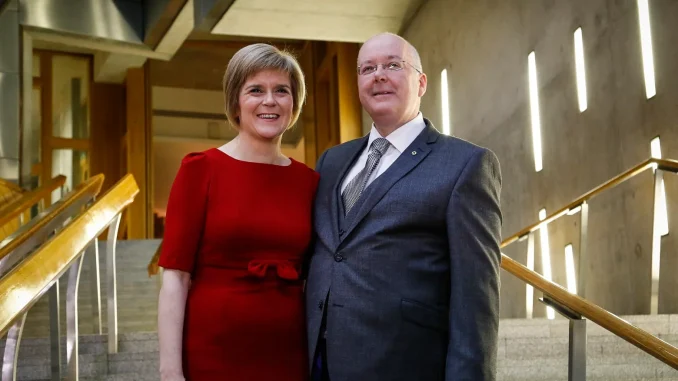
Peter Murrell, who was then the partner of SNP First Minister Nicola Sturgeon, spent the money on cars, campervans, and luxury goods. This went on for more than a decade. When questions were asked – including by NEC members of the party – about where the money had gone, there were no answers.
The fact that the SNP appointed a CEO of their party says a lot about their pro-business nature. That even the NEC and the finance and audit committee of the SNP were refused access to accounts also says a lot. This was defended and overseen by Nicola Sturgeon. It’s about as far away from a democratic party as it’s possible to get.
Socialist Party Scotland would argue, for example, that all elected MSPs should live on the average wage of a skilled worker, and that a mass workers’ party would have fully democratic and accountable structures and practices in place, including the right to immediately recall any elected officials if they were not carrying out their role properly.
The Scottish Government are demanding not only the powers to organise a new indyref, but also the devolution of powers on a range of other issues, including energy, amid rising household costs. The SNP energy minister argued: “That is why powers over Scotland’s energy must be in Scotland’s hands – so we can make our vast energy wealth work for us and bring down bills.”
Yet not a word from him on using those powers to nationalise the energy sector. At a time when bills are increasing again, a consequence of the conflict with Iran by the US and Israel, that demand takes on even more urgency.
Socialist Party Scotland supports full powers over the economy being held at Holyrood as part of an independent socialist Scotland. But using those powers to bring the entire energy sector, currently dominated by multinationals, under democratic public ownership is the only way to lower bills and ensure a workers’-led transition away from fossil fuels to sustainable forms of energy. This is something the SNP will never support.
All in all, on public services, on the cost of living, and on the fight for self-determination, the SNP are not fit for purpose. The building of mass working-class struggle and a trade union-led mass workers’ party on a socialist programme is essential. If you agree, join us.