
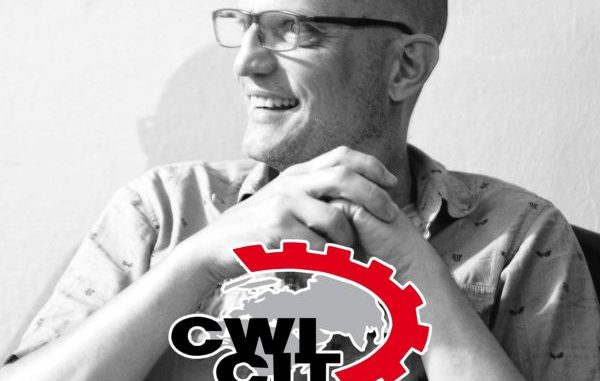
An interview with Sascha Staničić, member of the Executive Committee of Sozialistische Organisation Solidarität (Sol – section of the CWI in Germany) about his candidacy for the national committee of Die Linke (the Left Party)
You are standing for election to Die Linke’s national committee at the party conference in June. Why?
Because we urgently need a socialist workers’ party that represents the interests of our class against the rich and powerful and fights to overcome capitalism. Die Linke has made it its mission to build such a party. I want to play my part in bringing this vision to life.
Does Die Linke really meet this self-imposed standard today?
Probably no one in the party would claim that. Luigi Pantisano, who will be standing for co-chair at the party conference, rightly emphasises that Die Linke must do much more to reach out to and organise workers. There is still a long way to go. The many thousands of new members offer hope that Die Linke might learn from the mistakes of the past. So far, the party and parliamentary group leadership have not drawn the necessary lessons from the crisis the party found itself in until the end of 2024.
What, in your view, would those necessary lessons be?
The deeper reason for Die Linke’s existential crisis was the fact that the party became increasingly indistinguishable from the SPD (social democrats) and the Greens, and that in coalitions with these parties it supported policies that did not differ greatly from those of other state governments. Or did anyone perceive Thuringia as a rebellious federal state when (Die Linke’s) Bodo Ramelow was prime minister there?
And is that different now?
During the general election campaign, the perception of the party as the only reliable force against the right-populist AfD and as an opposition to all other parties was decisive. The slogan, “Everyone wants to govern. We want to change things,” expressed this well. Door-to-door campaigning, advice for tenants and similar activities also reinforced the impression that Die Linke is different from the other parties. But in the federal state governments of Bremen and Mecklenburg-Western Pomerania, it continues to dutifully administer capitalist misery and then votes in the Bundesrat (the upper house of national parliament) for war credits, cuts to corporation tax and arms deliveries to Ukraine. That undermines the party’s credibility.
Are new members taking over?
That remains to be seen. I am convinced that a large proportion of the new members see themselves as situated on the left within the party’s political spectrum and that there is a shift to the left at the grassroots level. This has already become apparent at some state party conferences. Hopefully, this will also shape the national party conference. But too little has changed in the party’s publicly visible politics. All too often, the party vies for the CDU’s favour and refrains from taking a radical stance. This has also disappointed many of the new members. We must prevent new members from withdrawing from active participation again.
How could that be prevented?
For example, by the party leadership unequivocally defending members who show solidarity with Palestine when they are attacked by the silver-haired Gysi and Ramelow (translator’s note: Ramelow and Gysi are old party leaders who belong to the party’s right-wing and who, in the last election, campaigned under the slogan “the silver-haired”) or threatened with expulsion from the party. The Die Linke’s call for a mass demonstration in solidarity with the Palestinians in September 2025 was a major step forward, but nothing has been built on that since, and the motion on the subject now before the party conference, submitted by the party executive, acts as if there were no clear-cut oppressed and oppressors in the region.
You are a member of the AKL (Anticapitalist Left) within the party and have now, together with others, taken the initiative to establish a new network of party leftists. Why?
The AKL plays a very important role in representing anti-capitalist positions within the party and advocating for democratic decision-making processes. Yet the many new members have barely found their way to it. The new project is not intended to compete with the AKL, but rather to appeal in particular to new members and not just the existing networks. In any case, a coordinated approach by the party’s left is necessary.
What do you intend to campaign for on the party executive?
Directly for the entire strength of the party and its parliamentary groups to be concentrated on the fight against social cuts, job destruction and militarisation. For consistent socialist policies. For capitalism to be identified as the root cause of social ills and for a socialist alternative to be actively promoted. This means, not least, actively demanding the expropriation of banks and corporations. For the party to maintain an independent stance from the pro-capitalist parties and to oppose any government coalition with them. For Die Linke to advocate an anti-capitalist and militant course within the trade unions as well, and to network and organise its members there. Against any watering down of the anti-war positions of the party programme, and for the fight against all cuts and for the preservation of all jobs. No division within our class must be encouraged. Not on such issues, nor on issues of gender, nationality, religious affiliation, sexual orientation, etc. And for the democratisation of the party: the ability to elect and recall officials at any time, and a salary cap for elected representatives.
Doesn’t your membership of Sol contradict your involvement in the party executive?
On the contrary. It ensures that I do not become independent of the party there and that I will maintain transparency regarding my work. It also shows that I do not wish to use this position as a springboard to a political career. For me, it is about politics. As an anti-Stalinist Marxist, I advocate views that have their place within the party and should be given greater prominence. More Marxism would do the party national committee good.
Election statement the national committee of Die Linke
Sascha Staničić , Berlin
I would like to play my part in bringing the idea of a socialist class-based party to life. To this end, I bring nearly forty years of experience in the labour movement – in building anti-racist movements, working on a strike committee, solidarity work with the Berlin hospital movement, establishing structures of solidarity with Palestine and socialist structures in a small town in Brandenburg, publishing socialist newspapers and books, and international solidarity work.
I will advocate for the following on the party executive:
- Focus on supporting protests and strikes.
- Identify capitalism as the root cause of social ills – explain that a socialist transformation of society is a necessity.
- Unity instead of division! Fight against ALL cuts, for the preservation of ALL jobs and against every form of discrimination.
- For a socialist and militant political stance within the trade unions!
- Cut the ground under the Nazis and the AfD! Combat the social causes of divisions and discrimination.
- For independent socialist class politics! No to government coalitions with any pro-capitalist parties.
- Consistently on the side of the Palestine solidarity movement. No expulsions or party disciplinary proceedings.
- Capitalism means war, socialism means peace! No watering down of the party’s principles on peace policy.
- Saving the climate can only be achieved by abolishing capitalism!
I am an anti-Stalinist Marxist and an advocate of socialist democracy, the principles of which we should already be applying within our party: through the ability to elect and recall all office-holders and elected representatives at any time, and by capping salaries and allowances at the average skilled worker’s wage.
Personal details: 55 years old, editor of “Solidarität”
Memberships: AKL, Socialist Organisation Solidarity (Sol), ver.di, National Working Group Workplace and Trade Unions (BAG B&G), National Working Group (BAG) Palestine Solidarity