
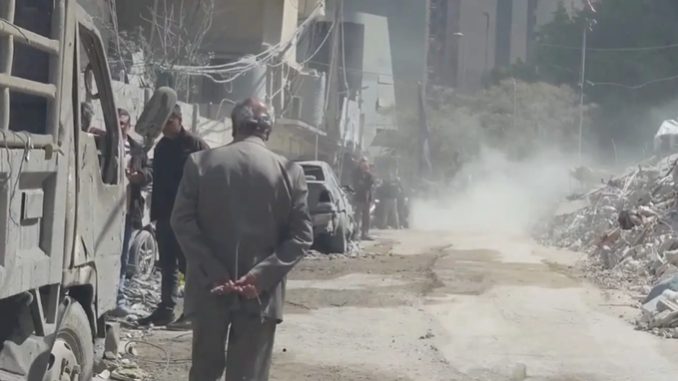
Under pressure, Netanyahu declared that “at the moment, the fire has been halted”. But the war on Lebanon continues and the aggression against Iran has only halted for the moment
First published on socialiststruggle.org on 9 June 2026.
The already undermined daily routine of tens of millions of residents in Tehran, Beirut, and also in the central cities under Israeli rule, was once again completely disrupted. Education systems, large workplaces, main roads, and transport routes were closed, hospitals shifted to emergency mode in anticipation of casualties, and day-to-day life was filled with anxiety and fear. And once again, this was not a force majeure or a natural disaster. Netanyahu’s government, with the far right, consistently pushed for an escalation in military aggression — both in Lebanon and in Iran — out of a transparent desire to torpedo the emerging agreements in the negotiations for a permanent ceasefire between Tehran and Washington.
Netanyahu’s threat of a provocative show-strike on the Dahieh suburb of Beirut was finally carried out on Sunday afternoon, following a one-week delay at Trump’s request, and as expected, it rapidly dragged the region into a dangerous escalation on the brink of a full renewal of a ‘multi-front’ regional war.
A “Domino Effect” That Would Collapse the Ceasefire in Iran
Iran’s counter-attack began the evening following the Israeli strike on Dahieh, in accordance with the statements made by the Iranian regime last week (1 June). Did Netanyahu, Minister of Defence Katz, and the arrogant generals underestimate the threats of the Iranian regime? It is more reasonable to assume that the provocative strike on Beirut was designed to drag the Iranian military into renewing the fire and to provide the Israeli government of death with an opportune moment to renew the attack on Iran, despite the pressures from Washington.
The Israeli newspaper Ynet quoted an “Israeli source familiar with the details” who claimed that the Israeli attack on Iran had been planned for Thursday, but “Trump exerted pressure to prevent it – and the move was taken off the table.” The same source exposed the twisted logic of the government and military top brass: “The fire directed at the Galilee was perceived in Israel as an opportunity to put the plan back on the table and they thought of a domino effect – Israel would attack the Dahieh, then Iran would attack with missiles – and Israel would have the justification to attack. The problem is that Trump ultimately forced Netanyahu to yield and halted attack plans in Iran.”
Trump, who emerged humiliated and desperate for an agreement and a diplomatic achievement after 40 days of a barbaric imperialist offensive on Iran and a further 60 days of fruitless negotiations with the regime, urged Netanyahu on Sunday in a telephone call not to respond to the symbolic missile barrage from Iran and to leave it at that. “I think Israel has responded enough, they do not need to respond further,” Trump said in a short interview with Israel’s Kan News that same evening. The following evening (Monday), Trump told Israel’s N12 News: “I told Bibi, you had better be very careful about what you do, because you might find yourself alone against Iran very soon.”
Although Washington itself has recently attacked Iran on several occasions during the ceasefire, the crisis in the Strait of Hormuz continues to exert pressure on the global economy and, through this, also on Trump; moreover, mass revulsion in the United States over the continuation of the war is expanding. Added to this was Trump’s desire to arrive at the start of the Football World Cup on Thursday with a binding ceasefire agreement in hand. Yet Washington’s ability to dictate moves is limited, and it is failing to fully control the height of the flames of the regional conflagration it ignited with the US-Israeli offensive that began on 28 February.
Dozens of fighter jets of the Israeli Air Force attacked Iran — in two waves of strikes — and local news agencies reported a series of explosions in Tehran, Tabriz, and Isfahan throughout the night and day. In Mahshahr, south-west Iran, the Air Force struck the Karoun petrochemical plant — which only underscores that the government of death is not “satisfied” with military targets but also attacks infrastructure sites and industrial zones. Sources in the Israeli military told the local media on Monday that the waves of strikes over the last 24 hours on Iran “are not retaliatory actions” but a continuation of the war: “The ceasefire halted the offensive in Iran on the 41st day, and we are now on the 42nd day.”
At the same time, the Israeli military attacked villages in the Nabatieh and Sidon governorates in southern Lebanon. The regional escalation was also exploited to tighten the siege on Gaza and to prevent the entry of aid to the surviving population in the Strip.
The Iranian regime’s counter-response included missile barrages aimed at Israel: Haifa and the north, Gush Dan, Jerusalem, and the Negev region. Following the Israeli military’s hit on petrochemical industry facilities in Iran, the Iranian regime threatened to expand the barrages “to all energy targets in the region.” The Houthi spokesperson in Yemen threatened to attack Israeli vessels in the Red Sea after claiming responsibility for firing a missile at territories under Israeli rule.
Iran’s emergency command declared in the afternoon the conclusion of the military response, whilst warning “that if the aggression continues, including in southern Lebanon, much more severe and harsher measures will be on the way.” Minister of war Katz was quick to respond: “We reject out of hand Iran’s threats. Any Iranian attempt to link Lebanon and Iran and attack Israel – will be met with great force, as happened yesterday.” Shortly before that, an Israeli military strike on the city of Tyre was reported in Lebanon, killing five and injuring eight, including four paramedics. On Tuesday, the deadly strikes inTyre continued, along with a call by the Israeli army to all of the city’s residents to flee. Thirteen were killed in South Lebanon on Tuesday morning
Netanyahu and His Rivals Promise More Rounds of War
The war on Lebanon continues, and the aggression against Iran has also been halted only temporarily — “at the moment the fire on this front is held,” as Netanyahu said in his filmed address on Monday evening. He promised to “respond forcefully” to any further military move by Iran, meaning he promises “another round” following the 24 hours of Sunday-Monday and two full rounds of war since June of last year. His speech was a combination of boasting — “Iran and Hezbollah are weaker than ever” — and cynical security scaremongering, presenting the PM’s actions as what ostensibly prevented, at the last minute, the destruction of Israel by Iranian nuclear bombs and a military takeover of the Galilee by Hezbollah.
There was no expectation that Netanyahu would address in his speech the thousands of victims who perished in his attacks this year on Lebanon and Iran, or the millions uprooted from their homes. But it’s also the case that the genuine fear of millions of Israelis of conventional missile fire, and the fact that families, both Jewish and Arab, from Tamra, Beit Shemesh, Bat Yam, and Arad lost their loved ones in the barrages both in June 2025 and in March–April of this year, were entirely absent from Netanyahu’s speech, perhaps to make people forget his declaration from last year regarding the elimination of the ballistic threat, alongside the nuclear threat. In practice, it was all bluster and empty promises. And so it is this time: if Iran and Hezbollah were genuinely “weaker than ever,” all the events of Sunday-Monday would not have occurred. In reality, the Iranian regime has strengthened its regional position as a result of the strategic failure of the Israeli-US imperialist offensive to bring about its downfall, and any motivation to break out to a military nuclear capability as a means of self-preservation can only have grown.
The feasibility – still present at this stage – that the incidents will not deteriorate into a full-scale renewal of the Israel-Iran war does not absolve Netanyahu of responsibility, nor his political rivals, who pushed in this direction just like him and once again sought an opportunity in the events to outflank him from the right. The chairman of the ‘Together’ political alliance and candidate for Prime Minister, Naftali Bennett, issued a statement on the eve of the latest attack on Iran that said: “containment or a symbolic response will signal to our enemies that the blood of our citizens is forfeit,” and called for a broad attack and, in effect, a full renewal of the imperialist war and military aggression. His partner in the leadership of Together, Yair Lapid, wrote following the announcement of the cessation of strikes: “After the Iranian announcement on the cessation of launches, it can already be said that the current move did not advance the toppling of the regime, did not advance the elimination of the ballistic missile programme, and did not advance the elimination of the nuclear programme. The government sends its citizens to sit in shelters, the economy is paralysed, and none of this has any strategic aim that anyone can understand, including within the defence establishment.”
The populist Lapid attempts to tap into the disenchantment within Israeli society regarding the endless state of war, yet without contradicting Bennett. His criticism is not regarding the very nature of the strikes, but rather that they did not advance the goals of Israel’s ruling class . The dispute between the leaders of Together and Netanyahu is tactical; it is not over the very cynical exploitation of the events of 7 October 2023 for a multi-front campaign aimed at reshaping the Middle East in accordance with the interests of Israeli capitalism.
Likewise, Democrats Party leader Yair Golan, in a recorded speech with party colleague Naama Lazimi by his side, said that one must “look straight at the reality of the endless war” only to clarify his party’s nationalist-militarist line: “Despite the immense military achievements of the IDF, our enemies see that Israel has the weakest leader in the Middle East”… “On his watch, Netanyahu turned Iran into a regional power, one that is not afraid to attack us directly,” “There is not even a single arena, a single front, that has been handled properly,” “This campaign is too big for Netanyahu and the bunch of incompetents around him.”
This is the speech of a general promising to be a ‘strong leader’ who will ‘handle all arenas properly,’ out of a deep and structural connection to the interests of the ruling class and the top military brass. Therefore, it was also regrettable to see the Communist Party led front Hadash “calling on the leaders of the opposition parties to show responsibility and political courage and to oppose Netanyahu’s war of survival right now, not in retrospect.” Bennett, Lapid, and Golan do not think the purpose of the war is Netanyahu’s survival, and they show responsibility towards the ruling elite when they propose continuing the war to preserve the regional hegemony of Israeli capitalism on the day after Netanyahu. Hadash, as a left-wing party, should help expose, rather than obscure, this fact.
Not Golan, not Lapid, and certainly not Bennett, will challenge the security demagogy that promises the residents of the north quiet and stability by means of destruction, devastation, and the mass displacement of the residents of southern Lebanon, along with ceaseless regional aggression, under the auspices of Trump and US imperialism, from Iran to Yemen — whilst that same aggression creates a reality of extreme lack of security and economic instability for millions of Israelis as well.
These days must not end in waiting — not for the next provocative attack by the Netanyahu government, not for “the next round,” and not for elections either. Action must be taken now to promote protest and towards building a cross-national, socialist, left-wing force of working people that will work in the upcoming general election campaign to strengthen the struggle for a total halt to the war and regional aggression, for the withdrawal of Israeli military forces from Lebanon, Syria, and Gaza, and for an end to the siege on the Strip and the occupation in the West Bank. This needs to be part of a socialist programme that will advance a root-and-branch solution based on equal rights to existence, to self-determination, and to a life of dignity, welfare, and personal security for all.