
We will take 11 March, 1990, when President Patricio Aylwin took office, as a starting point. He was presented as a great democrat, despite the fact that this character was one of the main promoters of General Augusto Pinochet’s coup d’état of 11 September, 1973, against the Popular Unity government and president Salvador Allende, which caused thousands to be tortured, killed and disappeared.
Before the end of the dictatorship, the ‘parties of the left’ (the Socialist Party, PS, and Communist Party, PC) started a campaign promoting the idea that in Chile, “the great contradiction is between dictatorship or democracy”. They told workers that all their problems were because of the dictatorship. But thirty-five years into “democracy”, the workers and the poor masses and communities (in Chile referred to as the “popular sectors”) continue to have the same problems. Most of the workers continue to receive miserable salaries, retirees receive starvation pensions, the problems in education are still just as serious, we continue to have terrible health care, and the housing deficit continues to grow. We can only draw the conclusion that “the great contradiction” was not “dictatorship or democracy” but the economic system that governed us, both under dictatorship and under democracy, that is, capitalism (neoliberal or whatever you want to call it). The great contradiction continues to be “capitalism or socialism”.
From those same years, when the dictatorship was clearly reaching its end, the ‘parties of the left’ also promised that “joy is coming”. But after thirty-five years, twice as long as the dictatorship lasted, we can say that joy definitely did not arrive. But the ‘parties of the left’s’ worst idea was for “justice”, but adding the qualifier, “as far as possible”. This policy sealed the impunity of the torturers and murderers of the dictatorship and also of the right-wing civilians who promoted the 1973 coup, as Patricio Aylwin himself did.
After Alwyn came the government of Eduardo Frei Ruiz-Tagle, another activist of the Christian Democrat party (DC) which was one of the parties that promoted the coup against the Popular Unity government. Under the dictatorship he did well as a businessman and amassed a fortune. Like the Aylwin government Frei dedicated himself to deepening and “perfecting” the neoliberal system that they inherited from the dictatorship, signing free trade agreements and privatizing the few things that had not been privatized under Pinochet.
Under the government of Frei, and with the agreement of most of the parties of the ‘opposition’ Concertación coalition, part of the National Copper Corporation of Chile (Codelco) was privatised. A little more than 300,000 hectares of deposits were transferred free of charge to foreign companies. It also privatised the Port of Ventanas and the Tocopilla Thermoelectric Plant. Frei also privatized Colbún, Edelnor, and Edelaysen, which produced about 40% of the country’s electricity generation.
Under the Frei Ruiz-Tagle government, the privatization of drinking water companies began. The Valparaíso Sanitary Services Company (Esval) tendered the sale of 35% of its rights, which were awarded to the Enersis-Anglian Water consortium. It also sold the drinking water distributors of the metropolitan region.
We then come to the presidency of Ricardo Lagos, who continued the economic policies of the dictatorship and the Aylwin and Frei administrations. In several cases he had to stop the privatization processes begun under Aylwin and Frei, such as the privatization process of Endesa and the Metropolitan Company of Sanitary Works (EMOS). But under his government, different road and public infrastructure projects were built, which allowed foreign companies to take control of roads.
Worst of all, under Lagos’s government the Credit with State Guarantee (CAE) was promoted. With this criminal policy in education, of selling and transferring education to the profit of private banks, Lagos indebted several generations of students and their families.
Next came the two governments of Michelle Bachelet. These basically continued the economic policies implemented by the dictatorship and the governments of Aylwin, Frei and Lagos. Bachelet tried to give the capitalist system, completely bankrupt throughout the planet, a ‘human face’. But in concrete terms the living conditions of the workers did not change under her two governments. Although some try to claim “important” achievements under Bachelet, such as a supposed health reform (which is nowhere to be seen, given the deep crisis of the public health system today), the creation of the Ministry of the Environment, and the delivery of bonuses to low-income families.
We cannot fail to mention the two governments of the right-wing president Sebastián Piñera, a multimillionaire businessman, who also fattened his fortune under the dictatorship, especially doing business with the “Bank of Talca”. That is the morality of these characters – a president who governed for his class and for his interests. There is practically nothing to note in terms of gains for the working class under his two governments.
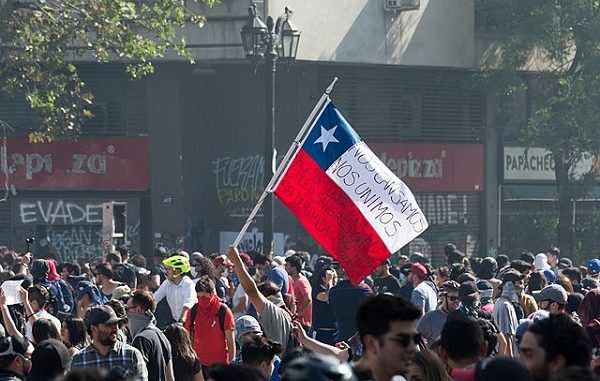
Piñera was the president who faced the great social outbursts of October 2019 and who almost left government early as a result. He had to suffer all the anger that had accumulated from the previous post-dictatorship governments, summed-up in a sentence, “It’s not thirty pesos, it’s thirty years”. This underlines an important feature of Chile today – that most people under forty years of age did not live through the evils of the dictatorship. They have only known the governments of the Concertación, New Majority, the right-wing represented by Piñera and now the government of the Frente Amplio (Broad Front) and its allies under president Gabriel Boric.
Boric’s government stands out in the negative for its approval of the TTP-11 trade agreement, for the rescue of the Isapres private health insurers and for the consolidation of the AFPs private pension finance administrators. With the approval of the 40-hour work week, labour flexibility was approved, something much desired by business. In other words Boric’s government defended and deepened the neoliberal policies inherited from the dictatorship, just like previous presidents, and all governments of this supposed “democracy” – a democracy that only benefits big business, the richest 1% of Chile, the elite of the country.
The great contradiction continues to be “capitalism or socialism”, if we workers are not able to resolve this contradiction we are condemned to continue suffering the onslaught of a capitalist system that is based on inequality and the misery of the vast majority of the working population.