
Workers’ movement must urgently respond!
The ‘Unite the Kingdom’ march in London on 13 September sounds a warning that the workers’ movement must urgently respond to. Police estimate that 110,000 took to the streets in the largest-ever demonstration called by far-right racist Tommy Robinson. Those that attended, who went far beyond the still small numbers in the organised far right, heard a succession of speeches whipping up racism and division, including from the world’s richest man, Elon Musk. Anyone who the far right were demonising unlucky enough to be in central London that day – whether migrant, Black, Asian, trans, Muslim or others – will have felt intimidated. While the majority of marchers were peaceful, the fascistic thugs on it were given confidence by the size of the march. The much smaller Stand Up to Racism counter-demo was surrounded by the far right and had to rely on the police for protection.
This alarming picture does not, however, represent the underlying balance of forces in society. While this demo was bigger than previous far-right marches, there have been much greater numbers on repeated protests over Gaza. And opposition to racism is widespread. For example, only 8% today agree that being white is important to being ‘British’. Polling in January this year shows that only 4% of people have a ‘very favourable’ view of Tommy Robinson, while 52% see him ‘very unfavourably’. That, however, must be shown in action, and the trade unions need to take the lead.
Working-class strength
The strength of the six million-plus trade union movement stems from workers’ ability to organise collective action to fight for their common interests. In 2022-23, when we saw the biggest strike wave since the 1980s, workers from all backgrounds struck together. Increased division and racism does not only effect those that experience racism, it weakens the whole working class. It is essential that the trade unions take the lead in fighting against it.
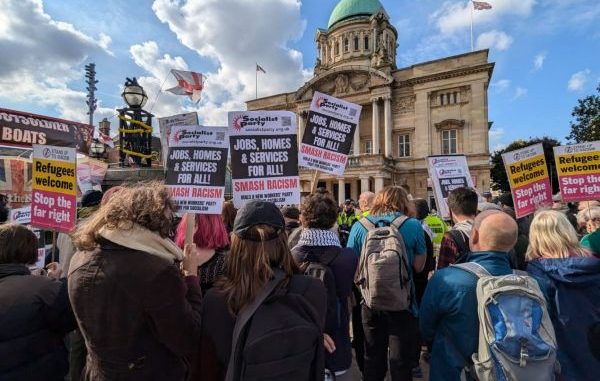
For a long period, trade union leaders have agreed donations to Stand Up to Racism, and considered their anti-racist duty done. But Saturday’s events showed beyond doubt that this is not a way forward. The trade union movement itself needs to take responsibility for, and democratic control of, the fight against racism. In 2018, the Trades Union Congress (TUC) agreed to build a mass campaign for ‘jobs, homes and services, not racism’. It is overdue that those words are turned into action.
The fight against racist division cannot be separated from organising opposition to New Labour’s pro-capitalist government. Starmer is the most unpopular prime minister a year after a general election in history. He is hated because Labour has continued with Tory austerity, particularly attacking the poorest sections of the working class. More voters earning under £30,000 a year have abandoned Labour and said they will vote Reform than any other section of society. No surprise that those who have suffered from the continued two-child benefit cap, the cuts to the winter fuel allowance and to disability benefits are looking for a means to express their rage, and that some have picked up Farage and Reform as a means to do so.
In reality, Farage supports brutal austerity and attacks on the working class. Back in 2011, he actually organised a ‘pro-austerity’ demonstration. Just a few hundred people attended. Meanwhile three quarters of a million marched on the trade union demonstration against Tory/Liberal Democrat austerity, followed by a one-day public sector general strike of two million workers. The trade union movement needs to do the same again. Alternatively, if trade union leaders continue to try to act as cover for the New Labour government, they will be putting out the red carpet for Reform, and leaving room for racism and division to grow further. The resolution agreed at this year’s TUC conference to call a national anti-austerity demonstration needs to be made a reality, by seriously mobilising for a national Saturday demonstration – before the 26 November Budget – under the slogan ‘no to Labour austerity, no to racist division’. This act alone would transform the situation. All trade unionists should call on their unions to demand the TUC takes this step, and to coordinate with others to ensure it happens if the TUC does not act.
At the same time, the need for the working class to have its own political party is urgently posed. The 800,000 who have answered Jeremy Corbyn and Zarah Sultana’s ‘your party’ call is a sign of the possibilities. This too is a potential force that could mobilise hundreds of thousands on the streets for the national demonstration that is needed. It could also provide an alternative to Reform at the ballot box. In next May’s local and Wales Senedd elections, voters are going to be looking for a means to express their rage at continued attacks on the working class. Reform is the main weapon many can see at the moment. But if Corbyn and Sultana’s call has led to a party – organised democratically and with a fighting socialist programme – it would be possible for it to win councils on a programme including mass council housebuilding, rent controls, refusal to implement cuts to local services.
Already 67% of Reform voters think Jeremy Corbyn is ‘for working people’. The launch of a party that was prepared to use their positions in councils to wage a real campaign against New Labour government austerity, instead of Reform’s racist posturing, would mark a huge step forward in uniting the working class in a common struggle against the capitalist elite.