
Your Party must stand as part of a mass working class and socialist election challenge
The Scottish National Party (SNP) annual conference met over 11–13 October, just seven months before the Scottish Parliament election due in May 2026. Prospects for an SNP win in the Holyrood vote have improved significantly over the course of this year.
Primarily, this is due to the collapse of Labour’s support since Starmer was elected British prime minister in July 2024 and the rise of the right-populist Reform UK, who are currently polling at 20% in Scotland and eating into Labour and Conservative Party (Tory) support.
However, the possibility of the SNP winning next May is in no way reflective of a positive endorsement or enthusiasm for them. Their support has fallen from 47% at the last Holyrood election in 2021 to just 34% currently, and from 40% in the regional list vote then to 29% now.
Collapsing party membership has also accompanied these polling reversals. The SNP have around 50,000 members — a drop of more than 50% since the aftermath of the 2014 independence referendum (indyref). They also lost 39 MPs at the Westminster election last year.
Political fragmentation, reflecting the increasing undermining of the traditional parties and polarisation in Scotland, is continuing to deepen. With Reform likely to enter Holyrood for the first time — and with the possibility of Your Party registering to stand — next May could see seven or eight parties gaining representation at Holyrood.
At the same time, the falling away of support for the SNP — who have increasingly been exposed for their role in cutting public services and other anti–working-class policies — has been accompanied by a strengthening of support for Scottish independence. The majority of polls since Starmer became prime minister show rising support for independence, currently at just over 50%.
Growing disenchantment with the SNP has also created a politically “homeless” segment of the independence-supporting electorate. In 2011, 90% of those who supported independence voted SNP. Today, that figure is less than 60%.
To a certain extent, the Scottish Greens have benefited from some of this layer, as the pro-independence Alba hope to do next May as well. However, the potential for the emergence of a new workers’ party in Scotland to appeal to all those seeking an alternative is continuing to grow.
Socialist Party Scotland (CWI Scotland) is calling on Your Party to register a name and prepare to mount a major election challenge for Holyrood. By basing itself on socialist policies and a fighting appeal to the working class as a whole, it would be possible — given the acute political vacuum that exists — to win the election of a number of MSPs.
National Question
Political polarisation around the national question also continues to be a major feature of Scottish politics. Left in the hands of pro-capitalist parties like the SNP on one side, and Labour, Tories, and Reform on the other, that polarisation will continue. However, there is one thing that all sides agree on, and that is the need to make the working class pay for the capitalist crisis through cuts to public services, wages, and benefits.
That’s why it’s essential to build a united working-class political alternative in the form of a mass workers’ party with socialist policies. Such a force could cut across both forms of bourgeois nationalism while resolutely defending the right of self-determination for the Scottish people.
In order to do that effectively requires a sensitive approach. On the one hand, it means fighting for the right of the Scottish Parliament to be able to organise a second independence referendum — and that means overcoming Westminster’s refusal to allow it. On the other hand, it also means appealing to workers with a socialist solution, including to those who are not convinced that capitalist independence can offer a way out of the crisis.
That’s why Socialist Party Scotland has always refused to give an iota of political support to the SNP, even while many on the socialist left were capitulating to nationalism in 2014 by taking part in a joint indyref campaign under the leadership of the SNP (Yes Scotland), while some even called for a vote for the SNP or a form of electoral pact with them.
We warned that the experience of the SNP in power would burn away the enthusiasm of those who hoped that the leadership of Alex Salmond and Nicola Sturgeon would stand up for the working class — and so it proved. Left in the hands of the Scottish nationalist leadership, the struggle for democratic rights has been driven into a constitutional dead end, accompanied by SNP cuts to housing, health, and council services.
Of course, the primary responsibility for refusing to allow any possibility of a second indyref lies with the Tories and now Starmer’s Labour government. They will fight tooth and nail to prevent the break-up of the UK for their own class and strategic interests. And if that means denying basic democratic rights, then so be it as far as they are concerned. Look at the way the institutions of British capitalism were used — for example, the UK Supreme Court ruling that Holyrood could not organise an independence referendum.
Yet still the SNP leadership continue to peddle the myth that there can be a return to the “gold standard” arrangement that allowed for the Edinburgh Agreement. When the SNP won a majority at Holyrood in 2011, the then Tory government of David Cameron signed a deal with Alex Salmond to allow a legal referendum to take place. Cameron had calculated that they could easily defeat independence and that would end the issue for generations to come. It did not turn out that way. An insurgent independence campaign came very close to defeating the pro-union side.
Today, with support for independence at over 50% — not the 30% it began at before the 2014 referendum — there is no chance that appealing to Starmer to respect constitutional fair play will move the dial.
Back to the Future
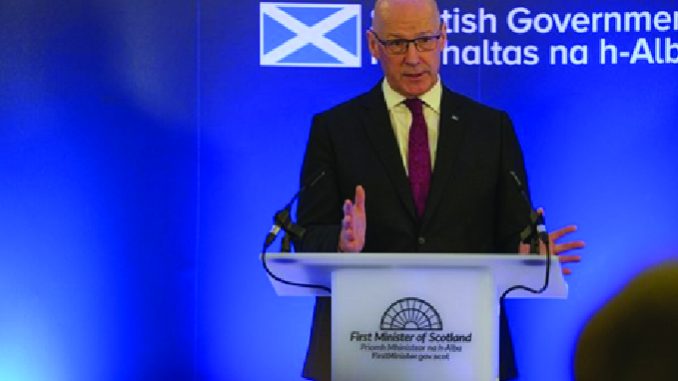
First Minister John Swinney proposed to the SNP conference that if they win a majority of seats at next May’s Holyrood election, “this will then be taken by the Scottish Government as a mandate to start negotiations for a second vote.”
“This is what happened in 2011, and precedent is a substantial factor in legal consideration of the right of the people of Scotland to decide their own future.”
This approach will not deliver the right to hold a second indyref. Moreover, the SNP leadership know this. So why are they taking such an approach? Primarily, the calculation is driven by the need to shore up their support base. It’s an appeal purely aimed at maximising the SNP vote and the number of MSPs amid falling support.
Rather than seek to build a mass campaign by mobilising the working class in a struggle for democratic rights — including mass demonstrations, strike action, and occupations — the SNP are happy to use the issue of indyref2 for their own electoral benefit exclusively. Nor do any of the other pro-independence parties, such as Alba or the Scottish Greens, have any other viable strategy.
The struggle for self-determination has to be linked to the social and economic liberation of the working class if a majority is to be won for independence.
Moreover, the demand for an independent socialist Scotland, linked to a united struggle for socialism in England, Wales, and Ireland, is a vital one for socialists to fight for. Not only does it clearly differentiate this from the idea of the SNP’s capitalist independence, but it can also appeal to workers — both in Scotland and in other parts of Britain and Ireland — who rightly seek to maintain the unity of the working class amid genuine fears of division driven by nationalism, racism, and sectarianism. All of these methods of divide and rule are used by the capitalist class to maintain its domination.
That’s why, while being the best fighters for democratic rights, socialists have the responsibility to advocate an independent socialist Scotland as part of a voluntary and democratic socialist confederation with England, Wales, and Ireland — as a step toward a socialist Europe.
Again, unlike the SNP, who want to liberate Scottish capital from the “limitations” of British capital in order to exploit the Scottish working class all the more surely, socialists stand for public ownership and democratic planning of the economy — in other words, ending the rule of profit.
A Fresh Start?
The latest regurgitation of the benefits of capitalist independence from the Scottish Government — A Fresh Start with Independence — was unveiled by Swinney just before the SNP conference. It begins:
“Scotland is a wealthy country with enormous potential, yet too many people in Scotland today are finding it difficult to make ends meet.”
The blame, says Swinney, lies with Westminster austerity and the decision to leave the EU. Not a word about the SNP’s own role in accepting and then passing on Westminster austerity from Holyrood to councils, the NHS, and public services. Not a word about what could have been done if the SNP-led parliament and SNP-led councils had refused to make cuts and had instead set no-cuts budgets while launching a united fightback for the return of the money stolen by the Tories.
Neither is there a word about the actions of the EU and the European Central Bank in the enforced pauperisation of the Greek working class, among others, during the sovereign debt crisis of the 2010s. Nor is there anything about the EU bosses’ club and its role in enforcing strict limits on national governments’ right to increase public spending and restrictions on bringing industries and services into public ownership.
The document goes on to state:
“Setting credible and responsible fiscal rules, and demonstrating that there is a plan in place to meet them, is essential to ensuring market confidence in a newly independent Scotland. … Given the Scottish Government’s aspiration for an independent Scotland to join the EU, we would propose that fiscal rules were, as far as practical, aligned with the principles and the approach of any future EU Stability and Growth Pact.”
It’s worth pointing out that the requirements in the Treaty on European Union state that public deficits should not exceed 3% of GDP. Currently, Scotland has a deficit of 11.6%. So, to join the EU would mean a massive clampdown on public spending to achieve that figure — unless there were a transformation in economic growth under capitalist independence, which is ruled out.
Given the crisis in Scotland’s NHS and ongoing cuts to council services and social care, how can the promise of further cuts possibly inspire anyone to support the SNP’s vision for independence?
“Living standards are not rising, energy prices are high,” says the Scottish Government document. Yet the remedy for this is to bring the entire energy sector into public ownership under democratic working-class control and management. This is the surest way to cut energy bills and to ensure the freeing up of billions in profits to invest in renewable energy, as well as ensuring a socialist transition for workers in the fossil fuel sector with guaranteed employment and no loss of pay. Yet there is nothing from the SNP on this.
Ireland and Denmark are once again rolled out as the models for what a capitalist independent Scotland could achieve. This despite the horrendous housing, health, and social crises that have taken root in the Republic of Ireland after decades of underinvestment, while foreign multinationals have been making a fortune. Food inflation and the cost-of-living crisis are adding further unbearable pressures for growing sections of the working class. Is this the model the SNP want to see in Scotland?
During the post-war economic upswing from the 1950s to the mid-1970s — at least in the advanced capitalist countries — the working class won important concessions on welfare, public services, full employment, and, relatively speaking, improvements in wages and incomes. Denmark was one of the Nordic countries that represented the pinnacle of this Keynesian model, based on high levels of taxation on profits and wages, high government spending, and quality public services. These were concessions made by the ruling class to secure a degree of social peace by giving up a portion of their profits to secure some stability.
The economic crisis in the mid-1970s brought this period of upswing to a crashing end. A crisis of profitability and the emergence of hyperinflation meant that the capitalist class could no longer afford full employment and decent public services. In Denmark — where there still exists a degree of the previous social gains — this has been undermined.
The economic crisis of 2008–09 hit Denmark severely. Its property bubble burst, banks went under, and billions were cut from public budgets. The Social Democratic–led government introduced an unprecedented austerity package in 2012–13 that included the slashing of unemployment entitlement for workers. This was implemented alongside tax cuts for the richest. Against this backdrop, there has also been a rise in racist divisions over immigration, with electoral advances since then by the right-populist Danish People’s Party and the Denmark Democrats.
Your Party Must Stand
For all these reasons, it’s absolutely clear that a socialist and working-class alternative based on the trade unions is essential for the Holyrood elections. The enthusiasm for the Your Party announcement by Jeremy Corbyn and Zarah Sultana in July was echoed by tens of thousands in Scotland. The Scottish Trade Unionist and Socialist Coalition is working with others to build as wide a socialist challenge as possible. Our preference is to do so as part of Your Party.
If the enthusiasm for a political alternative can be married to building a mass socialist force, with the 600,000 trade union members in Scotland at its heart, then the tide can be turned in favour of the working class, and against all those who wield austerity as a weapon and attack public services while big business and the super-rich cash in. That, in turn, would open the door to the overcoming of racism and division by a united working class and socialist movement.