
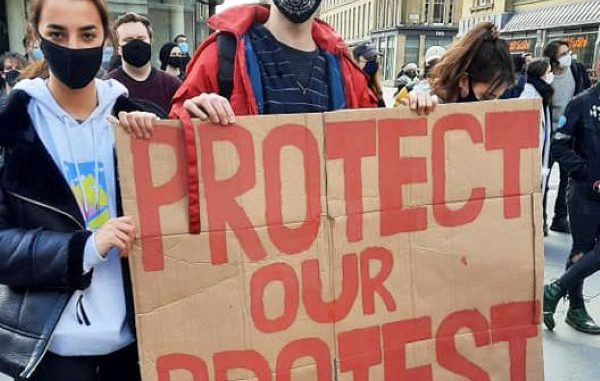
Our right to protest is under attack. Recent years have seen a whole number of measures introduced by governments in Britain meant to undermine our democratic right to fight back: the jailing of Just Stop Oil protesters, increasingly heavy policing of protests against the slaughter in Gaza, and the shocking proscription of Palestine Action as a supposed ‘terrorist’ organisation. This last attack now means a potential 14-year prison sentence for being a member of Palestine Action. Over 2,000 people have since been arrested for protesting against the ban, including a number of pensioners, simply for holding placards.
The freedom to express opposition in the cultural sphere is under threat as well. Culture Secretary Lisa Nandy attacked music group Bob Vylan for leading anti-IDF chants during their performance at this year’s Glastonbury festival, and Irish rapper Mo Chara from the group Kneecap was also threatened with a terror charge after allegedly being seen with the flag of proscribed organisation Hezbollah.
Clearly this Labour government is attempting to create an atmosphere of intimidation to discourage people from organising and protesting against the war and austerity agenda that it has pursued since coming to power last year.
Unpopularity
At last year’s general election Labour leader Keir Starmer won an historic majority, defeating the hated Tories. So why would a supposedly popular government be worried about resistance to its policies? The reality is that the ‘historic’ majority represents very little in terms of real support. Starmer was only able to win 9.7 million votes – fewer than the supposedly unpopular Jeremy Corbyn won in both 2017 and 2019 – and he has only become less popular since. His approval rating is now lower than Rishi Sunak’s prior to the election!
The Socialist Party warned at the time that this new Labour government – wedded to big business and divorced from the working class – would seek to manage the growing economic crisis through a policy of cuts to public spending and the driving down of living standards. This is exactly what has happened and, as the lack of serious economic growth continues, the attacks will only get worse.
But the other development has also been the beginning of mass opposition to the government’s pro-austerity policies, particularly around attempted cuts to the winter fuel allowance and disability benefits – both of which the government has had to at least partially retreat on. It must loom large in the minds of Labour politicians that similar policies from the Tories provoked mass strike action and huge anti-war demonstrations, the likes of which had not been seen in a generation. More recent international events cast a shadow as well – 7 million demonstrating against Trump in the US and general strike action in France against attempted public spending cuts.
Labour’s attacks on the right to protest are an attempt to cut across movements of that type developing in the future. But they in no way represent a strong government, confident to go on the offensive against the working class. Rather, they reveal a government that is increasingly weak and ailing, terrified of how mass movements and strike action could accelerate its political demise.
Look how much effort has been spent trying to break the heroic strike of bin workers in Birmingham with the use of court injunctions and arrests to try and prevent effective picketing. The government correctly realises that a victory for those workers would be a confidence boost to workers everywhere else about the possibility of resisting austerity at council level.
Backlash
But even implementing repressive measures is not straightforward and can end up even further undermining Labour’s already crumbling support. Over 70% of Labour’s own membership, when polled, thought that the proscription of Palestine Action was a mistake and a number of Labour MPs voted against the measure in parliament. Even a number of pro-capitalist newspapers came out in opposition to the ban – not because of their genuine concern for democratic rights, but because the more sober representatives of the ruling class can recognise the huge danger of these attacks provoking a backlash and giving a fresh impetus to the movement against this government rather than stopping it.
While the ruling capitalist class is certainly united on the need to make the working class pay for its crisis, how those attacks should actually be implemented is harder to agree on and splits are beginning to show in ruling circles over the way forward. This was shown by the fact that the proscription of Palestine Action took place around the same time as the winter fuel allowance was reinstated for pensioners – the government is trying to balance between implementing repressive measures on the one hand while giving concessions to the movement on the other. Unfortunately for them, neither has been sufficient to quell the rising mood of anger against their policies.
The danger of what a backlash can lead to was illustrated on numerous occasions when the hated Tories attempted to attack the right to protest and strike for the same reasons. At the end of 2023, the then Home Secretary Suella Braverman denounced protests against the slaughter in Gaza as ‘hate-marches’ and made comments which provoked far-right elements to try and attack the anti-war demonstration that November. The response to this was the defiant mobilisation of hundreds of thousands on one of the biggest demonstrations so far. Braverman was unceremoniously removed in a cabinet reshuffle shortly after – no doubt being seen to have gone ‘too far’ in attempting to attack the movement at that stage.
The Tories were humiliated again the following year after attempting to use their new ‘minimum service levels’ law to compel striking workers to return to work in certain key sectors. The response of Aslef, the train drivers’ union, when this was deployed against them, was to call an additional five days of strike action – forcing a rapid retreat by the government and a repeal of the order. There was never even an attempt to use the law again – it was rendered completely unenforceable just by the threat of workers’ action.
These events contain key lessons for the movement today in developing a strategy to defy Labour’s new round of undemocratic attacks. Individuals or small groups will struggle to effectively resist state repression, but mass movements with correct organisation can make the implementation of undemocratic laws and attacks unworkable.
Mass mobilisation
As Starmer’s attacks continue, there is a clear urgent need to build such a movement in a way that will give an increasing number of people the confidence to stand up and fight back in the face of increasing repression. As the largest democratic organisations in the country – organising potentially the most powerful force in society, the working class – the trade unions have a key role to play in organising this.
A crucial next step is to implement the policy that was agreed unanimously at this year’s Trades Union Congress (TUC), and to organise a national trade union-led demonstration against Labour’s austerity – and, we would add, against the attacks on our right to protest.
Properly built for, this could lead to the mobilisation of hundreds of thousands, representing not just trade union members themselves, but the millions of people who oppose this government. Such a show of strength would give confidence to people that it is possible to fight back and could be a launchpad for a serious sustained campaign – including strike action and further demonstrations – in defiance of Labour’s policies. What better way to show the government that any further attacks on our rights or standard of living will face serious resistance from the organised working class?
This goes for any attack on groups or individuals, even those with tactics or policies that we don’t fully agree with. The Socialist Party would have criticisms of some of the methods of groups like Just Stop Oil and Palestine Action on the basis that, by focusing on the actions of a small number of activists – while undoubtedly genuine and self-sacrificing – they can fail to point towards the mass struggles necessary to change society, or even risk pointing in the opposite direction. We completely oppose the state repression and brutal court sentences inflicted on those activists. If these attacks were to go ahead unchallenged, similar attacks could then be more easily carried out against trade unions and socialist organisations in the future.
Democracy and struggle
This must be seriously taken up by the workers’ movement, or it will risk giving the government confidence to go ahead with its undemocratic measures. Clearly none of the rights that we have won will ever be secure while we live under a government that prioritises defending the profits of the super-rich over the interests of ordinary people. Even in ‘democratic’ Britain, the ruling class is not above using repressive, authoritarian measures when its interests are threatened.
Does that mean that they would go as far as trying to end democracy in Britain at this stage given their increasingly weak position? The risky alternative of open authoritarian rule – capitalism without its democratic mask – would display the brutal nature of society all the more clearly and would risk provoking huge movements in defence of democratic rights that could go as far as bringing down the government. Just look at the events in South Korea last year, where an attempt to implement martial law and suspend parliament by an unpopular president was met with general strike action and mass protests. Overnight, the coup was aborted and the president eventually impeached and forced to resign.
Given the backlash in response to the undemocratic attacks that have already taken place, it seems extremely unlikely that the ruling class in Britain would look to ‘give up’ on democracy at this stage. But clearly they will still attempt to implement attacks on our right to protest and organise even while remaining within the framework of capitalist democracy.
Where possible, they prefer the use of ‘capitalist democracy’, as it allows the ruling class to try and foster the illusion that people can effect change without the need for open struggle against the system. While the key levers of the economy and the state remain firmly in the bosses’ hands, this type of ‘democracy’ does not fundamentally threaten their control over society in normal times. Of course, the right to vote and form political parties even under such a truncated form of democracy has still had to be fought for by the workers’ movement. The fight for working-class political representation, independent of the capitalist class, is a key demand for socialists. Other demands to defend and extend democratic rights – for example, to lower the voting age to 16 – are also necessary.
Socialist democracy
Even if dictatorship is not on the cards today, any attacks on the right to protest must still be taken very seriously and fully opposed by the workers’ movement. But this must be done while also explaining the driving factors behind those attacks and that we will have to continue defending our rights for as long as we remain under this crisis-ridden capitalist system.
The only way to permanently end these attacks and to guarantee genuine democracy is to bring about the socialist transformation of society. With the huge wealth and resources in society nationalised, under working-class control and management, a democratic plan could be drawn up to end poverty, war, economic instability, and all the other factors that drive division and oppression around the world.
The apparatus of the state that exists today, and is used by the capitalist class to repress workers – the courts, the army, the police and so on – could be replaced with new bodies under the democratic control of communities and workers’ organisations that would defend the interests of the majority in society, rather than repressing them in favour of a tiny minority. Once the material basis of want and exploitation were removed, the need for any form of repressive apparatus in society would be removed too.
We are in an age of increasing authoritarianism in Britain and around the world. But we are also in an age of mass struggles and revolutionary movements of workers, young people, and the oppressed on every continent. The crushing of democracy by a desperate ruling class could only succeed on the basis of a demoralised workers’ movement following a whole series of setbacks and defeats.
It is clear today that the balance of forces is still overwhelmingly in favour of the working class. Provided it is armed with the correct ideas and a socialist leadership it can certainly defy any attacks on its democratic rights and fight to transform society into one where repression and authoritarianism are consigned to the history books.