
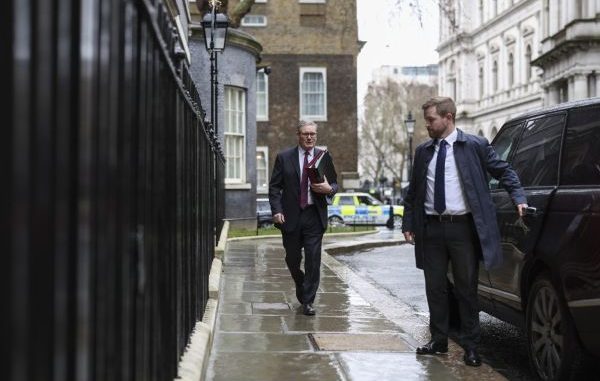
Keir Starmer started the new year with net approval ratings (-66 points) lower than any prime minister since polling records begun in the 1970s. The sordid revelations from the Epstein files, going to the heart of the Blairite Labour Party machine of which Starmer is the figurehead, will only have deepened his unpopularity.
For now, Starmer remains prime minister of choice for the majority of the capitalist class. “The longer the prime minister fails to turn things around… and the more his misjudgements pile up, the less compelling the argument will become that his continued leadership is the lesser of two evils,” the Financial Times (FT) puts it.
Any illusions that his Labour rule might be more stable than the Tories that preceded it, tearing themselves apart, will be melting away.
Starmer might not yet reach two years in office. In the unlikely event that he were to survive as prime minister leading a single-party majority in parliament past the three-year milestone, he would be the first to do so since Tony Blair. In other words, since the 2007-08 economic crisis.
The Epstein Files revelations again expose to millions the rottenness of the system and further undermine all its institutions. They come on top of a decade and a half of austerity attacks and stagnant living standards. In the 40 years to 2004-05, the typical income for the poorest half of working families doubled. At the current rate, a further doubling will take over 130 years, according to the latest report from the Resolution Foundation ‘Unsung Britain’.
It is increasingly hard for the capitalist bosses to peddle the lie that their system is any longer capable of improving living standards and taking society forward. And it is increasingly hard to peddle the illusion that it is possible to improve things simply by electing a different set of capitalist politicians, without the working class itself entering the fray.
The FT talks of “the lesser of two evils”. For them, for now, the lesser is Starmer who finds himself significantly weakened and, to their frustration, less confident to force through the attacks on the working class that are asked of him.
The other ‘evil’ posed in the immediate term is his replacement as Labour leader. Such is the character of the overwhelming majority of the Parliamentary Labour Party, and the iron-like grip of the Blairites on the broader party machine, the prospect of a new leader fundamentally changing the character of Labour as a capitalist party is not posed.
Nevertheless, the ‘evil’ comes from the fact that whoever it is will be forced to pose as being to Starmer’s left to win – and so can be a conduit through which working-class anger is expressed. For the capitalists, that means further potential frustrations to forcing through attacks on the working class.
Reform Party
Undoubtedly there are sections of the capitalist class who would like to try to overcome those frustrations through the medium of a right-populist Reform government. Billionaire Sir Jim Ratcliffe, in spouting his reactionary bile about Britain being colonised by migrants, and of nine million workers ‘choosing to live on benefits’ – his real target – also said of Reform leader Nigel Farage: “I think Nigel is an intelligent man and I think he’s got good intentions. But in a way, you could say exactly the same about [Sir] Keir Starmer. I think it needs somebody who’s prepared to be unpopular for a period of time to get the big issues sorted out.”
Recent months have seen a procession of Tories into the ranks of Reform. As well as trying to secure future political careers for themselves, it also represents a conscious attempt to ‘prepare Reform for government’, as is the formal responsibility of former Tory Daniel Kruger MP.
As Donald Trump’s second term as US president is demonstrating though, right-populism is not a stable form of rule either and will provoke struggles of the working class – as inevitably the coming to power of a future Reform government would. These are reasons why the majority of the capitalists would, for now, prefer to avoid it. It is why there will be continued attempts to discredit Farage and Reform from sections of the capitalist establishment and media – which, in turn, can for sections of the working class have the opposite effect of helping to burnish Farage’s false anti-establishment credentials.
What can most effectively cut across working-class support for Reform is steps towards the working class having its own political representation. Sharon Graham, general secretary of Labour-affiliated Unite the union, the party’s biggest union funder, took to the FT to warn: “Next year, Unite’s conference will consider our current affiliation to the Labour Party; the mood music right now is to depart.”
Socialist Party members in Unite have successfully won support for a motion to get it onto the table of the union’s executive calling for “the convening of special policy and rules conferences to draw political and organisational conclusions, potentially including the building of a new workers’ party, standing and supporting workers’ candidates, calling for a conference across unions to build a political alternative for workers on a pro-worker, socialist programme.”
Steps like those, taken by Unite or any other trade union, would fundamentally change the equations on the capitalists’ slates, and would tip the balance towards the working class.
That the authority of all of the capitalist institutions is being undermined, that the divisions in the capitalist class over how best to govern in their interests are widening, and that Starmer’s capitalist government is weakened, are all favourable for the working class.
The trade union leaders should be pressing that advantage by acting on the decision of the TUC to call a union-led demo against Labour austerity, as a step towards coordinating future industrial action.
The capitalist class faces its own crisis of political representation, decades in the making. Much deeper is the decades-long crisis of working-class political representation, since Tony Blair’s 1990s transformation of the Labour Party into the completely capitalist New Labour. Their crisis will not be resolved, it is driven by the failure of the rotten, crisis-ridden capitalist system. The case for the working class to have its own mass party, however, is now posed more starkly than ever. The Socialist Party will continue to fight for the trade unions to play the lead in bringing one into existence.