
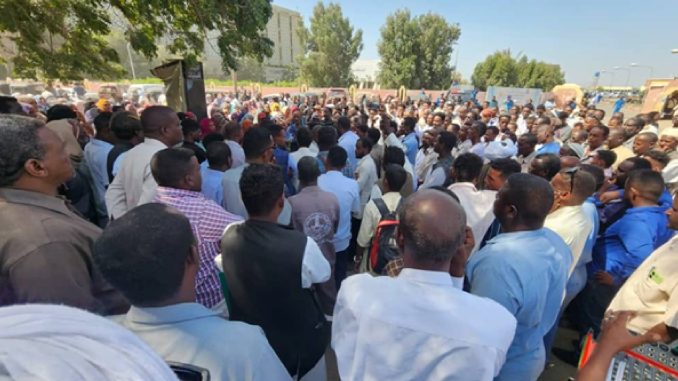
The civil war in Sudan has entered its fourth bloody year. It has brought death, the massive displacement of peoples, hunger and famine to the people of Sudan. The eighteen-month siege of the city of El-Fasher, and the genocidal massacre of tens of thousands after its fall, stands amongst the most barbaric atrocities of this century. The break-up of the country is emerging as a fact on the ground, with two rival governments with different regional bases established in 2025. All this horror is rooted in the capitalist social relations of Sudan, the wider region, and world capitalism.
From the end of 2018 revolution ebbed and flowed in Sudan. A determined mass movement forced the military to remove Omar al-Bashir, dictator for thirty years. Initially, the military attempted to continue ruling, hoping that the removal of al-Bashir would be sufficient to end the mass movement. But it was not. Despite bloody repression, including massacring protesters in Khartoum in June 2019, the military were forced to make concessions. It allowed the formation of a transitional government in which pro-capitalist civilian politicians who had supported the protest movement could participate, but alongside the leaders of the military factions. Elections would be organised for a future, unspecified, date. Thus, despite acting as a check on the ruling class during this period, the revolution failed to break its grip on the state, its military factions and the economy. The policy of revolutionary forces forming coalitions with representatives of the ruling class, civilian and military, is one which has been seen in many revolutions and always led to the revolution’s defeat.
Born of a policy based on compromise with the military, and pushing its own pro-capitalist economic policies, the transitional government was incapable of meeting the demands of the masses and protests continued. In October 2021, the military carried through a coup, removing the civilians from the transitional government. This was partially reversed under the pressure of a new wave of mass protests but it brought the revolution and the counter-revolution to a deadlock that was only broken by the start of the civil war. At its outbreak in April 2023, the CWI explained that it was not a development independent of the class struggle and the revolutionary process. It was a symptom of a revolution that had reached an impasse. The two warring military factions represented rival counter-revolutions. On the one side, the Sudanese Armed Forces (SAF) led by General Abdel Fattah al-Burhan, and on the other, the Rapid Support Forces (RSF) led by General Mohamed Hamdan Dagalo (aka Hemedti, or “little Mohammed”). (Follow this link for our analysis of the outbreak of the civil war).
The civil war has enormously complicated the struggle for a democratic Sudan. But the counter-revolution, while causing immense suffering, including the displacement of twelve million people, has not succeeded in entirely crushing the revolution. The forces of revolution and counter-revolution have continued to vie with each other throughout the three years of civil war.
Evolution
The Neighbourhood Resistance Committees (RCs) were the energy of the revolution, with the Sudanese Professional Association (SPA), a coalition of trade unions, playing a crucial coordinating role. More than five-thousand RCs existed at the height of their influence. They acted as local political centres, organising protests and developed a significant level of regional and national coordination. Even before the revolution, they had developed an administrative role in local communities, ensuring the provision of services such as cooking gas, electricity and healthcare. They also began supervising bakeries, controlling prices and ensuring the fair distribution of bread. A nascent alternative to the capitalist state and its military factions was emerging, what Marxists refer to as ‘dual power’. This has not been eliminated by the civil war, although the struggle to simply survive is now dominant for many.
To respond to the catastrophic situation activists ‘re-tooled’ the RCs to operate in the conditions of civil war through the creation of Emergency Response Rooms (ERRs). These continue attempting to organise basic services in communities. The ERRs have set up public kitchens to feed the displaced and share out aid. They have stepped into the vacuum as government health and education services have collapsed, organising the distribution of medicine and organising school classes for children. The ERRs have also played a role in supporting small farmers to counter the threat of famine from crop failure.
Fully aware of the continuity between the RCs and the ERRs both counter-revolutions have used the cover of war to try and ‘settle scores’ with the revolution. The CWI warned of this at its outbreak. Both warring factions have arrested, assassinated and disappeared activists. Hamid Khalafallah, writing for the Tahrir Institute for Middle East Policy, describes how, “Whenever one warring faction gains control of an area, it allows opponent troops to withdraw peacefully, only to unleash retaliatory violence against civilians. While the motives behind these attacks may differ, civilians have consistently borne the brunt of violence from both SAF and RSF. Notably, the attacks on civilians have mostly focused on pro-democracy activists, particularly members of the Resistance Committees and the Emergency Response Rooms…”[1]
Regional Proxy War
Throughout the revolution regional and world powers applied relentless pressure to limit its scope. Compromise with the military – the real power behind al-Bashir’s dictatorship – was demanded at every turn. This was not only a counter-revolutionary policy but a fundamentally anti-democratic one, insisting that a place must be found for the military regime in any future ‘democratic’ Sudan. This policy has continued throughout the civil war, which, after three years, has evolved into a regional proxy war as a result.
The ‘Quartet’ of the US, Egypt, Saudia Arabia and the United Arab Emirates (UAE) has initiated several rounds of ceasefire negotiations. What unites the Quartet powers, whatever different emphasis each individual government gives to ‘stability’, ‘peace’, ‘democracy’ and ‘civilian rule’, is that the counter-revolution must triumph in one form or another.
All four Quartet powers are warmongering counter-revolutionary governments. The Egyptian regime came to power in 2013 in a coup aimed at ending the democratic reforms forced upon it after the revolutionary ‘Arab Spring’ that brought down the dictatorship of Hosni Mubarak and spread through the region. The Saudi and Emirati ruling classes played a crucial role in the regional counter-revolution against it. These revolutionary uprisings shook these autocratic ruling classes to their cores. They have been playing more aggressive regional roles since in the futile hope of nipping revolution in the bud. All these ruling classes looked upon the revolution in Sudan with loathing, fearing it heralded a revival of revolution in the region.
The competition inevitable between ruling classes under capitalism has fuelled a growing rivalry between the Saudi and Emirati ruling classes for influence in the region. This rivalry has been carried into the Quartet. Egypt and Saudi Arabia back the SAF and the UAE backs the RSF, each manoeuvring to entrench their influence when the guns fall silent. But both the Saudi and Emirati ruling classes are key allies of the US too. The US itself, preoccupied with waging its war on Iran alongside the Israeli state, and backing the Israeli state’s wars on Gaza, Lebanon and other neighbouring countries, wants to keep both on side. A bill in the US senate that proposed to end all US arms sales to the UAE until guarantees could be given that the weapons would not end up in the hands of the RSF was blocked out of fear of alienating the Emirati ruling class. Predictably, the Quartet has solved nothing. Its abiding achievement has been prolonging the civil war.
Since the Arab Spring, the Emirati ruling class has attempted to extend its influence in the region by backing different factions in conflicts in its larger neighbours. The ruling class of this small, though extremely wealthy country, wants a region in its own image – a patchwork of small statelets dependent on its largesse and therefore more easily coerced. To this end, the Emirati ruling class has built relations with the rulers of Somaliland, Puntland and Jubaland, three regions with ambitions to secede from Somalia. In Yemen, it has backed forces fighting for the independence of the south and in Libya has helped maintain the eastern statelet that emerged from the civil war there. One commentator has described the Emirati ruling class’s network of support as an “axis of secessionists”, drawing a parallel with the Iranian regime’s “axis of resistance”.
Behind this policy, the Emirati ruling class’s strategic goal is greater control over the Red Sea and the Bab-el-Mandeb strait through which all Suez Canal shipping must pass. The value of this ‘chokepoint’ has been underlined by the Iranian regime’s ‘weaponisation’ of the Strait of Hormuz as an extremely effective lever against American imperialism. The UAE’s withdrawal from the OPEC oil consortium also reflects the Emirati ruling class positioning itself for a more independent role. These developments are a symptom of the multipolar character of world capitalism in this era.
Counter-Revolutionary Governments
After the SAF’s recapture of the Sudanese capital Khartoum in March 2025 the idea that the RSF could take control of the entire country is, for now, a distant prospect. Denied first prize, the UAE is comfortable pursuing a policy that encourages the break-up of Sudan. It backed the formation of an RSF-supported government based in Nyala in South Darfur. The Kenyan government was bribed with loans from the UAE to host the negotiations that led to its creation, an attempt to give it greater ‘international legitimacy’. Ethiopia, which shares borders with Sudan and Kenya, is also giving support to the RSF, allowing it to launch attacks from its territory. On the other side of Sudan, the Sovereignty Council, formed in Port Sudan, is backed by the SAF and its international allies.
From the moment al-Bashir was removed different wings crystalised amongst the civilian political forces who had opposed his regime – one willing to compromise with the military and capitulate to the demands of the regional powers and US imperialism and another opposing compromise. Following the October 2021 coup these wings took pro-coup and anti-coup positions. In the context of the civil war the same logic of compromise has led to the splitting of the ‘pro-compromise’ civilian political forces. One section, now organised as the Sudan Founding Alliance (Tasis – “Foundation” in Arabic), has supported the establishment of the RSF-backed government. The other section, now organised as the Civil Democratic Alliance of the Forces of the Revolution (Somoud – “Resilience” in Arabic), is supporting the Sovereignty Council. Both civilian factions feel compelled to posture as the inheritors of the revolution, maintaining its pro-democracy language and claiming some distance from the warring parties. Both counter-revolutions still feel sufficient pressure from the masses to humour this, seeing a civilian fig-leaf as useful.
However, the civilians will be tolerated only as long as necessary. Other reactionary political forces are waiting in the wings that the counter-revolutions will lean on against them. The discredited right-wing Islamist political organisations that supported the al-Bashir dictatorship – and drove the reactionary agenda of his dictatorship, especially in its first decade – are attempting a come-back through support for the Sovereignty Council. Linked to Islamist political organisations, the Al-Baraa Bin Malik Battalion/Brigade is now 20,000 strong and has been fighting as an auxiliary to the SAF. Its young fighters are drawn from the families of the better-off middle class and the militia is explicit in its rejection of the democratic aims of the revolution and its opposition to the civilian political organisations. In return for its support, the SAF-backed government is restoring wealth and property confiscated from al-Bashir’s Islamist supporters under the pressure of the revolution. Organisations supporting the Nyala government include various armed ethnic and tribal militias.
Programme
The creation of the ERRs and the role they are playing in the civil war is maintaining the link between the Sudanese masses and the politically conscious revolutionary activists. Their selfless and courageous role is strengthening their political authority which remains a threat to the counter-revolutions, despite all the violence and repression thrown at them.
Recognising the authority of the ERRs, other imperialist powers, especially those in Europe, have seen it prudent to court their leading activists with the hope of coopting them in the future. The ERRs, for example, have been nominated for both the Nobel Peace Prize and the Chatham House research institute’s prize. Even the UK’s Financial Times, the mouthpiece of British capitalism, published an editorial praising the ERRs to the sky. There is also an excitement amongst sections of the liberal left in the imperialist countries that the ERR’s herald a new “grassroots” model of “mutual aid” in conflict zones. Their significance as a potential political alternative to Sudanese capitalism and its military factions is entirely missed.
During the revolution the RCs adopted the slogan, “No negotiation, no compromise, no partnership with the military.” In December, on the seventh anniversary of the first mass protest of the revolution, a press statement was issued in the name of the Resistance Committees holding firmly to this position. After condemning the civilian politicians that have sided with one or other counter-revolution, the statement renews the Resistance Committees’ call “not to support either side of the war, and to engage in the broadest grassroots mass front to end the war and address its roots—grounded in the widest popular mobilisation—so as to complete the revolutionary path and achieve its objectives.”
Up until the start of the civil war, leading organisations in the revolution, like the SPA, advocated a policy of ‘non-violence’. Appeals were correctly made to those under arms to refuse to be used against the revolution. However, in an interview published in November 2025, Marwan Osman, a founder of the SPA and activist in the Khartoum RCs, explained that there was an ongoing debate over how armed resistance could “eventually become necessary”. In the CWI’s view, the point at which it became necessary for the RCs and ERRs, the SPA and other revolutionary organisations to create their own armed self-defence force has long been passed.
Such a step would not contradict the spirit of the revolution if such a force was democratically controlled by local communities and organised on a multi-ethnic and multi-tribal basis. Any armed actions that moved beyond simple self-defence would need to be firmly harnessed to the action of the masses themselves, such as strikes, sit-downs, occupations and marches. In other words, all elements of armed struggle would need to be based, as the RCs put it, on “the widest popular mobilisation”. This would make appeals to the rank-and-file of the military and militias more concrete. The revolution would be inviting them to bring their military training to the side of the revolution. To assist with splitting the ranks of both the SAF and RSF, the RCs’ demand for the “principle of non-impunity” for the perpetrators of atrocities in the civil war and before, is best directed clearly at military officers and militia commanders. The CWI believes this is the route to imposing a ceasefire on the revolution’s terms, halting the civil war and rebuilding a Sudan in the interests of the working class, the poor and oppressed.
In his interview, Marwan Osman expresses frustration with the lack of international solidarity with the people of Sudan. It is not entirely clear to whom this complaint is directed. If it is to the regional pro-capitalist governments and the imperialist powers this ‘solidarity’ will never come. The only force that offer genuine solidarity and stand with the people of Sudan, rather than one or other faction of the ruling class, is the working class of the region. Especially in the countries whose ruling classes are fuelling the civil war, it is the working class who has the power to stop the war machines dead in their tracks.
The masses of the region can be inspired to respond to such an appeal if the democratic demands of the Sudanese revolution are fused with a programme that can answer the demands of the working class and poor masses for a fundamental transformation of their living standards. This will only be possible with the overthrow of the ruling classes of the region, their dictatorships and the rotten capitalist social relations they defend. This need to be replaced by governments of workers and the poor, placed in power by the masses with a programme to end capitalism and start building socialism. Upon this class basis the masses of the region could be united in defence of the Sudanese revolution, seeing its victory as a step toward their own liberation from poverty, insecurity and oppression. In other words, the goal of the Sudanese revolution needs to move beyond the struggle for a political revolution and embrace the struggle for a social revolution.
But such a programme needs a vehicle to fight for its implementation. This vehicle can only be a revolutionary party which wins mass support. Throughout the Sudanese revolution the absence of a party uniting the activists of the RCs, the SPA and other workers’ organisations, and now the ERRs, has repeatedly allowed pro-capitalist political forces to step into the political vacuum and pursue compromise. Because of the complete discrediting of the established political parties and civilian politicians, revolutionary activists have rightly remained determined not to become “politicians” and to maintain “people’s power” through mass mobilisations on the streets. Taking steps toward the creation of a revolutionary party does not contradict this – rather, it is the best defence against co-option by rotten Sudanese capitalism. First and foremost, a revolutionary party would be a party of struggle. But simultaneously it is an instrument through which the masses can win and consolidate political power. A revolutionary party would not stand in opposition to the institutions of “grassroots democracy” – the RCs and ERRs. The RCs had the potential to develop into an alternative state power based on the majority of the people – the working class, the poor, the small and subsistence farmers, the small-scale mineworkers, the marginalised tribespeople, and the revolutionary women and youth. It would be the task of members of the revolutionary party to win the RCs over to struggle for political power and socialism.
[1] “Sudan’s Counterrevolutionary War: The Systematic Targeting of Pro-Democracy Activists” (15 April 2025)