
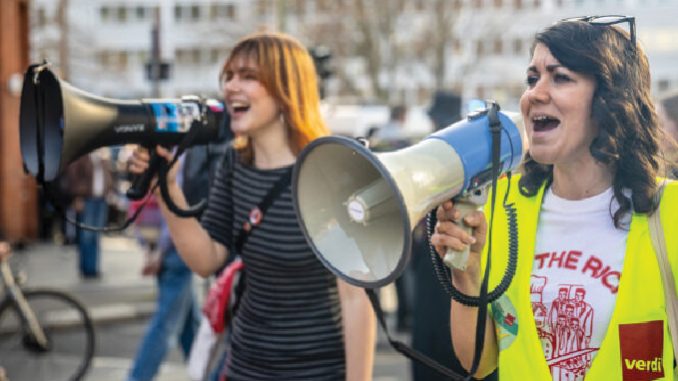
Below are two articles appearing in the new issue of Solidarität, the newspaper of Sol (Sozialistische Organisation Solidarität) the CWI in Germany.
Hard Attacks, Weak Government
Class struggle from below is the alternative
Tom Hoffmann, Sol – Sozialistische Organisation Solidarität (CWI Germany)
The federal government – a ‘black-red’ ‘grand’ coalition of the Conservative Democratic Union (CDU/CSU) and the Social-Democratic Party (SDP) – is pushing ahead with the biggest attacks on the working and poor population since the ‘Agenda 2010’ policy under Gerhard Schröder in the early-2000s. However, their approval and poll ratings are already in the basement. Trade unions and the left have a duty to do everything they can to take the resistance to the streets and to the factories now and to show how this weak government can be defeated.
The fact that the winds of austerity are blowing stronger can be seen if you list only the largest measures that the government is planning or that are being discussed in ministries and commissions:
- Drastic cuts for both insured persons and employees in a health care system that is already crumbling at all ends.
- Savings in the long-term care insurance funds, whose contributions are already a program for old-age poverty.
- At least 8.6 billion less for young people and people with disabilities, including in integration assistance
- Abolition of the 8-hour day, when a reduction in working hours is urgently needed
- At least twenty billion euros in budget cuts, including housing and parental allowance
- Attacks on pensions, possibly by raising the retirement age
Social Cuts & Rearmament
The cuts are the flip-side of the gigantic rearmament, which in turn is the result of the increasing conflicts between the capitalist powers worldwide. While, for example, school assistance will be cut for children and young people with disabilities in the future, the federal government is investing 776 billion euros in the Bundeswehr – the German military – by 2030. It is not doing this to defend those in the country for whom it is closing hospitals and extending working hours at the same time. The increase in the annual armaments budget to the level of France and Great Britain combined serves to defend the interests of German banks and corporations in the future by force of arms in an increasingly competitive world.
Chancellor Merz, Finance Minister Klingbeil and Co. may try to give the impression that “everyone” is making a contribution by suspending the automatic increase in parliamentary salaries, which are already 11,833 euros. But this cannot conceal the class struggle from above. In view of the stagnation and industrial crisis of German capitalism as well as intensified global competition, it is not only the government waging this class struggle from above, but private sector bosses too. Jobs are being destroyed by the hundreds of thousands and the pressure on real wages and working conditions is increasing. According to official statistics alone, three million people are unemployed.
Decline of the Establishment
But the CDU/CSU and SPD are weak and under pressure from all sides. Many more attacks are being demanded from the side of capital, and by 2030 the annual interest payments in the federal budget alone will increase to 80 billion euros. The CDU and SPD have long since ceased to have a majority in the polls, while the right-populist Alternative for Germany (AfD) is leading the polls and benefiting most from the rampant discontent.
However, the decline of the old party structure is also expressed in the fact that there is no viable alternative to the once “grand” coalition from the point of view of capital. For the time being, the majority of the bourgeoisie and also the majority in the leadership of the CDU/CSU reject cooperation between the CDU/CSU and the AfD, not least because of the social polarization that this further fuels. But the debate about this will not stop, but will increase when, after the state elections in the autumn, the AfD becomes the strongest force in East German state parliaments or could even form a state government for the first time.
The fact that the AfD has become the main beneficiary of the current situation is as dangerous and tragic as it was avoidable. The strengthening of the AfD is primarily a symptom of dissatisfaction and anger at the establishment in large parts of the working class and middle classes. However, it is also an expression of the fact that Die Linke – the Left party – has too often acted as part of the establishment in recent years and that the trade unions have not lived up to their task of consistently formulating the interests of the working class and organizing real struggles. It is not enough to declare that the AfD does not pursue policies in the interests of wage earners – especially when the same trade union leaderships continue to cling to the ‘social partnership’, approve job reduction plans and rotten collective bargaining compromises and do not show any perspective for fighting and showing how the living standards of the masses can be defended and expanded.
Socialist Alternative
Consistent class struggle from below against the class struggle from above: This is long overdue in order to repel the government’s attacks, to fight for social improvements and to demonstrate that the AfD is not a workers’ party.
Die Linke, which claims to be a socialist class party, can play an important role in this. After its comeback last year, it now has an opportunity to prove its worth. The decision of the party executive to organize a summer and autumn of social protests with trade unions and social associations is also an opportunity to further build up the party and to determinedly carry socialist ideas into a society shaken by crises and fears. But for this to happen, it must also make it clear in its actions that it takes these ideas seriously, instead of seeking or approving cooperation in state governments and parliaments with the same capitalist establishment that defends this system. This orientation has led Die Linke into crisis before and made the rise of the AfD possible. Class struggle from below and the building of the Die Linke as a socialist workers’ party, on the other hand, is the recipe for bringing the AfD down and putting the workers’ movement on the offensive.
—————————
Government Horror-Catalogue and Job Cuts
Time to Act: Proposals for Resistance
Angelika Teweleit, Sol – Sozialistische Organisation Solidarität (CWI Germany) and member of the spokesperson’s circle of the Network for a Militant and Democratic Ver.di
The ‘black-red’ government is planning the sharpest attacks against the working class since Schröder’s Agenda 2010. At the same time, tens of thousands of jobs will be cut. The crisis of the capitalist system threatens the living standards and historic achievements of the working class. What is needed is the systematic build-up of mass resistance, organized by the trade unions, Die Linke and social movements.
At last May’s federal congress of the German Trade Union Confederation (DGB), Chancellor Friedrich Merz was rightly booed by the delegates when he defended the planned “reforms”. The DGB chairwoman and former SPD General Secretary Yasmin Fahimi said: “We are capable of mobilisation and also ready to mobilise.” But at the same time, the great opportunity to use this congress as the starting signal for a hot summer and autumn was missed. The congress could have decided on a concrete program of action: education and discussion in workplaces, protests, large demonstrations, strikes. Such a mandate must now be demanded and implemented.
Demonstration on June 10
After all, ver.di has called for a demonstration against the health cuts on June 10 in Hanover. The health insurance reform, but also the upcoming attacks on the 8-hour day, long-term care insurance, social benefits and pensions, mean deterioration for the mass of wage earners. Accordingly, in addition to hospital employees, employees whose pay and conditions are covered by the current collective bargaining rounds like those in retail, Postbank and others should also be called to strikes and mobilized by buses to Hanover for the central protest.
Nationwide Coordination
Health Minister Warken’s attack is already having real consequences. For example, the Charité Berlin hospital has terminated its collective Workload Relief Agreement (TV-E), the Vivantes management has withdrawn its offer of negotiation and others are refusing to raise wages in collective bargaining rounds. This must not be accepted. All these struggles must now be coordinated. It would be an opportunity to demand collective bargaining in other hospitals to relieve the burden in order to fight against staff cuts. Ver.di should generalise these struggles and unite them in a wider socio-political movement for the abolition of the insurers’ DRG fee system and for needs-based public health care for all, financed by the profits of corporations and millionaires’ taxes.
Political Strike
The planned agenda of the federal government will not be prevented by protests alone. Yasmin Fahimi threatened “strikes against free-market politics” in the autumn. These words must finally be followed by deeds! Wherever the ability to strike can be established through demands for collective agreements, this should be done immediately. The collective bargaining round in the metal and electrical industry is scheduled for autumn. This would be an excellent opportunity to call hundreds of thousands of fellow workers to strike and to bring them onto the streets en masse. So far, it looks as if the IG Metall union leadership wants to keep expectations low in this collective bargaining round. The collective bargaining struggle could play an important role in a trade union socio-political mobilisation against wage theft, job cuts and the government’s plans. However, it is also possible that the DGB trade unions will call for work stoppages against specific government plans. In 2007, for example, 300,000 employees in metal companies took part in work stoppages against retirement at 67. Ultimately, it will be necessary and a question of the social balance of power to extend the right to strike, which is limited by decades-old court rulings, through decisive and mass action. However, such strike measures must be well prepared.
Gatherings
Just as ver.di held works meetings in hospitals on May 28, meetings should take place nationwide and across industries to clarify all attacks and discuss the necessary steps of resistance. In addition, trade union activists’ conferences should be convened immediately everywhere to plan a cascade of protests and strikes throughout the country. The trade unions should enter into an alliance with all those who are willing to stand in the way of the government and the job cuts and seek to close ranks with the left and social movements that have already begun to build local alliances. Where the trade union leaderships do not move or only insufficiently, active colleagues and subdivisions should lead the way.
Break with SPD necessary
It is a danger that the leaderships of the DGB trade unions will shy away from these steps and hope for negotiations with the federal government. All experience shows that these either lead to sacrificing the interests of the working class or collapse. The trade union leaderships are closely linked to the SPD, although the latter does not have policies in the interests of the working class. A final break is necessary, because the SPD has long since ceased to be a workers’ party. Instead, it would be the task of the trade unions to establish a consistent political voice for the working class. That would also be the best recipe to stop the further strengthening of the right-wing populist AfD. Refraining from resistance out of fear of the AfD and a fall of the government would only lead to the AfD being able to count on even greater support and electoral successes.
Capitalist ‘location logic’
Unfortunately, the trade union leaderships continue to defend a ‘social partnership’ line and ‘location logic’. According to this, Germany must be defended against competition from the USA and China – especially in times of intensified protectionism and trade wars. Within the capitalist competitive system, however, no jobs are secured, even with more and more sacrifices. On the contrary, waiver agreements cause a downward spiral by playing off employees from different locations, companies and countries.
Consistently fighting against job cuts
In the last two years, there have been more announcements of job cuts or even plant closures than at any time since the Great Recession of 2008/09. IG Metall and the DGB trade unions in other sectors should establish the ability to strike in all companies affected by relocation, closures or job cuts with the demand for a collective agreement that serves the goal of preserving all jobs. However, such an agreement should not lead to concessions or waiver agreements like previous “employment security agreements”. The goal must be to preserve all jobs and incomes, among other things with the demand for the distribution of work among all through a massive reduction in working hours with full wage compensation. Where the official union leadership is unwilling to organise this struggle, workers should discuss how they can take the initiative themselves. Demands should include the inspection of all business books, as well as – as it says in the IG Metall statutes – the transfer of the key industries into public ownership. In this way, the companies can continue to be run under democratic control and administration by the working class. It is then possible to switch production to socially meaningful goods instead of armaments.
Fight against Militarization
Struggles against austerity and job cuts and against militarization and rearmament belong together. The government’s plan to increase arms spending annually to up to 180 billion in 2030, while cuts are to be made in health, social affairs, public transport, education, etc., makes the connection clear. The trade unions must therefore clearly position themselves against militarization and rearmament and stand up for a clear internationalist class position against wars for corporate interests.
Pressure from Below and Networking
It is urgently necessary to network from below in order to build up pressure so that massive and consistent resistance is organised. The “Network for a Militant and Democratic Ver.di” has formulated model motions for the development of resistance, which have already been submitted to some ver.di company groups and committees.
Die Linke
Die Linke could play an important role and build itself if it consistently focuses on organizing resistance in solidarity with trade unions and social movements. This also means that it does not itself implement cuts and attacks against the working class as part of state governments, which was recently the case in Bremen with the extension of working hours for civil servants there, but ends participation in capitalist governments. The initiative for local and nationwide social advice and alliances is correct. This must be expanded and the party should organize resistance in neighborhoods, at universities, schools and in companies.
At the same time, Die Linke should organize its many members in the trade unions to argue for a militant strategy, including a political strike, and a program that questions capitalism. It should use the opportunity to make a completely different policy than all the other parties. Not only in consistent resistance to the attacks, but also by showing an alternative to the capitalist profit system and combining this with clear rejection of imperialist war policy. Die Linke could play a central role in providing substantive answers to the capitalist crisis. Members of the Sol are campaigning in Die Linke for a socialist program for resistance:
- No to all attacks on healthcare. For needs-based hospital and health care close to home without profit-making. Abolish the flat rates per case. An end to two-tier medicine.
- No to the amendment of the Working Hours Act – reduction of working hours with full wage and personnel compensation instead of extension of working hours
- No to raising the retirement age and further deterioration in pensions – instead reduction to 60 years and introduction of a tax- and duty-free pension of 70 percent of net wages
- A guaranteed minimum income and minimum pension of €1,000 plus rent and heating costs for every adult, and €800 per child – without means-testing or bureaucratic harassment.
- No cuts and no attacks on living and working standards for working people – whether imposed by local councils, state governments, the federal government, or employers.
- Fight against job destruction – those who lay off, those who close, should be expropriated!
- Massive disarmament instead of rearmament, conscription and militarization. No to NATO’s five percent target
- For a public investment program in the areas of social welfare, education, health and the environment, financed by the profits of the banks and corporations
- For a wealth tax of ten percent from one million euros in assets and a strongly progressive tax system with drastically higher taxes on corporate profits and large inheritances
- For the transfer of the banks and corporations into public ownership under the democratic control and administration of the working population
- For socialist democracy instead of capitalist chaos, war and crisis